
Friday, November 13, 2026Nov 13

Opinion: Are we headed to a new Cold War; should we be?

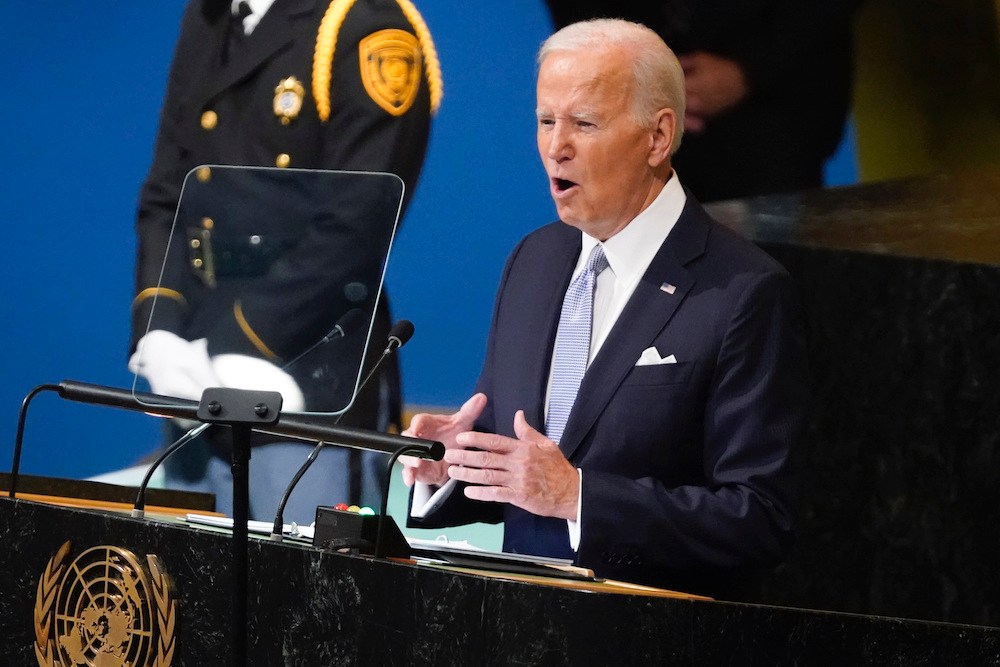
President Joe Biden addresses the 77th session of the United Nations General Assembly on Sept. 21, 2022, at the U.N. headquarters.How will the US, Europe respond if Vladimir Putin seeks to escalate his way out of a bad situation on Ukraine’s battlefields? To start with, by doubling down on the tactics that helped put Russia in a corner: more sanctions and isolation for Moscow, more arms for Ukraine. Biden promises a “consequential” response if Russia uses nuclear weapons. But Western leaders show no signs of matching Vladimir Putin's renewed nuclear threats with potentially escalatory nuclear bluster of their own. (File/AP Photo/Evan Vucci)
President Joe Biden addresses the 77th session of the United Nations General Assembly on Sept. 21, 2022, at the U.N. headquarters.How will the US, Europe respond if Vladimir Putin seeks to escalate his way out of a bad situation on Ukraine’s battlefields? To start with, by doubling down on the tactics that helped put Russia in a corner: more sanctions and isolation for Moscow, more arms for Ukraine. Biden promises a “consequential” response if Russia uses nuclear weapons. But Western leaders show no signs of matching Vladimir Putin's renewed nuclear threats with potentially escalatory nuclear bluster of their own. (File/AP Photo/Evan Vucci) President Joe Biden addresses the 77th session of the United Nations General Assembly on Sept. 21, 2022, at the U.N. headquarters.How will the US, Europe respond if Vladimir Putin seeks to escalate his way out of a bad situation on Ukraine’s battlefields? To start with, by doubling down on the tactics that helped put Russia in a corner: more sanctions and isolation for Moscow, more arms for Ukraine. Biden promises a “consequential” response if Russia uses nuclear weapons. But Western leaders show no signs of matching Vladimir Putin's renewed nuclear threats with potentially escalatory nuclear bluster of their own. (File/AP Photo/Evan Vucci)

“We do not seek a Cold War,” declared President Joe Biden in front of world leaders gathered at the United Nations on Sept. 21, 2022. America was not asking “any nation to choose between the United States or any other partner,” he added.

But that’s likely not how everyone views the prospect of a new Cold War. Despite Biden’s protestations, foreign policy observers are increasingly framing the relationship between the U.S. on one side and Russia and China on the other as a “Cold War” in which countries are, in fact, being expected to choose sides. Moreover, in a March 2022 poll, more than six in 10 American adults said the chance of a Cold War was higher than it was five years earlier.

To be clear, there is no reason to question Biden’s personal sincerity. But as a historian of the Cold War, I think it is legitimate to ask whether the “no return to Cold War” position is wholly representative of Washington’s foreign policy establishment, given that the Cold War presented advantages and opportunities to the U.S. Moreover, I believe that if Americans were really being honest on the issue, some might concede they actually miss the Cold War.


Identity and intervention