
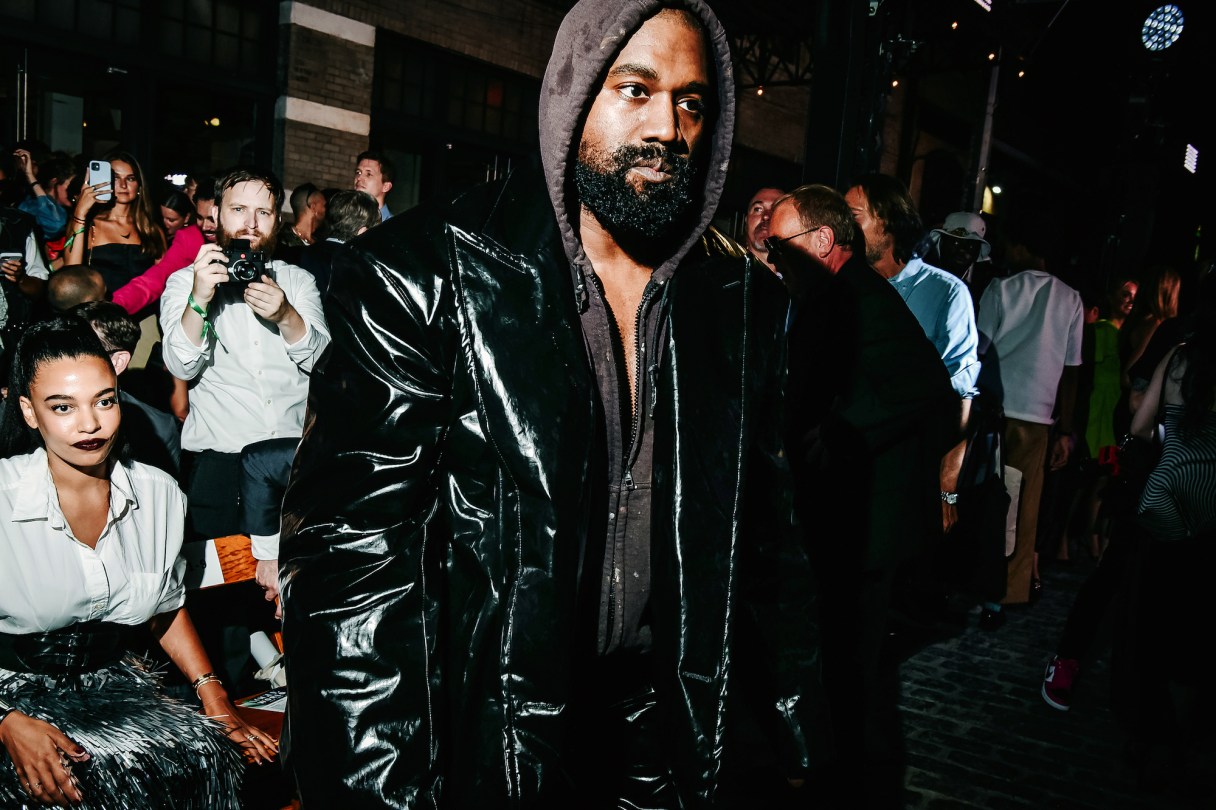
Dear Kanye West, or “Ye”:
We’ve never met, and I hope we never will.
Still, I’d like to express a sort of gratitude. With a few outbursts in a few days — you threatened in a tweet this month to go “death con 3” on “JEWISH PEOPLE” — you’ve probably done more to raise public awareness about the persistence, prevalence and nature of antisemitism than any other recent event.
It’s remarkable how long it took us to get here. For 2020, the FBI reports that Jews, who constitute about 2.4% of the total adult population in the United States, were on the receiving end of 54.9% of all religiously motivated hate crimes. On many nights in New York City, Hasidic or Orthodox Jews are being shoved, harangued and beaten.
At times, reporting has all but accused Jews of bringing the violence on themselves, with stories about allegedly pushy Jewish neighbors or rapacious Jewish landlords. At other times — such as after the attack in January on a Texas synagogue by a British Muslim man who had traveled 4,800 miles to get there — reporters seem to have gone out of their way to find non-antisemitic motives for nakedly antisemitic attacks.
More often, attacks on Jews are treated as regrettable yet understandable expressions of anger at Israel. In May 2021, Jewish diners at a sushi restaurant in Los Angeles were physically assaulted by a member of a group that, according to a witness, was chanting “Death to Jews” and “Free Palestine.”
It’s worth pondering the extent to which, in American culture today, Jews are excluded from inclusion and included in the excluded. That is, the Jewish people’s status as an oft-persecuted minority goes increasingly unrecognized, while their position as a legitimate target for contempt and ostracism is becoming increasingly accepted.
Take Hollywood, where the new Academy Museum of Motion Pictures opened its doors last year with a panel dedicated to “Creating a More Inclusive Museum.” Yet, as The New York Times’ Adam Nagourney reported, “Through dozens of exhibits and rooms, there is barely a mention of Harry and Jack Warner, Adolph Zukor, Samuel Goldwyn or Louis B. Mayer” — the Jews who essentially founded the modern movie industry. (After an outcry, the museum now plans a permanent exhibition for them.)
Or take Israel. Is the Jewish state so uniquely evil that, alone among 193 U.N. member states, it has no moral right to exist? Or is it the unique evil of antisemitism that directs this hatred at one state only — while generally ignoring the endless depredations of regimes in, say, Caracas, Venezuela; Havana; and Tehran, Iran?
These are surely not what you had in mind when you decided to go “death con 3” on my people. Nor were they for many of the celebrities who denounced you in tweets and Instagram posts. But your bigotry is as good a place as any to begin to have an honest conversation about antisemitism — one that will hopefully last longer than your career’s self-destruction.
Honest would be to acknowledge antisemitism is as much a left-wing phenomenon as it is a right-wing one. Honest would be coming to grips with the fact antisemitism infects corners of Black politics as much as it infects the politics of white supremacy. Honest would be holding to account people who were complicit in your antisemitism — such as Tucker Carlson, who praised your “bold” beliefs while editing out your antisemitic remarks from his interview with you. Honest would be coming to terms with the extent to which anti-Zionism has become the antisemitism of our day, echoing the same sordid conspiratorial tropes about Jews as swindlers and impostors.
Honest would also be admitting you speak for more people than many Americans would have cared to admit. For that, but only that, you deserve thanks.
The New York Times