
(Editor’s note: First of two parts)
Almost weekly, Chattanooga residents see an announcement about an event scheduled for Miller Park, the city’s central community space. From musical performances to social action gatherings, Miller Park has become an anchor site for the exchange of ideas and meaningful interactions. As the city moves forward with exciting plans for the revitalization of some area parks and the creation of new parks for multi-use, a glance backward is appropriate.
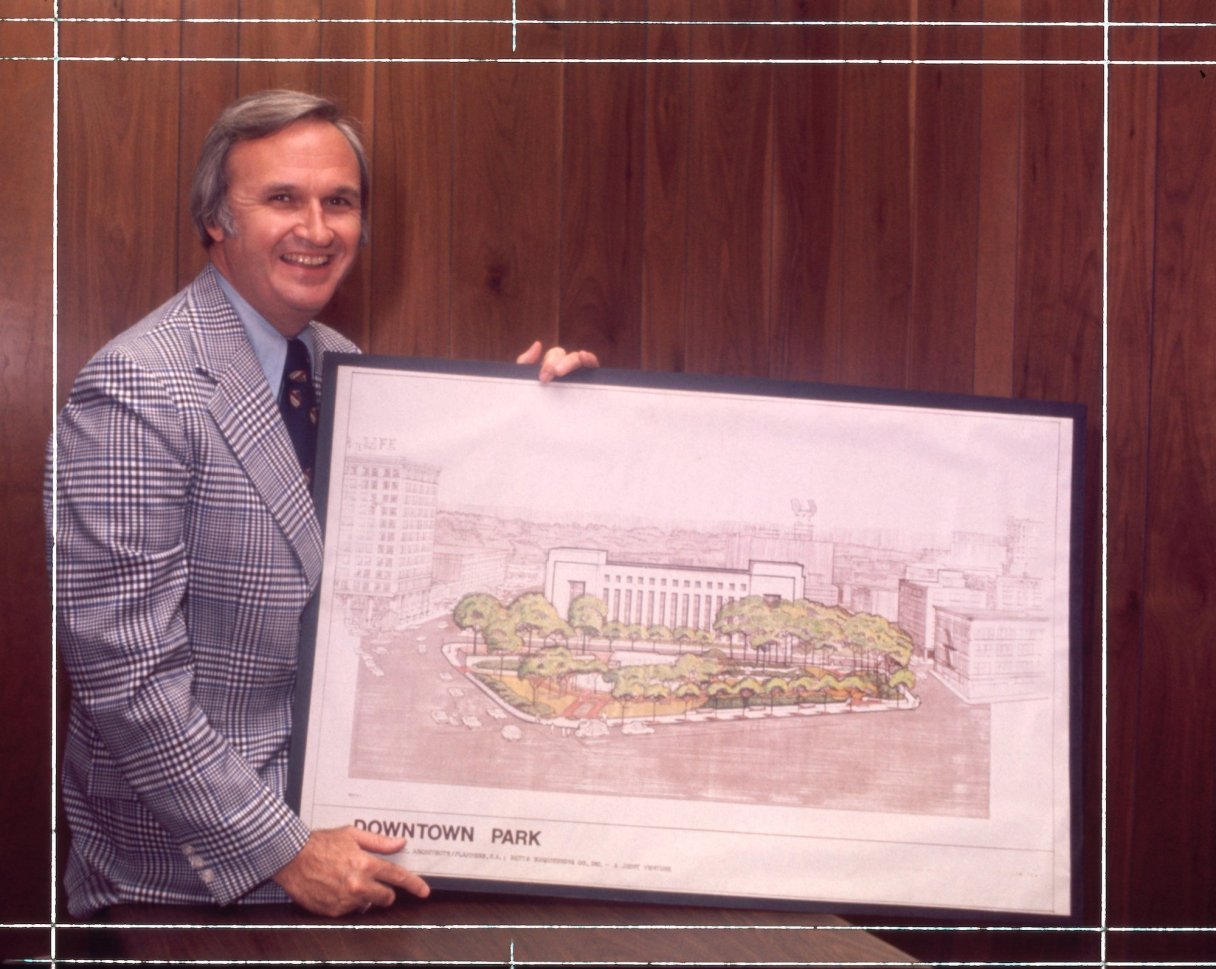
Fifty years ago, a central-city park was still an idea. The announcement by Chattanooga Mayor Robert Kirk Walker’s office on Sept. 16, 1973, “City to Raze Block for Park,” was a front-page headline in the News-Free Press, and the weekly coverage continued. The full city block, across from the federal building on Georgia Avenue, would be acquired using a combination of $1 million in private donations and an anticipated $500,000 city funding.
The mayor shared that discussions about a park and the requisite funding requirements had begun shortly after his election in 1971 and that Scott L. Probasco Jr., chairman of the Planning and Acquisition Committee, deserved the credit, along with his committee members, for securing private support for the public project. The committee members — Probasco, Cranston Pearce, H. James Hitching and Joseph H. Davenport, with assistance from George L. McInturff — would negotiate for the properties, arranging for the land transfers to city. At the end of 90 days, the other required properties would be acquired through condemnation. The city block, bounded by Ninth Street (now MLK Boulevard), Georgia Avenue, 10th Street and Market Street, included a variety of businesses and several vacant, deteriorating buildings.
“Fulfillment of Chattanooga’s dream of a downtown park has been one of the important goals of our administration,” Walker noted. “Coupled with the exciting prospect of development of the Union Station property, the new library and the many other significant developments planned or already under way, the park assures that Chattanooga will have a downtown area worthy of the pride we all feel in our city.”