
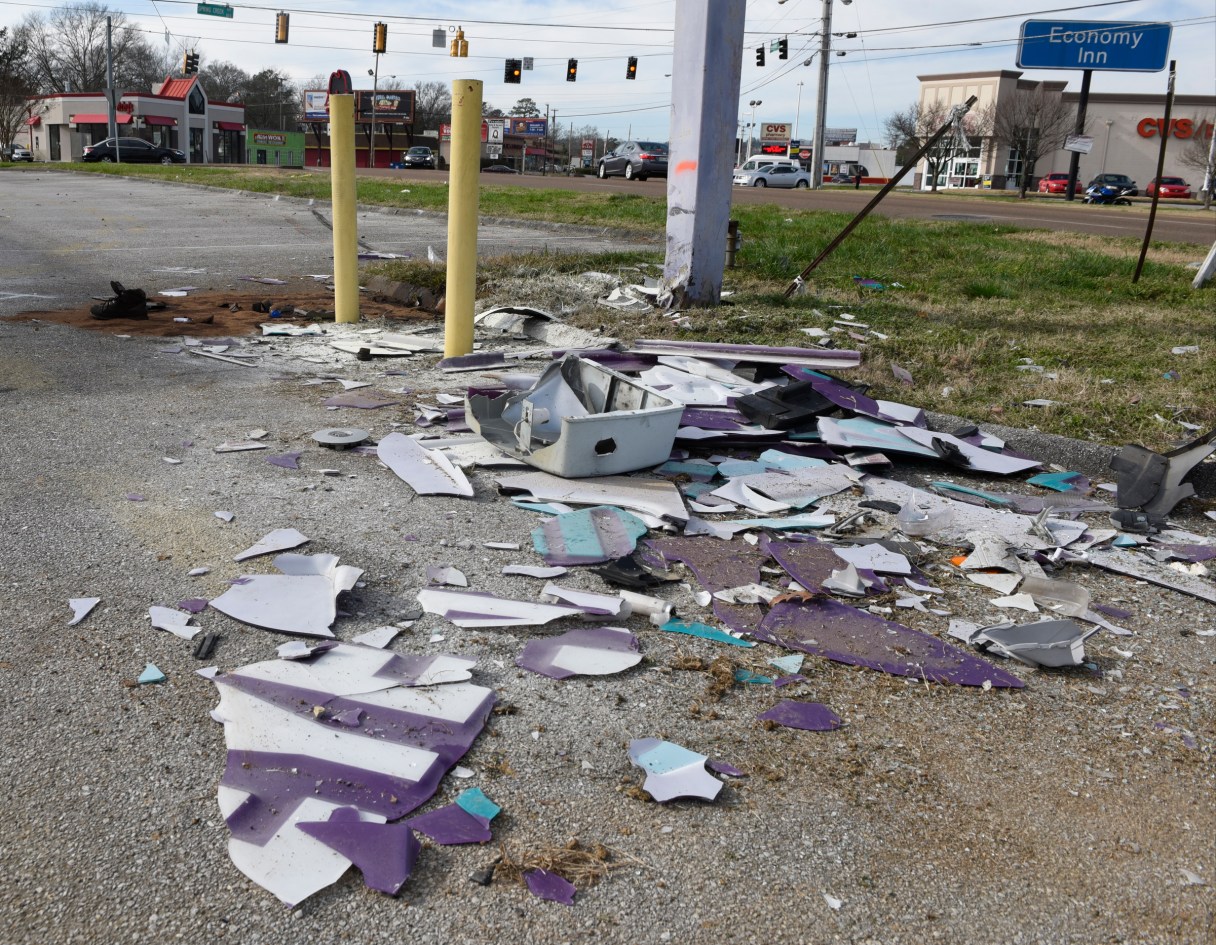

It’s pouring outside, it’s cold and you are involved in an accident with another motorist. Both vehicles are off to the side of the road and not blocking traffic, and no one is hurt. The cars are driveable, but barely. Both drivers are cooperative, but neither driver is willing to accept blame. A tree- shaded stop sign on one street and a parked car obscuring the view on the other blur the situation further.
If your accident is in the city, even though you’re shaken and frustrated and think it’s one of the worst things to happen to you — beginning Jan. 1, 2023 — no one from the Chattanooga Police Department (CPD) will be coming to your assistance.
A news release from the CPD last week said the type of accident described above is “considered lower on the scale of priority due to no injury or lack of severe property damage.”
Such crashes, according to the release, have taken too much of the department’s time and will allow officers to put more of their focus on violent crime.
Chattanoogans involved in such crashes nevertheless are to call CPD dispatch, which will then advise vehicle owners how they are to report the crash to the city and state before transferring them to a recording that explains their reporting requirements and the steps they’ll need to take.
Fortunately, in the rain and cold and amid the exploded airbags of a wrecked car, a piece of paper and pen or pencil to jot down instructions from a disembodied voice are bound to be right at your fingertips.
(Reporting forms also will be available on the CPD website and on its social media platforms.)
A city official in a recent conversation with this page used the same justification for the new policy that you may have used on your parents, your teacher or your principal: Everyone else is doing it.
And that’s true.
Nashville rolled out a similar policy in May 2021, Austin, Texas, in Sept. 2021, Baltimore in May of this year, and Knoxville on Sept. 1.
Baltimore, in implementing the policy for car wrecks and all non-emergency situations, said 80% of the calls to the city’s police department were for non-emergencies. Knoxville said its officers were spending a cumulative 24 hours a day working car crashes.
The CPD, in its news release, said its officers were spending 35 or more hours a day on car crashes that didn’t fit the eight qualifications for when an officer would be authorized to come to a crash scene. Of those, it said, 18 hours might be better focused on neighborhood policing.
The circumstances under which an officer will come to a car crash in Chattanooga include death or injury; hit and run; impairment of an operator due to alcohol or drugs; government-owned vehicles or property involvement; hazardous materials involvement; disturbances between principals; major traffic congestion as a result of the crash; and damage to vehicles to the extent towing is required.
CPD’s new policy is almost exactly the same one Knoxville implemented in September, though our neighbor to the north adds the involvement of an unlicensed or uninsured driver.
Tennessee law doesn’t require the reporting of all accidents, but its low requirement of reporting as little as $50 in property damage in one law makes it nearly certain that all accidents should be reported. But the law does not require the presence of law enforcement officers.
A second law requires a report when an accident results in $400 or more in local or government property damage, or $1,500 to any person involved, or causes death or physical injuries. In these situations, all drivers or owners of vehicles involved are required to file a report with the Tennessee Department of Safety & Homeland Security within 20 days.
A report is required regardless of who is at fault and in addition to any report filed by an investigating officer. The purpose of the report is to ensure all drivers are insured per state law.
Failure to file a personal accident report with the Department of Safety & Homeland Security can result in the suspension of driver’s license and registration or nonresident operating privileges of any person involved in an accident.
The CPD was expected to clarify the new policy at its weekly news briefing Wednesday but canceled the update. Instead, the department posted an explanatory, two-minute video to its Facebook site. Unfortunately, it added little to the news release.
The post received 118 comments less than 24 hours after it went online, almost all of them negative. Many of them had the same questions we did: How will insurance companies determine fault? Without an officer to make the determination, how would one driver know whether the other was impaired? Would the situation be helped by hiring more officers? How can an uninsured driver be made to be responsible? How can a responsible driver tell if the other party’s license is valid?
The department’s public information officer wound up the video by saying “we understand sometimes change is difficult” and to “be safe.”
However, we hope such platitudes will be followed with answer to the public’s questions since the policy is not likely to be reversed.