
AUSTIN, Texas — Oklahoma and Texas are heading to the Southeastern Conference in 2024, a year earlier than originally planned, after Big 12 officials cleared the way Thursday for the storied programs to exit their league.
The Sooners and the Longhorns will leave behind the $50 million each school would have received over the next two seasons under the Big 12’s media contracts. Big 12 commissioner Brett Yormak said his conference would agree to an early departure only “if it was in our best interest.”
“By reaching this agreement, we are now able to accelerate our new beginning as a 12-team league and move forward in earnest with our initiatives and future planning,” Yormak said in a release announcing the agreement.
BYU, Cincinnati, Houston and UCF are joining the Big 12 prior to the 2023 football season, giving the league a temporary membership of 14 schools.
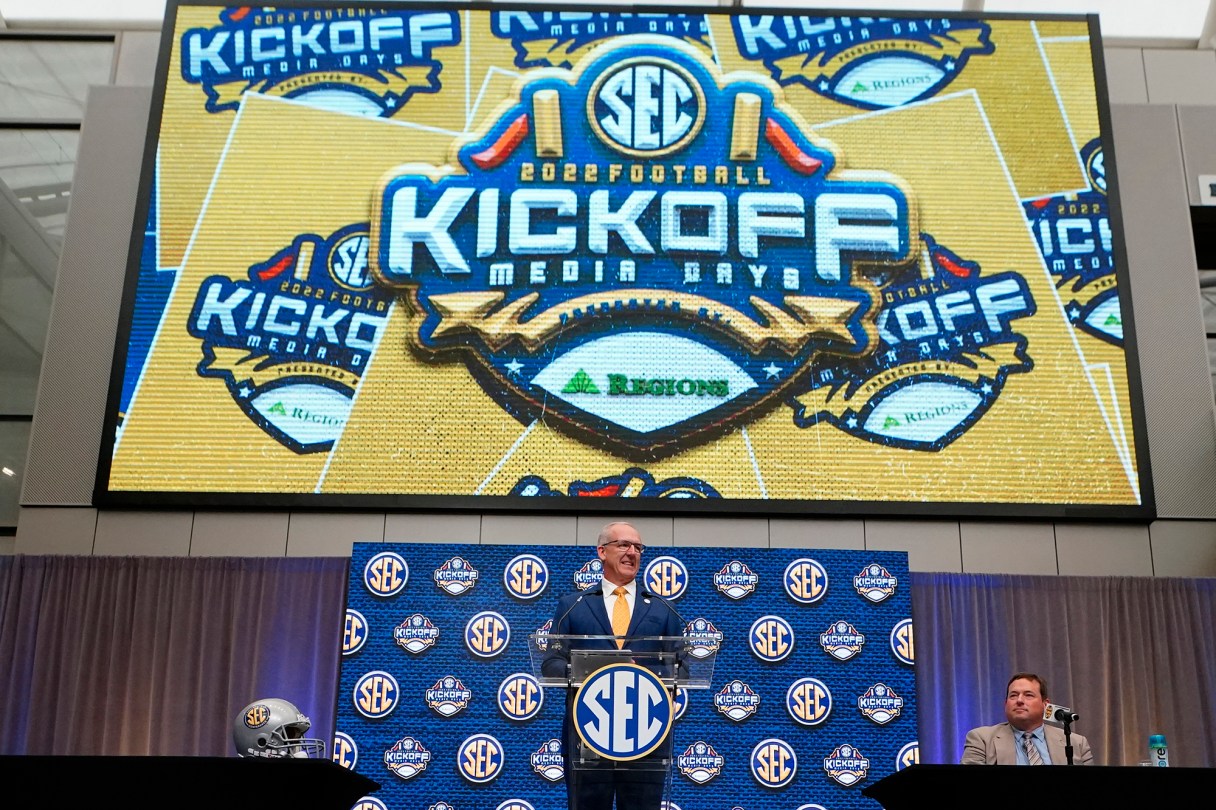
The agreement must still be approved by the boards of regents for Oklahoma and Texas, but that is considered a formality. SEC commissioner Greg Sankey said in a release that the schools will become full members of the conference on July 1, 2024.
“We are continuing our preparation for this membership transition, and we look forward to welcoming the conference’s new members and moving into our future as a 16-team league,” Sankey said.
The change of league address for Oklahoma and Texas has have been in the works since 2021, when the SEC invited the Big 12’s marquee programs to join what is already the strongest football conference in the country.
Oklahoma and Texas have combined for 10 national championships as determined by The Associated Press, but none since the Longhorns won a Bowl Championship Series title to cap the 2005 season. The College Football Playoff, the four-team event that began in 2014, has had only two participants from the Big 12: the Sooners, who have never advanced beyond the semifinals in four chances, and TCU, which reached the title game this past season but was routed by the SEC’s Georgia, which repeated as champion.
SEC schools have won nine of six titles since the CFP began, and the league’s next round of growth will now coincide with the playoff’s expansion from four teams to 12 in the 2024 season.
In the summer of 2021, Big 12 officials were initially stunned by the impending departures of Oklahoma and Texas. Bob Bowlsby, the conference’s commissioner at the time, even accused ESPN of trying to “destabilize” the league to help those two schools leave early.
Thursday’s announcement was much more cordial. Lawrence Schovanec, who is president of Texas Tech as well as chairman of the Big 12 Board of Directors, called the agreement “fair to all parties” and said it could not have happened without collaboration with league broadcast partners ESPN and Fox.
Money has been a driving factor in the shifting landscape of college athletics realignment. On Wednesday, the SEC reported a revenue distribution of $49.9 million per school for the 2021-2022 school year, exceeding by more than $7 million what the Big 12 distributed to its members for the same period.
Adding Oklahoma and Texas to the SEC’s broadcast portfolio is expected to only increase the league’s payout. They will land in their new league just in time for a new $3 billion deal with ESPN that gives the network the broadcast rights to all the conference’s football games.
Meanwhile, the additions of BYU, Cincinnati, Houston and UCF will boost the Big 12’s national footprint and push that league into new media markets.
Oklahoma and Texas haven’t already left for the SEC because both schools have been tied to the Big 12 and its other members through a grant of media rights through the 2024-25 school year. That deal ran concurrently with the conference’s television contracts with both ESPN and Fox.
“We have always been committed to fulfilling our contractual obligations to the Big 12. The collegiate athletics landscape has continued to evolve rapidly, and working together to accelerate our exit produced benefits for all parties,” Texas president Jay Hartzell said. “The Big 12 has been a respected partner for nearly three decades, and we look forward to a final season of spirited competition with our friends and rivals.”
Updated with more information at 10:30 p.m. on Feb. 9, 2023.