
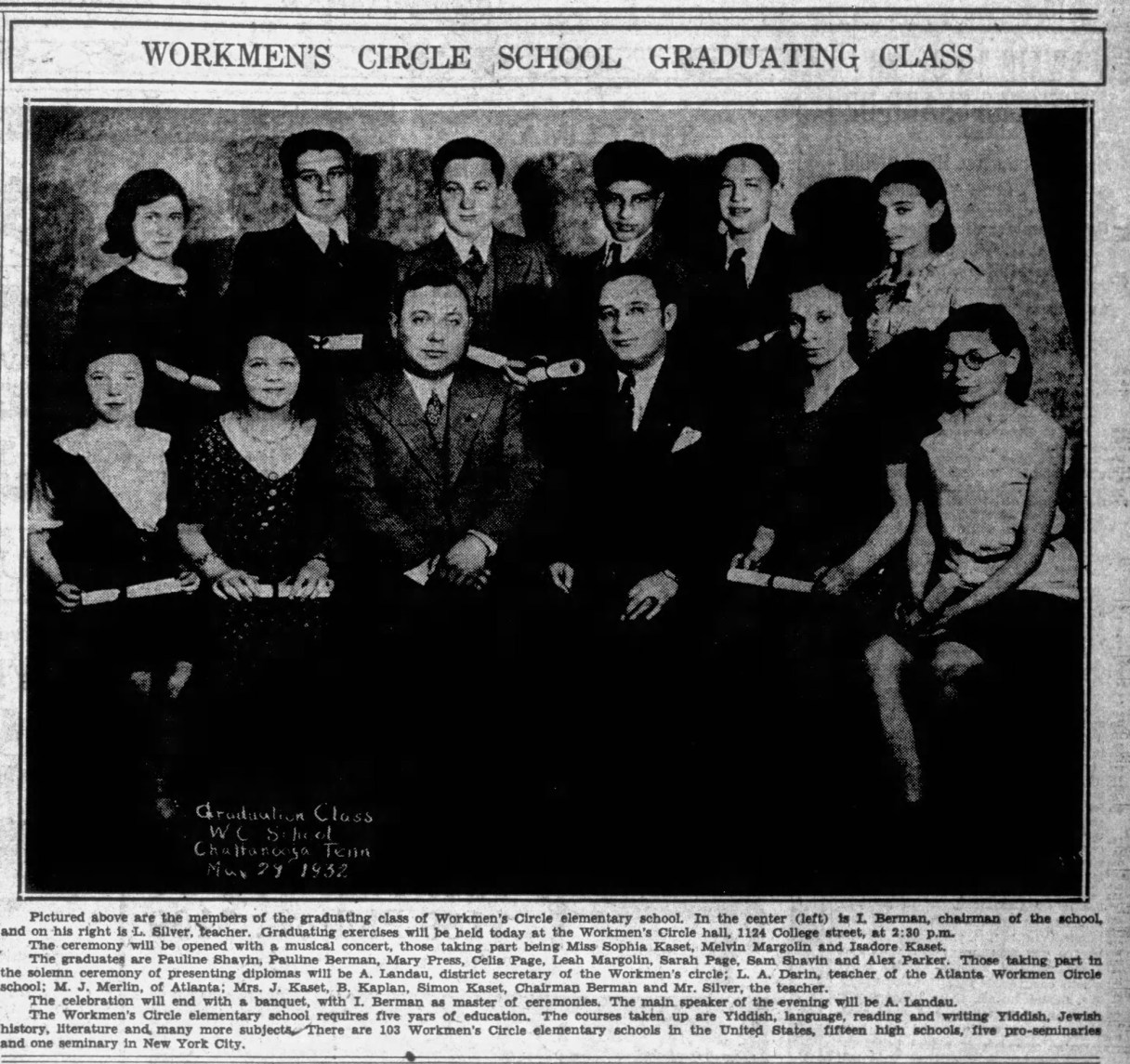
Established between 1912 and 1915, the Workmen’s Circle, also known as Branch 495 of the Arbeter Ring, provided an arts venue, political body, social meeting place and school, or shul, for Chattanooga’s Jewish residents.
Located at 1124 College Street (initially part of Cameron Hill, demolished in the 1960s), Workmen’s Circle was a “Yiddish speaking fraternal organization with socialist overtones.” Most of its families came from Eastern Europe and were of tradesmen or working classes. Members spoke Yiddish, and the school offered classes in Yiddish, art, folk songs and dances. The Circle donated to international relief agencies and supported political causes and candidates of a socialist nature. When Franklin Delano Roosevelt became U.S. president, members moved away from socialism in their support of Roosevelt’s policies and the New Deal.
The Circle worked as a mutual aid society, offering insurance, aid, unemployment relief, burial insurance, health care, education and social interaction in creating a Jewish community. The Workmen’s Circle shared Shari Zion Cemetery, which exists today at 313 Rowe Road.
Workmen’s Circle supported labor causes and equality. In 1913, the organization hosted the Rev. L.R. Robinson, who spoke in support of the relief fund for children of striking workers. The association in 1917 gave a donation to Jewish relief in “honor of the Russian revolution.” In 1918, the Circle sent a resolution to California Gov. William Stephens and U.S. President Woodrow Wilson urging that a new trial be given to Thomas J. Mooney, a political activist and labor leader who was convicted and sentenced to death for the 1916 San Francisco Preparedness Day bombing. Mooney had been tried under false testimony, and the Circle with other labor groups demanded he get a new trial. The resolution of Chattanooga’s Branch 495 with other petitions worked to secure Mooney a new sentence. He was pardoned in 1939.
The political leanings of the Circle were at times questioned. It often hosted events that others believed departed from the American way. In 1932, the Circle was host to the Chattanooga Socialist Party, in which many Circle members held positions. One member was Simon Kaset, organizer of the local Socialist Party and active in the Young Men’s Hebrew Association and Youth Circle.