
HOUSTON — A year ago at this time, men’s college basketball was getting ready for the game of a lifetime: Duke versus North Carolina at the Final Four.
And now? Well, to put it kindly, who the heck are these guys?
The NCAA tournament, the annual event that has told and sold and made marketing gold out of the story of underdogs and busted brackets has, in 2023, produced an extreme rendition of what happens when all that cherished unpredictability plays itself out to the end.
In Saturday’s semifinals on CBS, the first game has Florida Atlantic University (35-3), which won the East Region as a No. 9 seed, facing San Diego State (31-6), which won the South as a No. 5 seed, at 6:09 p.m. In the second game, it’s Miami (29-7), which won the Midwest as a No. 5, taking on the University of Connecticut (29-8), the West winner as a No. 4.
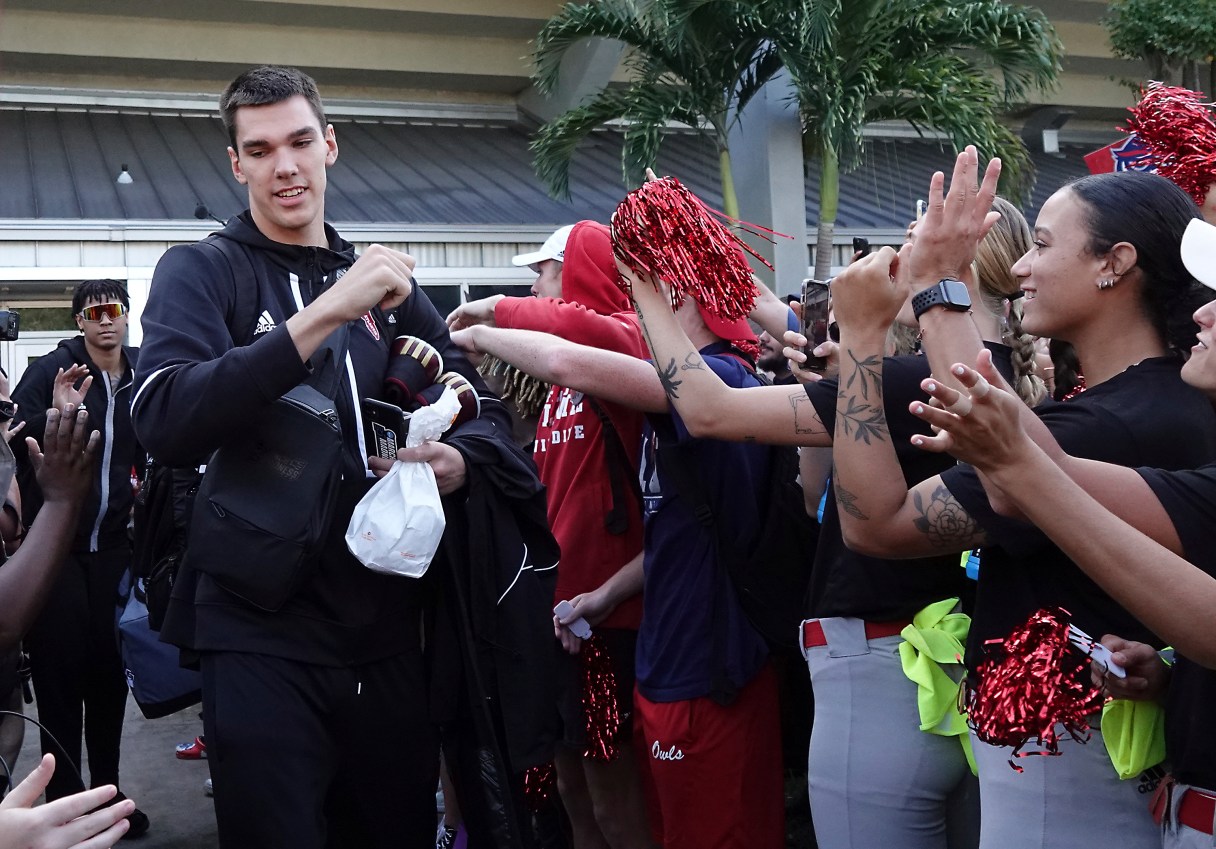
After FAU beat Kansas State 79-76 in the Elite Eight last Saturday night, Owls coach Dusty May was quick with a quip that summed up how nobody really expected his Conference USA team to be in Houston as March Madness gave way to the first weekend of April.
“I expect the prognosticators,” May said, “to pick us fifth at the Final Four.”
And by Sunday evening, the Owls weren’t the only surprise contender.
Of the four programs remaining in the running for the national championship, only one has ever been to a Final Four. It’s the first time in 53 years that has happened.
With its four NCAA titles and some famous names from the past, including coach Jim Calhoun and star players Rip Hamilton and Kemba Walker, the name UConn certainly should ring a bell, even if it might not tread all the way into true blue blood territory.
Miami? That was a program that was literally shut down for 14 years in the 1970s and 1980s due to lack of interest in basketball. The school was too busy building a football program that would become (in)famous for winning with a certain panache.
FAU? It’s a relative new kid on the block as a member of Division I since 1993, and its campus is in the retirement community of Boca Raton, a locale better known for its 4:30 dinner specials than its 7 p.m. tipoffs.
San Diego State? In the Aztecs’ defense, maybe this shouldn’t be their first Final Four. In 2020, they were 30-2 and generally slotted in as a No. 1 seed, albeit still an underdog to a stacked Kansas team that was the odds-on favorite. Then the coronavirus pandemic hit and wiped the remainder of that season off the boards before March Madness could begin.
“There are a lot of really good teams in college basketball, and the difference between winning and losing is paper thin,” Aztecs coach Brian Dutcher said.
Will anyone, outside of the truest of die-hards, bother to watch?
As of Thursday, a pair of seats in the nosebleed section for Saturday’s doubleheader — the most anticipated day on the college hoops calendar — were going for around $100 each on the secondary market. A year ago, shortly after the Duke-Carolina matchup was set, the average price for those same seats nearly doubled to $800 a ticket.
There has been a lot of debate and even some hand-wringing about how one of America’s greatest sporting events produced a Final Four in which the seeds add up to a total of 23, which is the second-highest in history, and the rosters have neither a single McDonald’s All-American nor one consensus top-30 recruit.
NCAA rule changes from recent years that allow players immediate eligibility when going from one school to another and the transfer portal’s ability to easily connect available athletes with interested programs might be the best explanation. Miami coach Jim Larranaga called it basketball’s form of “speed dating,” a get-rich-quick scheme that, with the right timing, chemistry and luck, can make a roster very good (or very bad) very quickly.
Some other possibilities: an NCAA selection committee some say is divorced from reality; the ever-shifting landscape caused by name, image and likeness deals that give players more leverage (and money); and, for sure, an abundance of flawed teams — including the No. 1 seeds — that were overvalued and placed at the top of the heap this year.
But before jumping to grand conclusions about matchups such as Saturday’s becoming the new normal at the Final Four, former Duke star and current TV analyst Jay Bilas reminds it was just last spring that the sport celebrated a completely different sort of get-together.
“I love the one about the narratives that you don’t need those McDonald’s guys to win,” Bilas said. “OK, so don’t recruit the best players, and see how that goes for you. I just don’t understand how all this gets this way.”
A year ago, the country got its dose of Cinderella, in particular when Saint Peter’s made an run into the Elite Eight that was unprecedented for a No. 15 seed. Then there was what seemed to be a perfectly timed resumption of normal.
Mike Krzyzewski got to close out his long career as Duke’s coach at the Final Four, and the end came against none other than the Tar Heels, the Blue Devils’ in-state and Atlantic Coast Conference archrivals. Joining those power programs in New Orleans last year were Kansas and Villanova, two more of the country’s great programs with seven national titles between them.
The total seed value of those four teams was 13, with most of that accounted for by the Heels, who got in as an No. 8 seed after knocking out Saint Peter’s.
Will 2023 be remembered as the year when chaos took over for good, or just a minor blip in the proceedings while all those blue bloods reload?
“The tournament is about a lot of different things to a lot of different people,” Bilas said. “Some people love it for the brackets, some people love it for the basketball. But no matter who’s in the Final Four, the bandwagon is always wide open, and you can jump on it whenever you want.”