
Monday, November 16, 2026Nov 16

Germany backs EU-Indonesia trade pact to curb China reliance

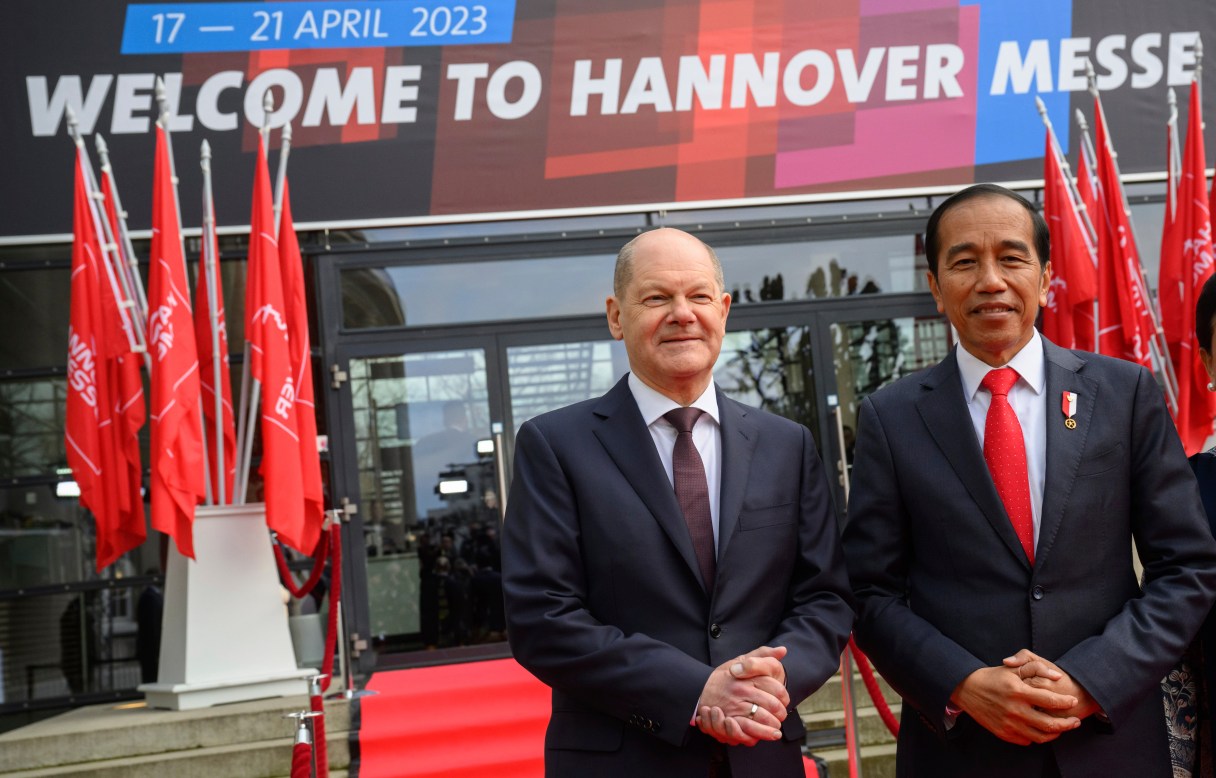
German Chancellor Olaf Scholz, left, and Joko Widodo, right, President of Indonesia, stand at the opening of the Hanover Messe industrial trade fair at the HCC Hanover Congress Centrum in Hanover, Germany, Sunday, April 16, 2023. German Chancellor Olaf Scholz said Sunday that he will press for a trade agreement between the European Union and Indonesia as part of his country’s efforts to reduce its reliance on China for crucial raw materials. Slogan reads 'Welcome To The Hanover Trade Fair'. (Julian Stratenschulte/dpa via AP)

BERLIN (AP) — German Chancellor Olaf Scholz said Sunday that he will press for a trade agreement between the European Union and Indonesia as part of his country’s efforts to reduce its reliance on China for crucial raw materials.

Speaking at the opening of the annual Hannover trade fair, Scholz told Indonesian President Joko Widodo that a trade deal between Southeast Asia’s most populous nation and the 27-nation bloc would create an economic area with 700 million people.

“I am working to finally get this agreement across the finish line,” Scholz said of the negotiations between Jakarta and Brussels, which have been ongoing since 2016.

The German leader said he was similarly hopeful about talks between the EU and the Mercosur bloc in South America, Mexico, Australia, Kenya and India.

“Here too, a whole new dynamic has emerged in recent months,” he said, adding that such agreements were necessary to help countries reduce their dependence on particular markets.