
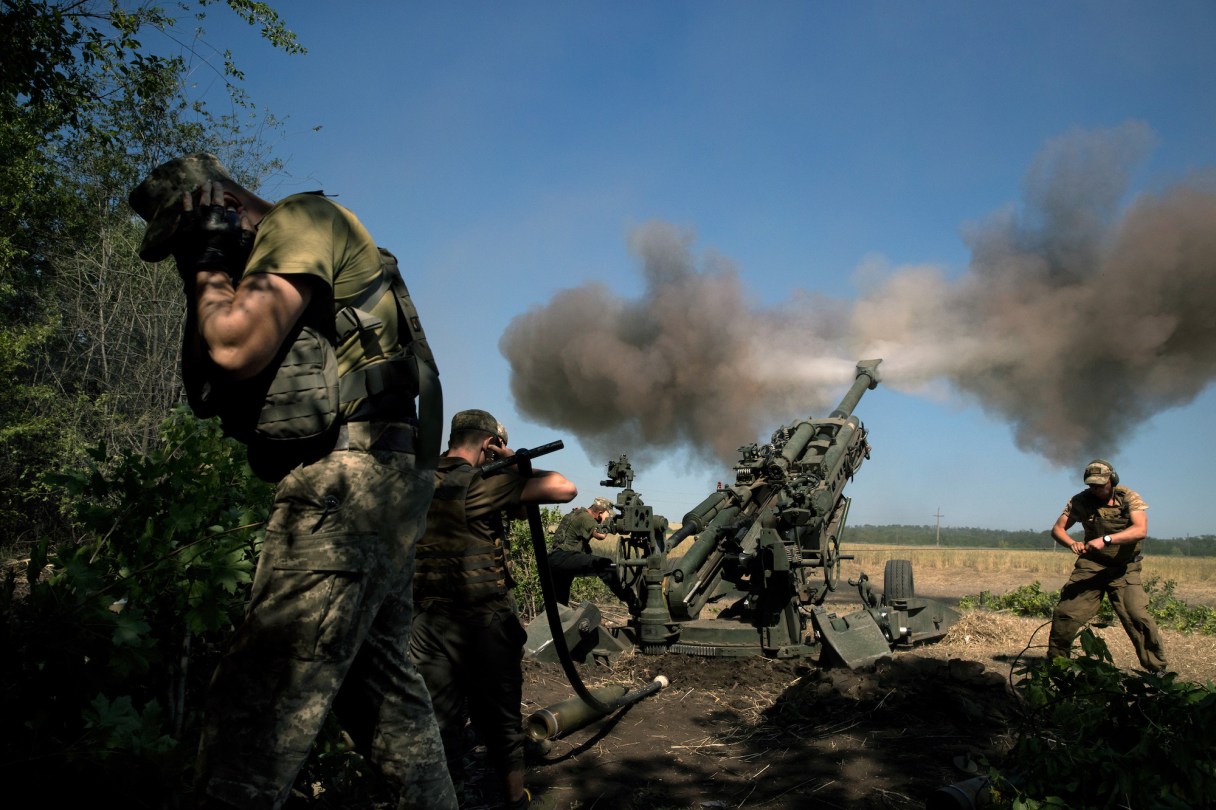
As the war in Ukraine rages and with Kyiv’s forces likely to begin a major offensive any day now, both sides in the conflict are facing shortages of ammunition, electronic components, precision-guided weapons and even cement. While the West has a vastly larger overall capability to deliver the necessities of combat, snarls in the global commercial supply chain are beginning to manifest.
The real “spring offensive” may not be tanks and armor but upscaled weapons production in the factories of Ukraine’s democratic supporters. What should they be doing collectively to make sure the Ukrainians get what they need to turn back Russia’s illegal and immoral invasion? And what will be the impact on broader global supply chains?
As the North Atlantic Treaty Organization’s military commander over a decade ago, I would often look deep into logistics and supply chains as I contemplated our combat operations in Afghanistan, the Balkans, Libya and counterpiracy. We felt comfortable that the overall Western defense industrial base — which supports over $1.2 trillion in collective military budgets for the 31 NATO nations — could handle those conflicts with relative ease.
But what made me nervous a decade ago was the possibility of great power conflict in Europe — notably a potential flare-up with the Russian federation. While the democratic allies enjoy an overwhelming capability and inventory advantage (Russia’s total defense budget is under $70 billion, one-tenth of NATO’s at best), the Russians have a competent industrial base, lots of raw materials, and can draw on conscript labor to man the machines in their foundries and factories.
The huge needs of Ukraine are driving challenges in supplying material to combat operations at a level I did not anticipate. The need for electronic components in particular — to build precision-guided weapons, sophisticated drones, anti-ship cruise missiles, and so-called smart artillery rounds — is soaring. Despite the sluggish global economy, civilian firms are competing with the Western militaries for the crucial semi-conductor chips, particularly the high-end ones produced largely in Taiwan.