
Monday, November 16, 2026Nov 16

In 370 days, Supreme Court conservatives dash decades of abortion and affirmative action precedents

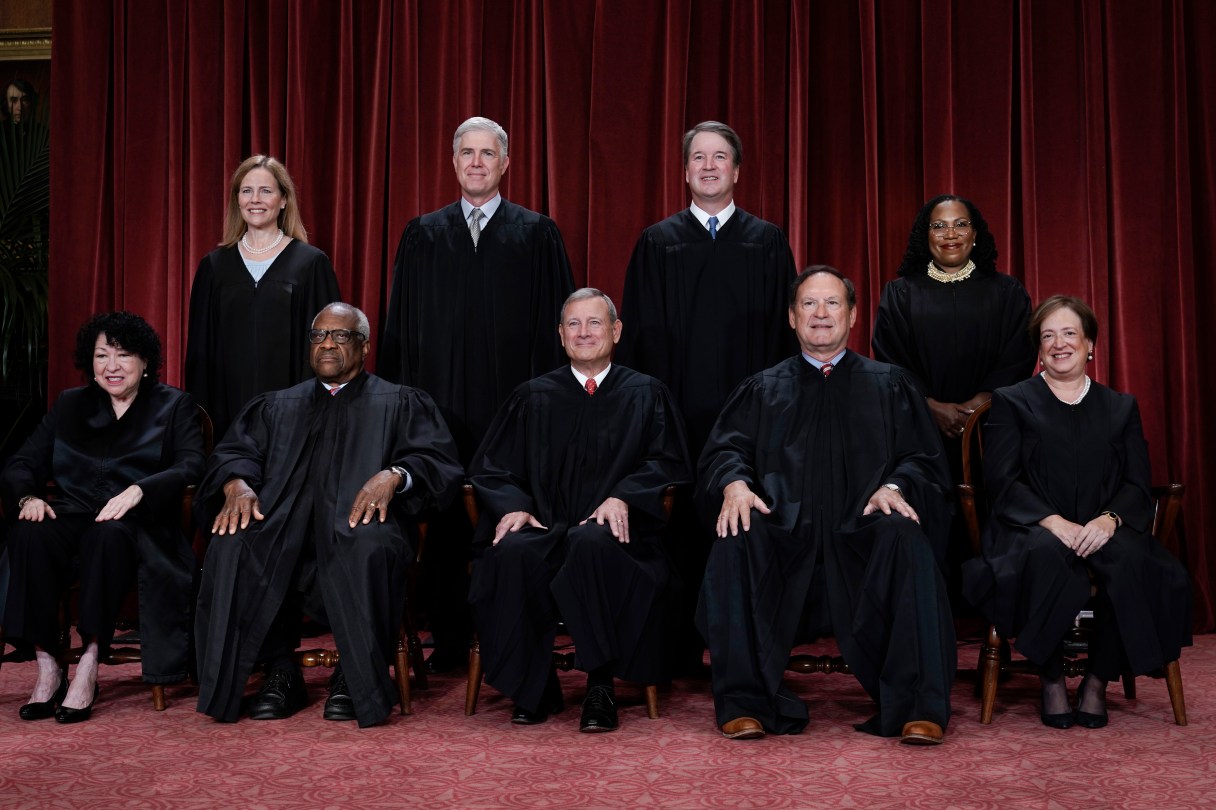
FILE - Members of the Supreme Court sit for a new group portrait following the addition of Associate Justice Ketanji Brown Jackson, at the Supreme Court building in Washington, Oct. 7, 2022. Bottom row, from left, Associate Justice Sonia Sotomayor, Associate Justice Clarence Thomas, Chief Justice of the United States John Roberts, Associate Justice Samuel Alito, and Associate Justice Elena Kagan. Top row, from left, Associate Justice Amy Coney Barrett, Associate Justice Neil Gorsuch, Associate Justice Brett Kavanaugh, and Associate Justice Ketanji Brown Jackson. (AP Photo/J. Scott Applewhite, File)

WASHINGTON (AP) — Overturning Roe v. Wade and eliminating affirmative action in higher education had been leading goals of the conservative legal movement for decades.

In a span of 370 days, a Supreme Court reshaped by three justices nominated by President Donald Trump made both a reality.

Last June, the court ended nationwide protections for abortion rights. This past week, the court’s conservative majority decided that race-conscious admissions programs at the oldest private and public colleges in the country, Harvard and the University of North Carolina, were unlawful.

Precedents that had stood since the 1970s were overturned, explicitly in the case of abortion and effectively in the affirmative action context.

“That is what is notable about this court. It’s making huge changes in highly salient areas in a very short period of time,” said Tara Leigh Grove, a law professor at the University of Texas.