
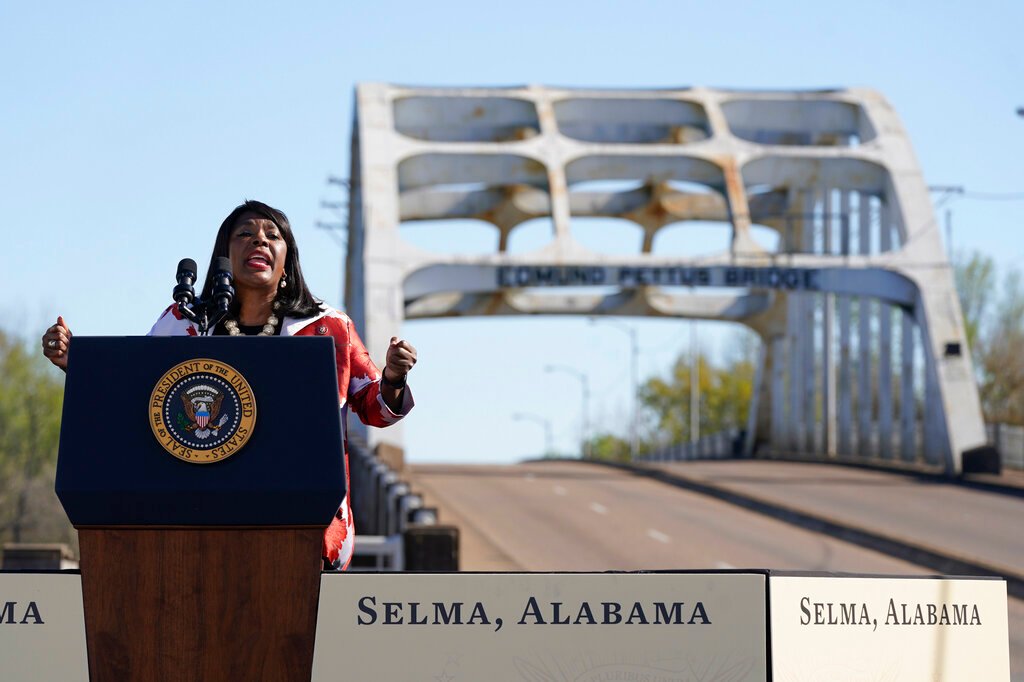
Alabama’s new congressional map fails to remedy a Voting Rights Act violation and amounts to an act of defiance against the U.S. Supreme Court, according to a brief filed in the state’s redistricting case.
The 11-page brief, filed Tuesday by U.S. Rep. Terri Sewell, D-Birmingham, and members of the Congressional Black Caucus, said that two new districts created by the maps — a 7th Congressional District in Birmingham and the Western Black Belt with a 50.65% Black population and a 2nd Congressional District in Southeast Alabama with about a 40% Black population — would not allow Black Alabamians to elect representatives of their choice and did not follow criteria laid out by a three-judge panel in 2022.
“In the face of a clear judicial mandate to enact a redistricting scheme that creates two majority-minority districts or ‘something quite close to it,’ the Alabama Legislature has demonstrated that it remains willing and eager to engage in racially discriminatory vote dilution in contravention of a federal decree,” the brief said. “Such an attempt must not be tolerated; the court’s holding must have teeth.”
The panel in January 2022 ruled Alabama’s 2021 congressional map violated Section 2 of the Voting Rights Act, which bans discriminatory voting laws, by packing many of the state’s Black voters into a single congressional district. The court cited the high degree of racially polarized voting in the state, where whites tend to support Republican candidates and Blacks tend to support Democratic candidates, in ordering the creation of two districts where Black voters compose a majority “or something quite close to it.”