
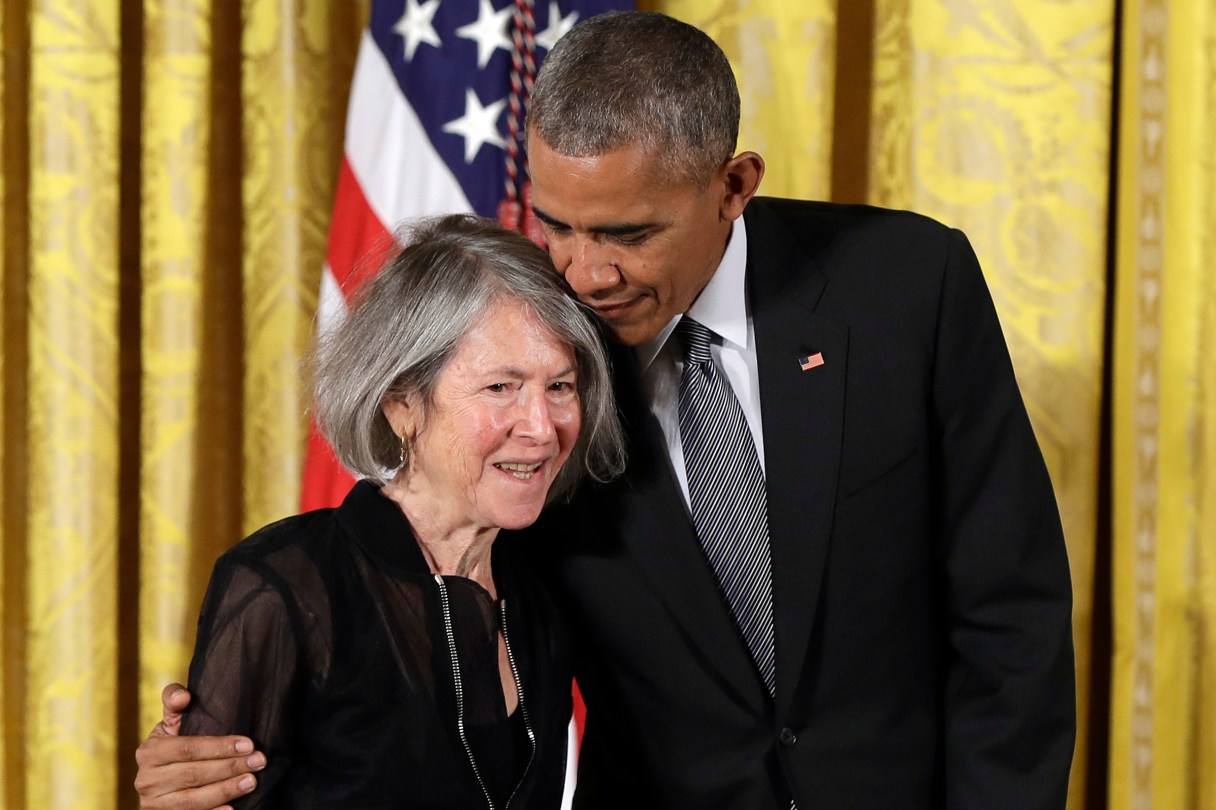
NEW YORK (AP) — Nobel laureate Louise Glück, a poet of unblinking candor and perception who wove classical allusions, philosophical reveries, bittersweet memories and humorous asides into indelible portraits of a fallen and heartrending world, has died at 80.
Glück’s death was confirmed Friday by Jonathan Galassi, her editor at Farrar, Straus & Giroux. She died of cancer at her home in Cambridge, Massachusetts, according to her publisher. A former student of Glück’s, the Pulitzer Prize-winning poet Jorie Graham, said that the author had only recently been diagnosed.
“I find it very much like her that she only learned she had cancer a few days before dying from it,” Graham said. “Her whole sensibility — both on and off the page — was cut that close to the spine of time.”
In a career spanning more than 60 years, Glück forged a narrative of trauma, disillusion, stasis and longing, spelled by moments — but only moments — of ecstasy and contentment. In awarding her the literature prize in 2020, the first time an American poet had been honored since T.S. Eliot in 1948, Nobel judges praised “her unmistakable poetic voice that with austere beauty makes individual existence universal.”
Glück’s poems were often brief, a page or less in length, exemplars of her attachment to “the unsaid, to suggestion, to eloquent, deliberate silence.” Influenced by Shakespeare, Greek mythology and Eliot among others, she questioned and at times dismissed outright the bonds of love and sex, what she called the “premise of union” in her most famous poem, “Mock Orange.” In some ways, life for Glück was like a troubled romance — fated for unhappiness, but meaningful because pain was our natural condition — and preferable to what she assumed would follow.