
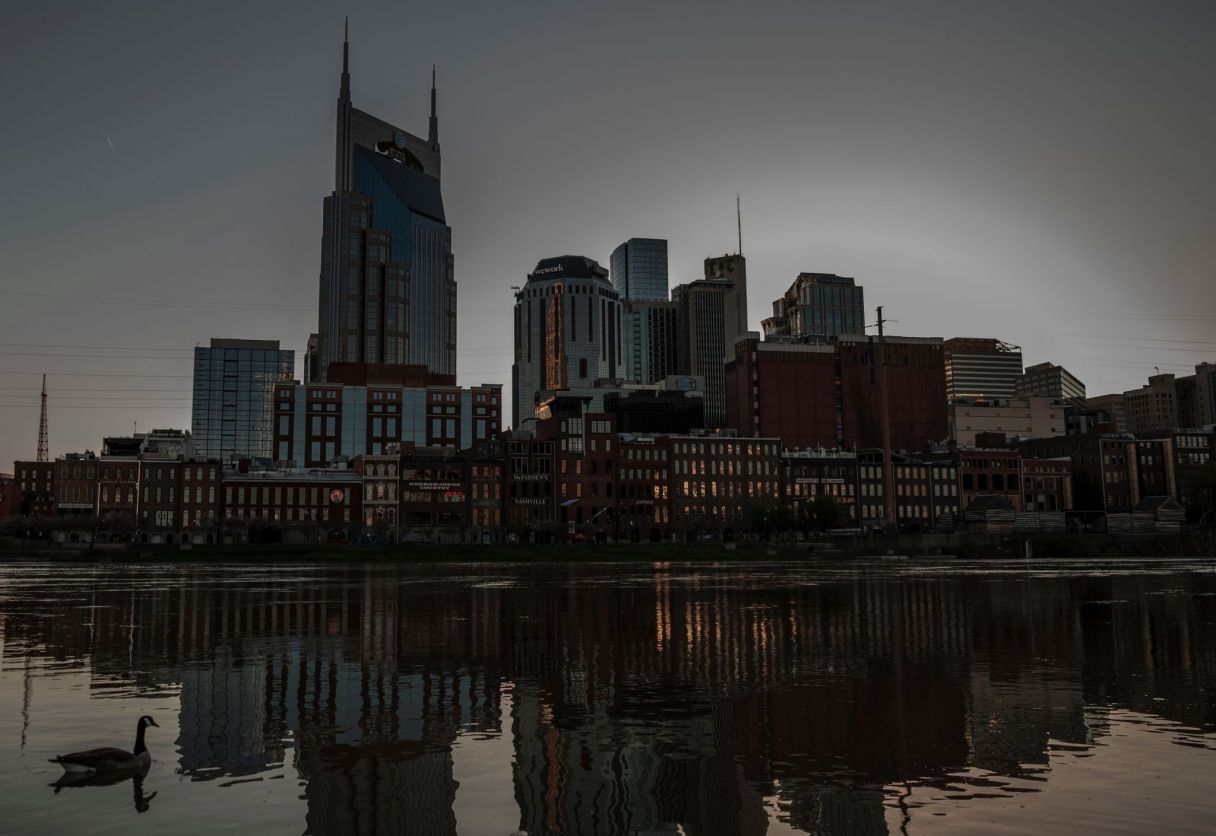
Former Nashville Mayor John Cooper made a lot of promises when trying to sell the public on the need to build a new NFL stadium for the Tennessee Titans and redevelop the East Bank.
He promised to build Nashville’s “next great neighborhood” with affordable housing, parks, a bus station and a new Tennessee Performing Arts Center facility while making bold financial claims about the project generating enough money to pay for itself.
But proposals by The Fallon Company — the winner of the city’s bid for East Bank master developer Sept. 12 — show the difficulty of accomplishing these lofty promises.
The committee tasked with evaluating proposals had bidders provide two proposals apiece: an initial plan containing 30 acres of city-owned land and an amended concept with 20 acres.
Both of Fallon’s proposals contained a combination of 25-40 story tall hotels, retail and residential spaces. The company’s initial concept included 1,500 residential units, including 1,095 deemed affordable.
Fallon estimated its initial proposal would generate $630 million in revenue for Metro Nashville over 30 years.
(READ MORE: Heightened security during session could become norm at Tennessee’s State Capitol)
In its amended proposal, Fallon reduced the housing units to 745, 200 of which are affordable. The plan also includes a parcel for the performing arts facility and an office space, which came despite Fallon’s warning in its initial proposal that selling office space would be challenging in a post-COVID-19 remote work environment.
The most significant difference between the initial and amended proposals is Metro Nashville asking developers to reserve parcels for the performing arts center and the parking requirements as part of its stadium deal with the Tennessee Titans.
The area is required to have a minimum of 2,000 parking space at all times. For the performing arts center, the state is offering $200 million for the facility to move from its downtown site. The 10 acres needed for these pieces played a large role in reducing the number of housing units.
Fallon projected the amended smaller project would generate between $527-$658 million in revenue for Metro Nashville, depending on who covers the surface level infrastructure costs.
The proposal provides a starting point for new Nashville Mayor Freddie O’Connell as his team tries to negotiate and implement a plan he opposed as a council member.
Former Metro Council Member Bob Mendes, a critic of the stadium and East Bank projects, and Sam Wilcox, a former deputy in Cooper’s administration, are the mayor’s point people for negotiating the deal.
Council Member Sean Parker, the council Transportation and Infrastructure Committee chair, said he’d push for more housing even if it leads to reduced revenue because the East Bank should be about building an affordable neighborhood.
(READ MORE: Metro Nashville draws another lawsuit in Fairgrounds Speedway deal)
“We get a lot of bang for our buck affordability-wise by putting units on the East Bank,” Parker said, “close to jobs, close to transportation, close to services, because it allows folks to utilize all these great things that are available in Nashville that you wouldn’t necessarily get if you put it in a suburban area.”
Some quick stadium math
Before Fallon’s proposal, Cooper said the stadium and East Bank project could generate billions in revenue, more than enough to cover the stadium and East Bank infrastructure cost.
The East Bank and the new stadium go hand in hand. They would have to be built up relatively quickly because Metro Nashville’s and the state’s ability to pay off the money they borrowed for the stadium requires the undeveloped area to flourish.
“Cooper’s original talk was this was going to all pay for itself with revenue generated, and that’s just not the case,” said Metro Nashville Council Member Emily Benedict.
Benedict is running for chair of the council’s Planning and Zoning Committee, adding the more public benefit on the land “the less it’s going to pay for itself.”
“But, I think we need to put as much public benefit on this as the public wants, including parks, TPAC and housing,” Benedict said.
Cooper’s administration tied the performing arts center, affordable housing and other more popular aspects of the East Bank project to its broader deal involving a $2.1 billion NFL stadium in an attempt to bolster public support for both projects.
Metro Nashville estimated last year it would have to come up with $753 million to cover all the infrastructure costs necessary to build up the East Bank.
Fallon’s projections only pass these expectations when it eliminated the affordable housing elements in its initial plan. That proposal estimated the area could generate $1 billion in revenue for the city without affordable housing.
Read more at TennesseeLookout.com.