
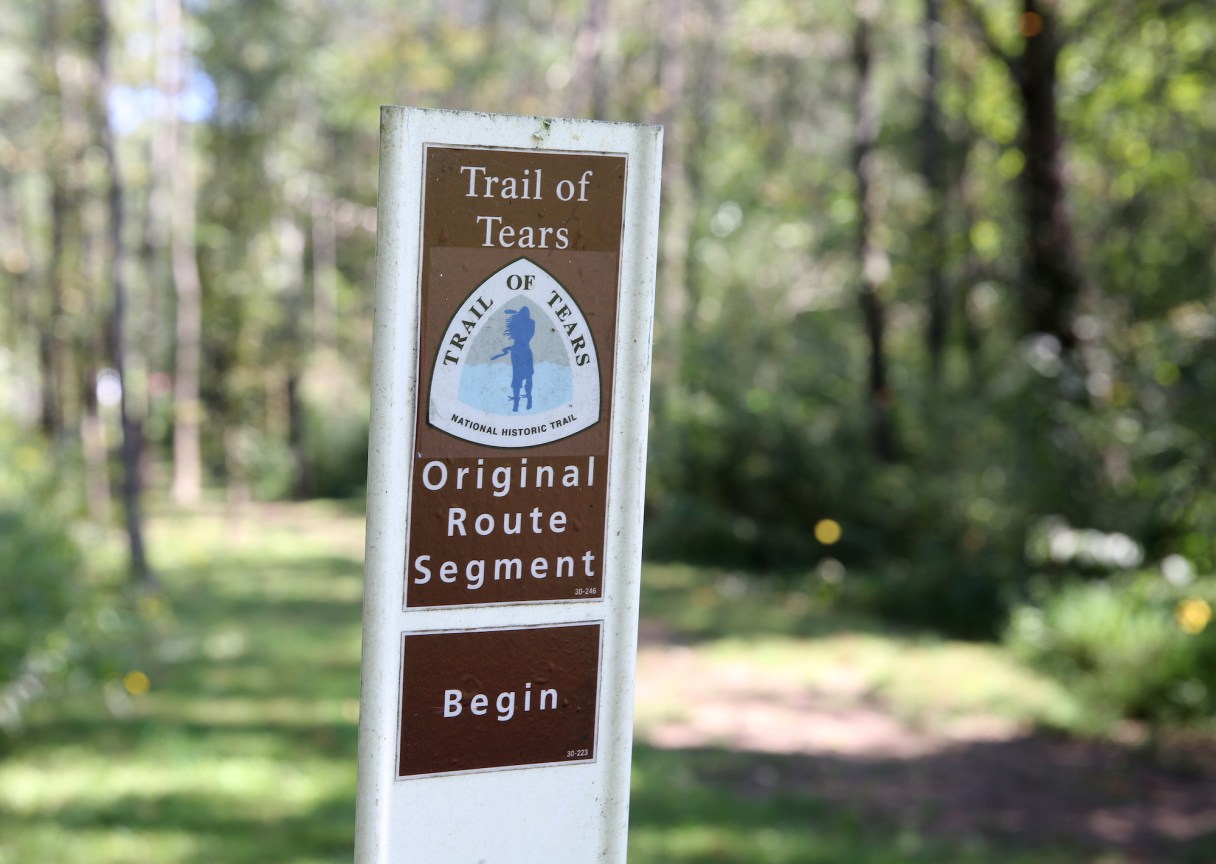
When the forced roundup of Cherokees began in May 1838, most were taken to Ross’s Landing or the Cherokee Agency on the Hiwassee River at Charleston, Tennessee. The plans were to deport Cherokees by water. However, after emigration halted for the summer, many of the remaining Cherokees traveled overland on what is called the Northern Route of the Trail of Tears. In 1987, Congress established the Trail of Tears National Historic Trail and designated both the Northern Route and the water route as official national trails. The water route includes the section of the Tennessee River that flows around Moccasin Bend.
The first three detachments to leave under armed guard departed from the Ross’s Landing area. On June 6, 1838, 489 Cherokees loaded onto flatboats pulled by steamboat from the landing. Then six days later, a second detachment left five miles upstream of Ross’s Landing. This group of 900 Cherokees was also sent by float boats and steamboat. In passing around Moccasin Bend, the party stopped at Brown’s Ferry and camped for three nights at the landing there in order to board more Cherokees from nearby camps at Ross’s Landing and to purchase clothing. Capt. R.H.K. Whiteley reported that the Cherokees refused the clothing and refused to give their names when he tried to develop a list of those on board. Whiteley’s detachment eventually lost 70 souls while the first detachment reported no deaths.
On June 17, a third detachment supervised by Capt. Gus Drane crossed the river at Ross’s Landing and marched across Moccasin Bend to Brown’s Ferry, where they crossed the river again. Then they walked to Bellefonte, Alabama, where many unloaded their wagons and refused to travel further. Although most were recaptured, at least 225 managed to escape at Bellefonte. At Waterloo, Alabama, they boarded boats for the remainder of the trip to Indian Territory. Their journey ended after 293 desertions, two births and 146 deaths, the most of any group.
Removal was halted for the summer due in part to low water levels in the Tennessee River; emigration resumed in early October. The John Bell detachment left Charleston on Oct. 11 and traveled to Ross’s Landing, where it crossed the Tennessee River at Ross’s Ferry. Samuel Hamill was paid $50 for two days’ work to ferry 56 wagons, 318 horses and 660 Cherokees to the north shore. Once across the river, they camped for two nights while waiting for their absent conductor, John Bell. Resuming their journey, they crossed Moccasin Bend. William Hixson, who John Brown accused of stealing control of his ferry, was paid to take the group across the river at Brown’s Ferry. The route of the Bell detachment across Tennessee roughly follows today’s U.S. Hwy 64. There were 23 deaths. Congress added the Bell Route, which crossed Moccasin Bend, to the Trail of Tears National Historic Trail in 2009.
The last group to travel by water around Moccasin Bend carried Chief John Ross, his family and his enslaved servants. This small party of four boats and 231 souls left Charleston on Dec. 5, 1838. A special pilot was hired to guide them through the Suck. They used a newly built canal to bypass the Muscle Shoals. Ross’s wife, Elizabeth, “Quatie,” died near Little Rock.