
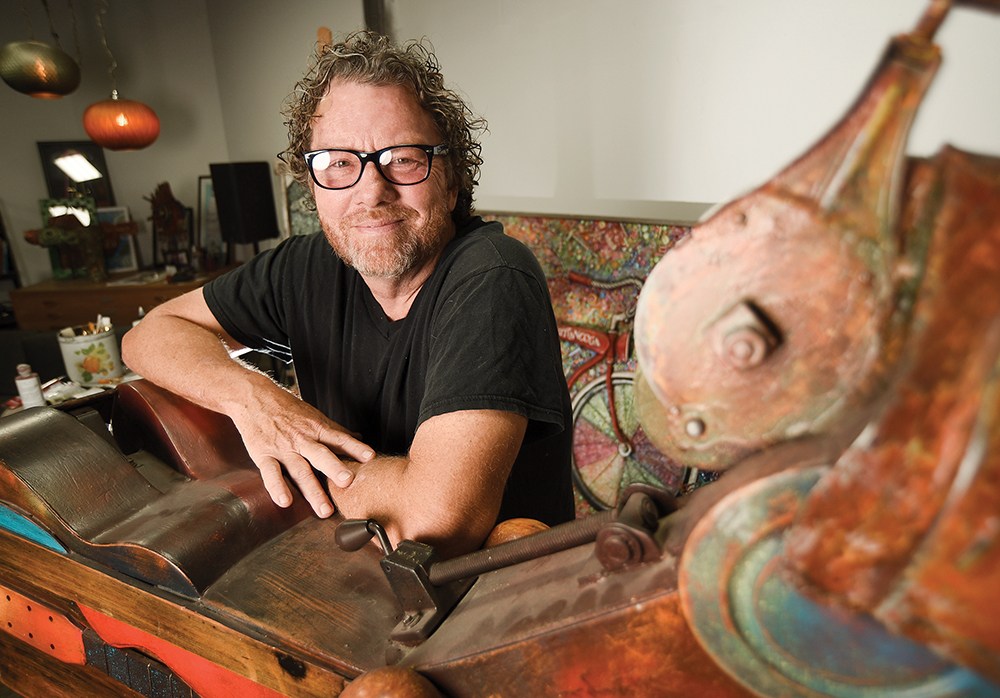
Upon entering Terry Cannon’s studio, you’d probably think that you walked into the wrong place. “Surely, this can’t be an artist’s studio,” you would tell yourself. “It looks more like a Home Depot.” But don’t let the assorted slabs of wood, work tables, power tools and shelves stocked with anything and everything fool you. You’re not at the hardware store; you’re in the refuge of an artist.
Cannon utilizes found objects to create extravagant, multi-colored sculptures and murals. Where most people see a guitar, Cannon sees the body of a horse; where most people see a bedpost, Cannon sees a butterfly’s abdomen. To any other person, a PEZ dispenser is just a plastic novelty with some famous character’s head on it, but in the hands of Cannon, those novelties become a crown adorning the lip of a vase.
While Cannon is well-established now with a decades-long career, the journey to becoming a full-time artist was not a straight and narrow one.
“From my earliest memories, I just felt like I was going to be an artist,” he says. “But the road to a career in art wasn’t laid out, especially in Hixson, Tennessee, in the ’60s, and I got a lot of messages that it would be impossible to make a career out of art.”
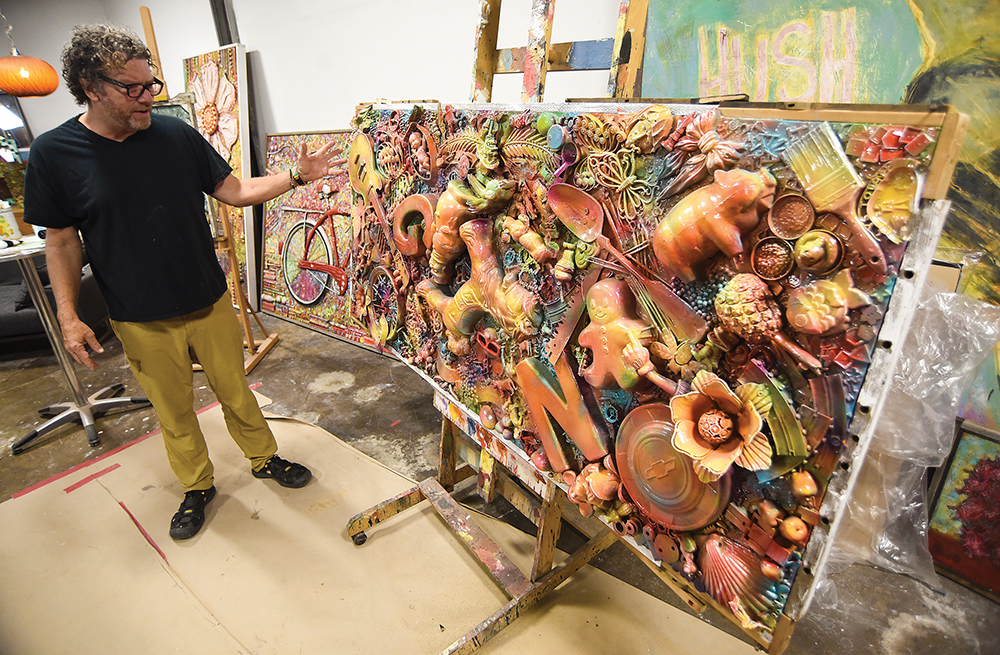 Staff photo by Matt Hamilton / Artist Terry Cannon talks about his art at his work space.
Cannon’s journey into artistry began in his youth, he says. He would draw cartoons, athletes, musicians and reproductions of pictures from magazines. At this point in Cannon’s life, art was a way to occupy his time and express himself.
Then came college, where, at the University of Tennessee at Chattanooga, Cannon was able to take formal art classes for the first time. But looking at the works of his classmates, he felt doubt about his own talents, he says. However, he was able to persevere and develop as an artist because of the encouragement from one of his professors: George Cress.
“George Cress pulled me aside and said, ‘Terry, you’re a talented artist. You’ve got a gift. You should use it,'” Cannon says. “I’ve never forgotten that.”
In his late 20s, Cannon says he hit a rough patch in life. Haunted by a sense of personal emptiness, he relied on alcohol and drugs to subdue this feeling. Recognizing that his life hung in the balance, Cannon entered treatment at the age of 29.
While in treatment, he fell in love with the process, and as a result, he put art aside, began volunteering in the healthcare field and went back to school to pursue a career in that industry.
Cannon says he sought to help others understand that they had a purpose in life and had the abilities to achieve this purpose. However, after years of giving this advice to others, Cannon says he realized it applied to himself as well, and so he began making art again in his 30s.
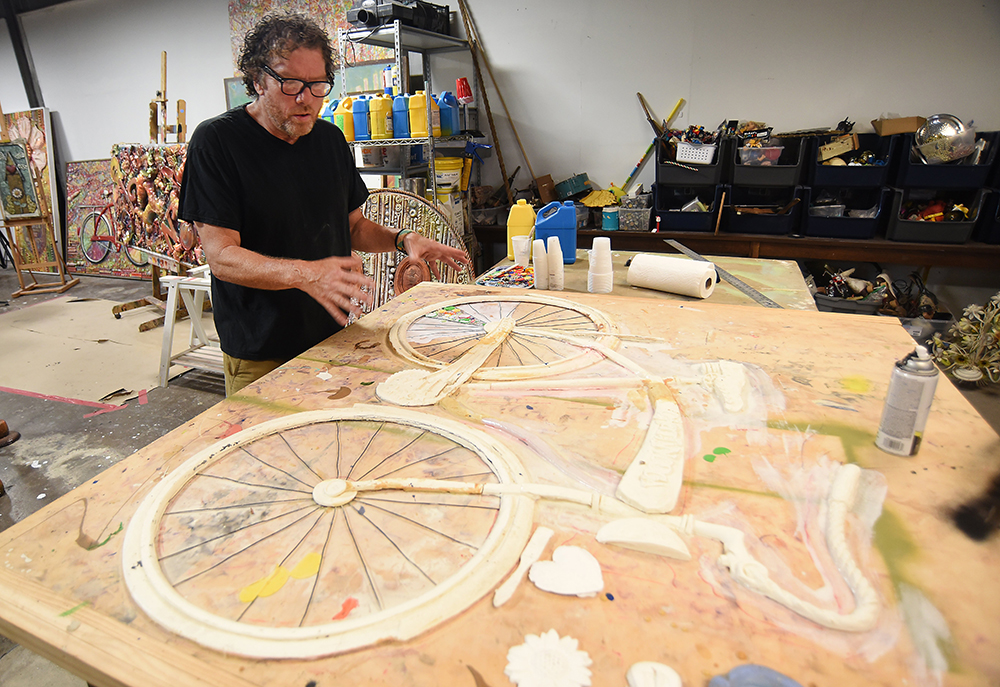 Staff photo by Matt Hamilton / Artist Terry Cannon talks about a work in progress.
With renewed passion, Cannon says he created Howard Finster-inspired works that were “fun, whimsical, quick, spontaneous.” At first, he made art just for himself to quell the empty feeling, but as his works accumulated, he started to display and sell his art. Eventually, he was able to leave his job and pursue art full-time.
“When I did that, it was like a valve opened up,” he says. “I was able to be more creative and just devote myself to [art], and it was incredible.”
The work was fun and successful, Cannon says, but another professional pivot came about 10 years ago when his then-wife was diagnosed with cancer. Once again, Cannon put art aside, this time for his family.
However, a few years ago, Cannon felt it was time to get back into art. He started working with Seth Champion, owner of Champy’s restaurants, to curate the restaurants’ iconic look, beginning with the Lee Highway location.
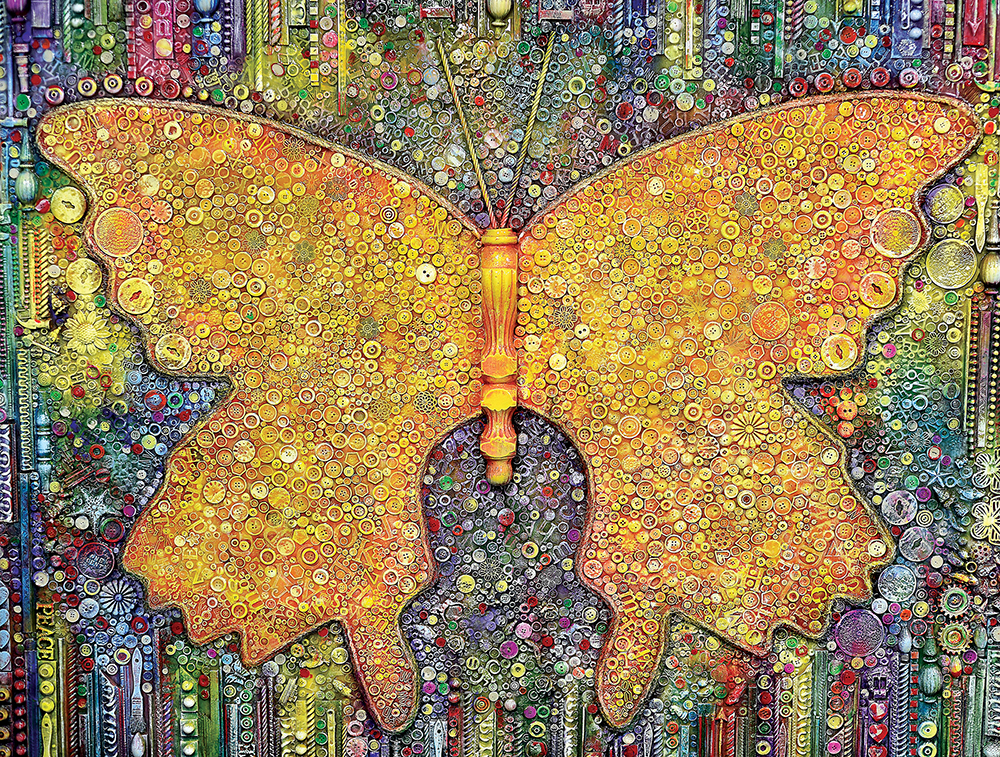 Staff photo by Matt Hamilton / A work by artist Terry Cannon at his work space.
“[Champion] just let me take it and run with it,” Cannon says of working on the restaurant. “It was like a big art installation, and I loved it.”
Cannon has subsequently worked on several other Champy’s locations, including the latest one in Cleveland, Tennessee. In addition to his restaurant work, Cannon also recently completed a large installation at the Creative Discovery Museum. His upcoming plans include working on another Champy’s location and hosting an art show.
Cannon enjoys seeing people’s reactions to his artwork and likes when others are inspired by his work, especially children.
“I love seeing a kid saying, ‘I think I can do that,’ and [I say], ‘You can do that. Get going on it. Go do it,'” he says.
For Cannon, art means expressing something original from within himself. He says that creating art fills an inner void and that anyone compelled to make art should pursue that compulsion.
“If you think you’ve been put here on this Earth to make art, then that’s what you’ve got to do,” Cannon says. “Because you’re not going to be happy unless you do it. Once you start doing it, nothing is going to keep you from doing it. You’re going to feel it, you’re going to own it, and nothing else will touch that.”
To see more of Cannon’s work, follow him on Facebook. 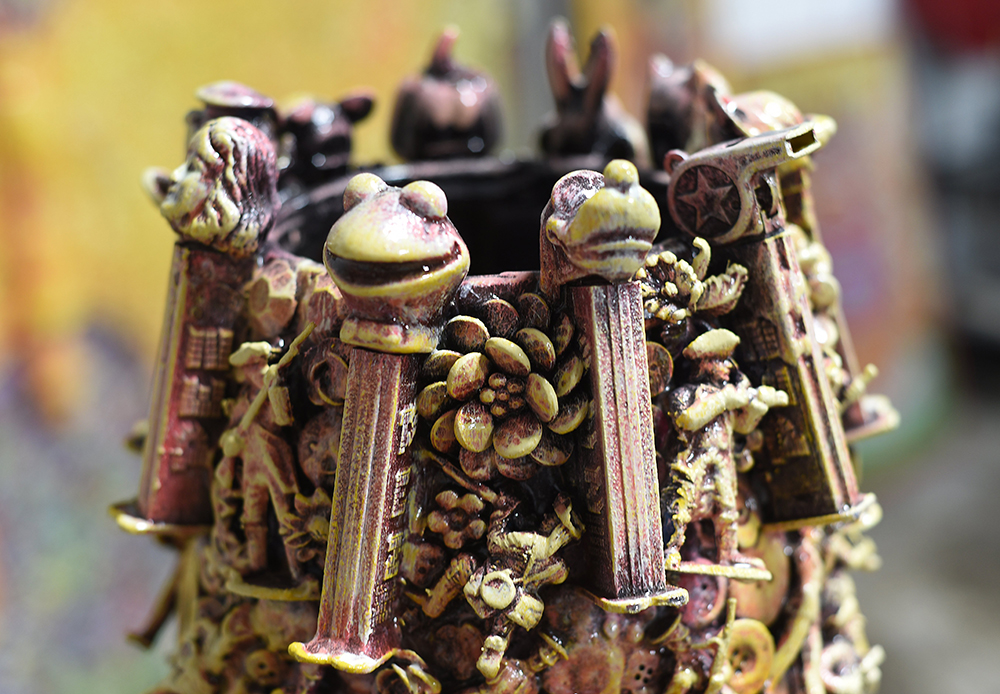 Staff photo by Matt Hamilton / Pez dispensers line the top of a vase made by artist Terry Cannon.