
Glassblowing is a kind of ballet of the dying swan. When the artist pulls 1,700-degree molten glass from a kiln, it’s glowing and alive, a shape dancing among harsh forces, like gravity, pressure, resistance, but ever cooling toward a frozen end.
“It’s this dance of properties and heat that gives the material its romance,” glass artist Matt Thomas says. “A dance I will never grow tired of.”
Thomas’ ability to respond in this dance is evident in the smooth sheen of a vase, the stolid clarity of his whiskey glasses and bell jar. Perhaps it’s because glass art can capture and freeze traces of this vital, elemental dance that it has the power to mesmerize.
Not unlike the way dancers practice to look graceful, glassblowing often takes conditioning. Processes like blowing a glass bubble and turning the glass constantly for evenness have a timing to them. More importantly, the timing involves swinging a long rod with a heavy molten ball at the end of it. It takes strength.
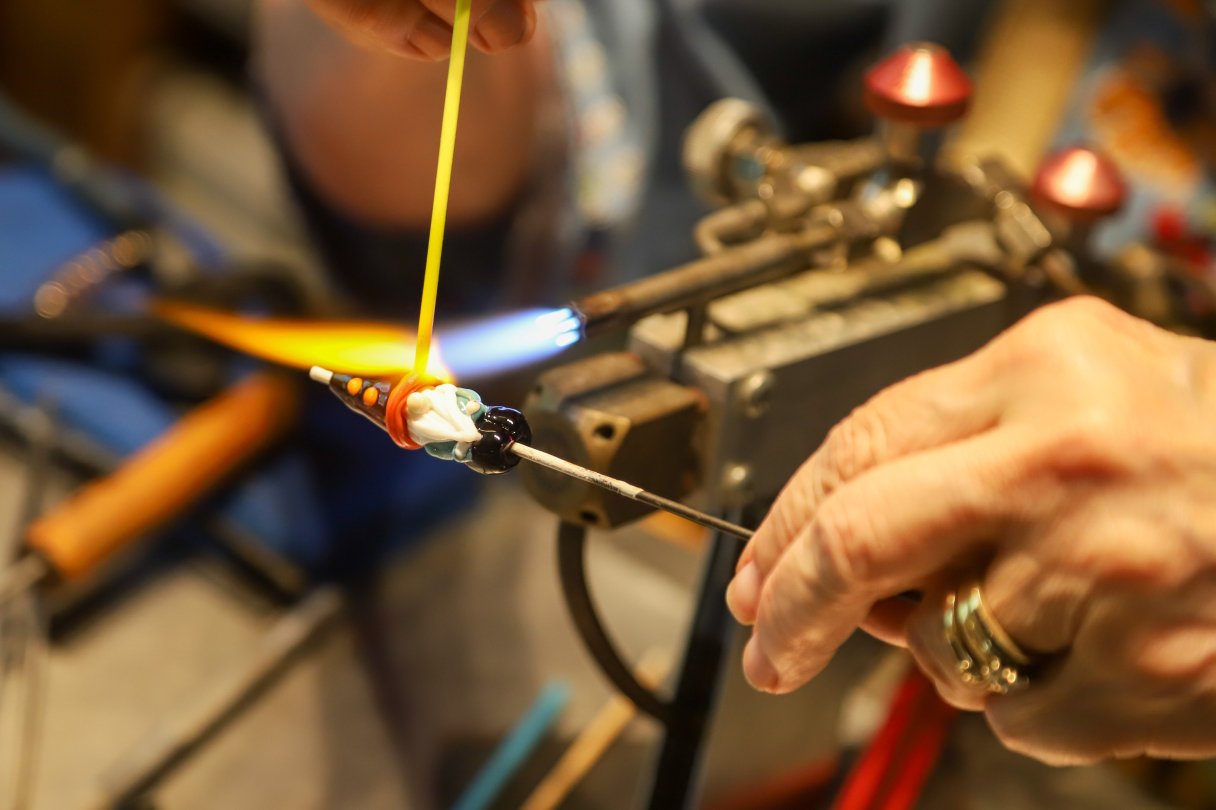
But other kinds of glass artists do not work with kilns full of molten glass or move it around at the end of a long rod or “punty.” Susan Parry makes small glass figurines, ornaments and jewelry. Parry’s well-known glass work has hung among commissioned ornaments from all over the country on the national Christmas tree in Washington, D.C. Through the nonprofit Beads of Courage, her handmade glass beads have inspired children dealing with long, crushing illnesses. Parry often uses a torch rather than a kiln when creating these small inspirations. She holds the glass, in solid form, to a “sweet spot” in the torch flame, about halfway in, until it’s soft enough to manipulate.
Like Thomas, Parry speaks about working with glass as someone enamored: “I have been having a love affair (with glass, anyway),” she says, “and it’s been going on for 20 years.”
It must be something as powerful as love that keeps these artists coming back “like a moth to the flame,” as Parry puts it. It takes a long, almost ruthless pursuit by the artist to make the magic and beauty happen. The dancer’s push through sprains and strains to perfect her form is echoed in the way the glass worker pushes through discomfort and negotiates with danger.
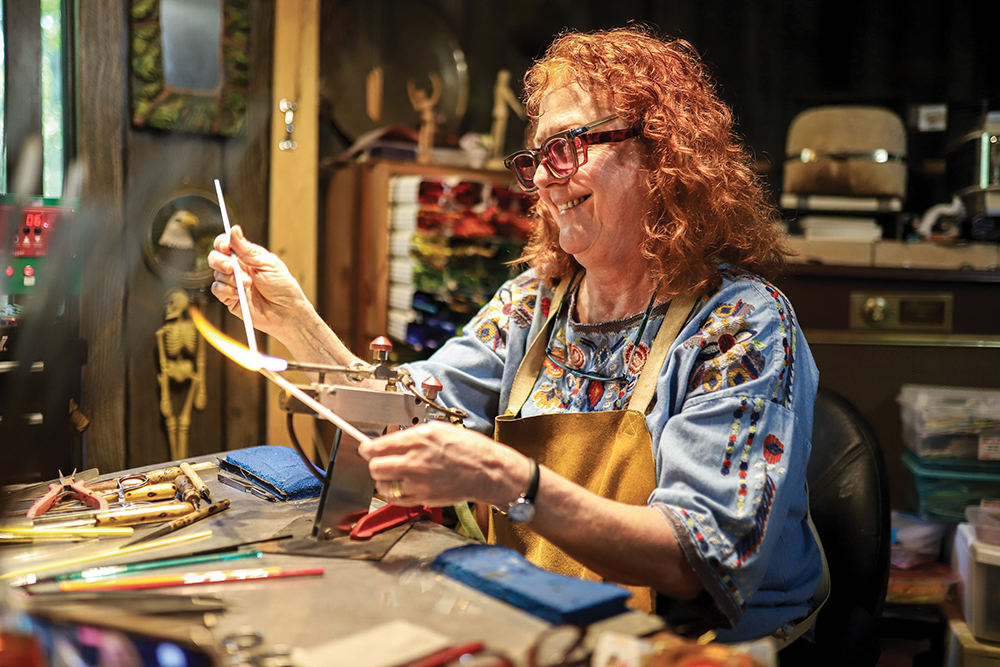 Staff photo by Olivia Ross / Susan Parry puts the finishing touches on a glass piece in her home studio.
“I wear a leather apron because glass can fall or fly,” Parry says. “I wear safety glasses because it helps me see into the flame … it cuts out that soda lime flare. If you’re exposed to that too long, it can cause retinal damage.”
The hazards of glass work include thermal shock, when something like a temperature change “shocks the glass.” This can cause little bits of glass to fly. “Sometimes, it even explodes,” Parry says, “and that’s dangerous.” Generally, she says, the flying bits feel “like a little bee sting” when they hit — but not always.
“I got burned pretty badly from a Bud Light bottle,” she says. The recycled blue glass had a lot of cobalt in it, which made it stiffer, according to Parry. “It started popping and shocking all over the place.”
Anyone who has been working with glass for a long time has these stories.
“Almost 20 years in glass has come with some burns, cuts and heat exhaustion,” Thomas says. “I had never really had a bad incident until last year.”
It only took a slight lapse in “spatial awareness,” as Thomas puts it, to bump a table and bring the glowing project, a would-be whiskey glass, into his hand.
“Being about 1,700 degrees at the time,” Thomas recalls, “it rolled off my hand to the ground and peeled the top layer of my hand with it.” Fortunately, his hand recovered.
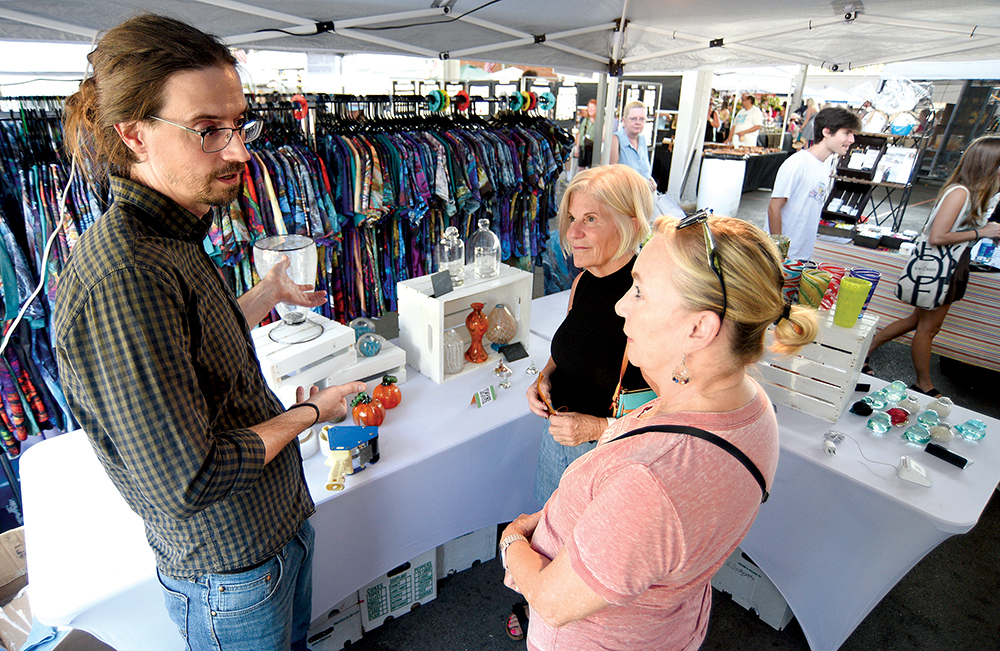 Staff photo by Matt Hamilton/ Artist Matt Thomas talks with Chattanooga resident Melinda Herrick, back, and her sister-in-law, Robin Herrick, at the Chattanooga Market.
Parry had a near meltdown in her studio with a new, but faulty, kiln. “I had all this melted glass all over the place. It almost ruined my kiln,” she says. She also mentions toxic smells as another danger of her art. Her workspace has a sliding glass door for the purpose, ever ready to open for better ventilation.
In addition to knowing the process and workspace by heart, glassblowing demands that the artist focus all their senses on what state the glass is in at any given moment.
“Say I’m sculpting a bird and I’m giving too much detail to the face,” Parry says. “If that tail doesn’t get its equal time, it will actually crack and break on me while I’m working on it.”
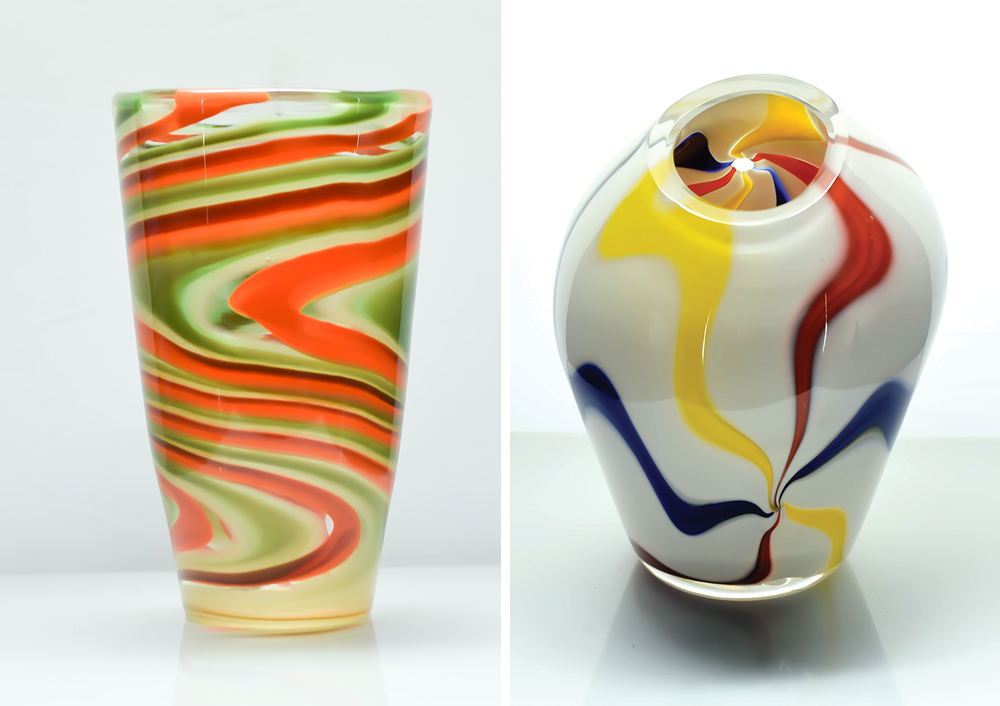 Works by glass artist Matt Thomas
Over time, Parry has developed an internal alert, a voice that tells her when to stop detail work and begin reheating the whole. This highly developed sense has served her well as burn prevention.
These artists enjoy working with glass for its versatility, possibility and beauty. And despite the danger, they love to experiment. “What surprises me and keeps teaching me new things is the material itself,” says Thomas. “Every day, you can get a little better craft, faster times and new ways to approach a form you’ve made for decades.”
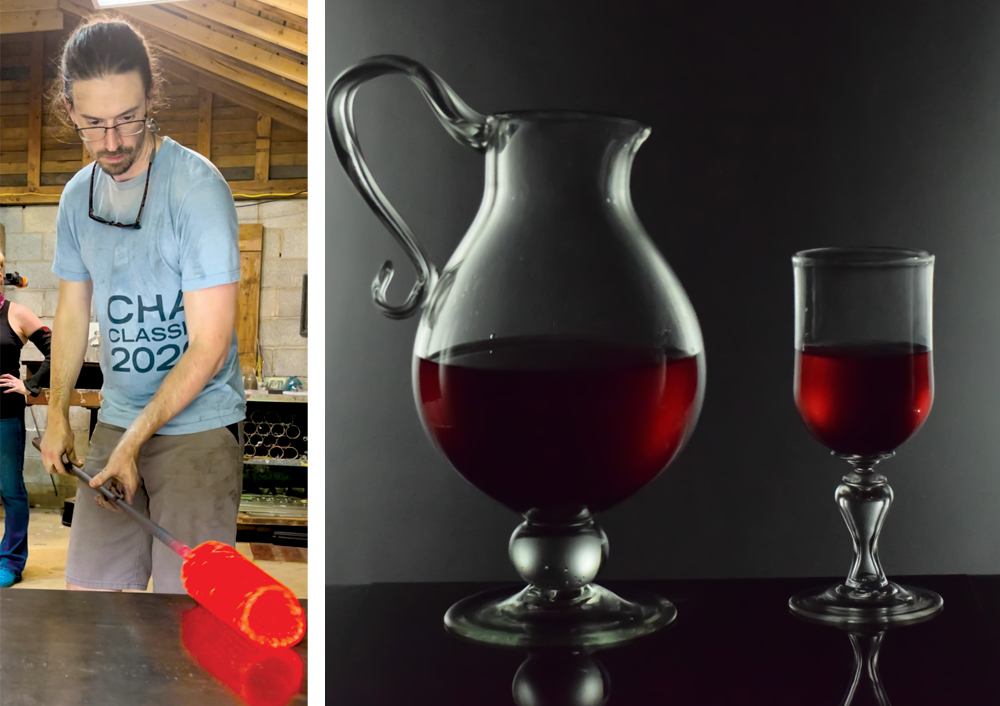 Photos contributed by Matt Thomas / Matt Thomas in his studio with some of his glass work