
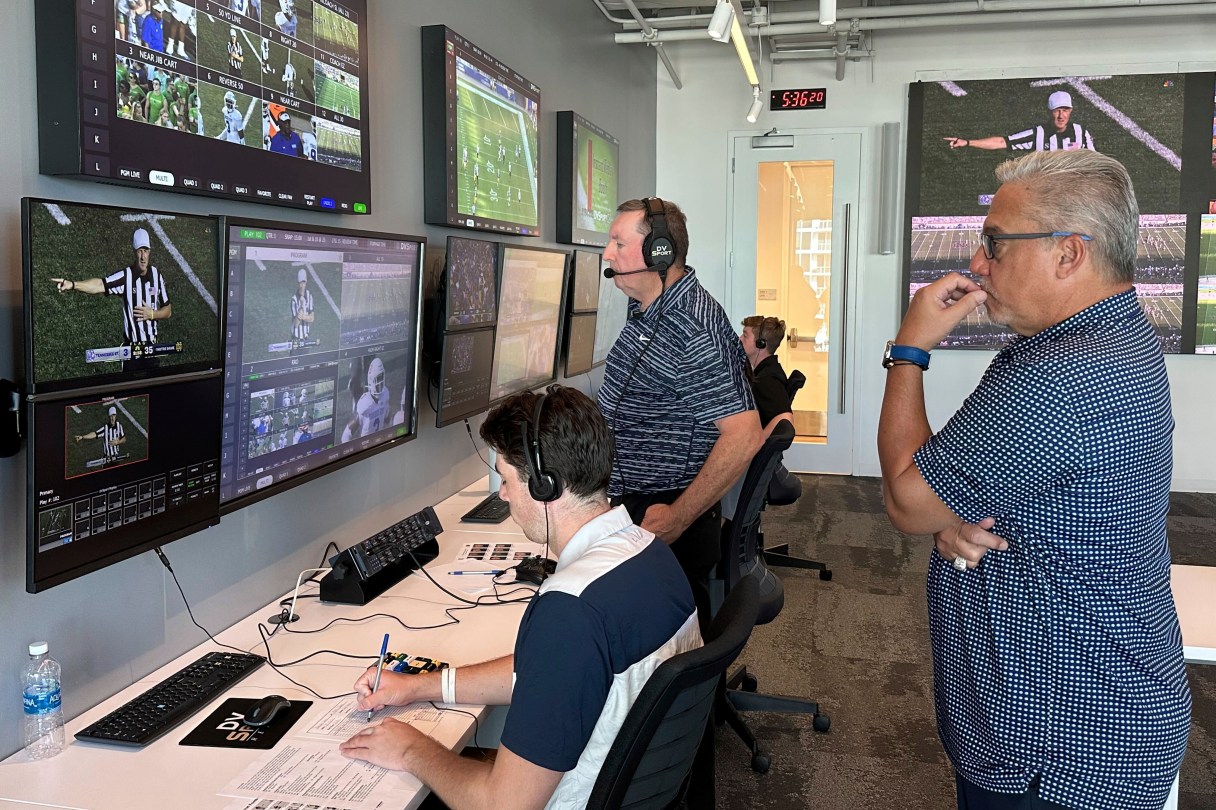
CHARLOTTE, N.C. — Video panels covered the wall with crisp, high-definition images of Atlantic Coast Conference teams playing on the season’s first full Saturday slate. Alberto Riveron watched intently, observing every detail possible as the league’s new supervisor of football officials.
That is, until one game stopped for a replay review.
Riveron moved across the room to join staff members pulling up replays and consulting with stadium officials on a targeting penalty. Moments later, a definitive replay angle appeared on a wall-mounted monitor, with the group studying and discussing the frame-by-frame sequence.
“That’s the only shot he needs to see,” Riveron said confidently as a staffer communicated via headset with stadium officials, who confirmed the call.
Every Power Five conference uses collaborative replay, which uses a centralized location to assist on-site officials. For the ACC, the game-day activity takes place in a tech-heavy center more than three times bigger than its predecessor, located in the league’s new headquarters in a downtown tower overlooking Bank of America Stadium, home of the NFL’s Carolina Panthers.
From Charlotte to Irving, Texas (Big 12) to Pittsburgh (Big Ten) to San Francisco (Pac-12) and Birmingham, Alabama (Southeastern Conference), the goal is the same: Make the right call and do it quickly.
“We’re not, in the middle of the third quarter, going to move the ball by a yard or a yard and a half, or put a second back on the clock,” Riveron said in an interview with The Associated Press. “Because again, players play, coaches coach and officials officiate. Down the line, we’re all going to make mistakes. It’s to catch the big mistake — the egregious mistake — and to stay consistent throughout the process.”
Seven years ago, the ACC and SEC used collaborative replay on an experimental basis and reported their findings to the NCAA rules committee, while the Pac-12 used it in limited fashion. Now it’s an integral part of officiating across the highest level of college football.
Steve Shaw, the NCAA’s national coordinator of football officials, said conferences track officiating accuracy and report rates exceeding 95% across all leagues. Data provided by Shaw or from the power conferences show replay reviews catch many of the incorrect calls that get through the on-field chaos in real time.
Off-site replay centers, Shaw said, work in a supporting role. Everything still starts with a stadium replay official stopping a game for any review.
“People think collaborative replay is this Wizard of Oz: smoking, all-knowing, all-being, stomping over everybody,” Shaw said. “Collaborative replay is actually the opposite of that. You let the replay official do their work. You’re monitoring everything. The only time you jump in is when things go down a wrong path or if they’re not considering a reviewable aspect of the play.”
For 2022, there were 820 plays overturned on replay review on 1,927 stoppages (42.6%) during the regular season and league championship games in the Football Bowl Subdivision (Division I’s upper tier of 133 teams, it includes not only the Power Five but the Group of Five and a handful of independent programs).
The power conferences’ collective average in 2022 — with some leagues limiting their data to the regular season but others including bowls — was similar at 44.5%. The Big 12 had the lowest average of that group at 34%, followed by the SEC (35.2%), Big Ten (46%), ACC (50%) and Pac-12 (54%).
Doing it quickly is another challenge.
In the ACC, Clemson coach Dabo Swinney wants “a good streamlined process” in each game, while North Carolina counterpart Mack Brown wants “more critical reviews in a shorter period of time.” For Shaw, the national goal is much more specific: Stay shorter than an average 2-minute mark, from review announcement to blowing the whistle to resume play.
The average FBS review in 2022 was 1:55. For the power conferences, four of five were in the 90-second range, while the Pac-12 was above but still near the target at 2:06.
Despite involving added voices in the process, Shaw said collaborative replay improves speed when it comes to reviews. It’s about having more eyes searching for the best available replay along with being a co-pilot to stadium officials in evaluating replays and walking step by step through rule interpretation.
“Many, many reviews end with the replay official in the stadium leading the entire process, collaborative replay officials listening in,” said John McDaid, Shaw’s successor as SEC coordinator of football officials. “And at the end just having a simple, ‘We good?’ And the collaborator says, ‘Yep.’ And we move on.”
That’s Riveron’s goal, too, back in the ACC.
He worked as a college and NFL on-field official, eventually becoming the NFL’s senior vice president of officiating. The ACC announced his hire last November while it was preparing to move within North Carolina from Greensboro — the city where the conference was founded in 1953 — to Charlotte.
The ACC is putting finishing touches on its headquarters, but the game-day center is full go. The eye-catching piece is that 140-square-foot display capable of showing 16 different video feeds at once on the front wall, while multiple video stations line each side of the room. At the back of the 1,216-square-foot space are windows overlooking downtown Charlotte, quite a change from the windowless 365-square-foot space in the former headquarters in Greensboro.
The new facility can handle up to 10 games simultaneously and take four video feeds from every ACC stadium as well as football independent Notre Dame — a league member in other sports — compared to one previously. There’s also space for training, all part of what Riveron proudly proclaimed “the best command center in the country.”
These days, it’s required equipment.
“We cannot shy away from technology; we’ve known over the years that replay has expanded,” Riveron said. “We’ve got to make sure that we maneuver it and we steer replay in the right direction, to not be intrusive on the game but to be an add.”