
(Editor’s note: Fourth in a series)
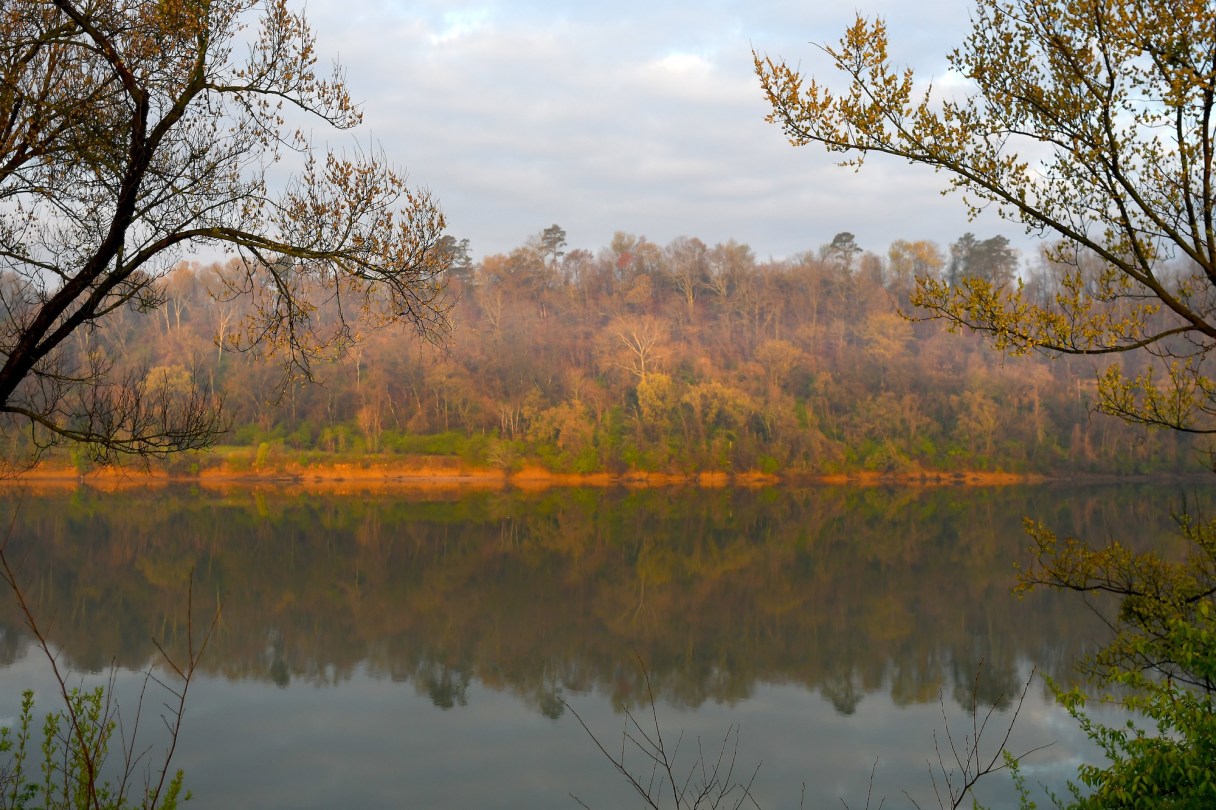
Long closed to the public, Stringers Ridge on Moccasin Bend offers a remarkable array of wildlife, panoramic views, wagon roads and trails, and well-preserved vestiges of the Civil War. All of this will welcome visitors once the full National Archeological District opens up — without the mental hospital and firing range on site.
Stringers Ridge’s Civil War history is notable. Federal occupation of the high ground became necessary when the Union Army retreated into Chattanooga after its defeat at the Battle of Chickamauga. National Park Service Historian Jim Ogden wrote in a 2013 Local History column: “While Confederates gained Lookout Mountain [and] cut the enemy’s supply route, the region’s unique geography played into the Federal’s hands. The hairpin bend of the Tennessee caused by the river encountering the mountain [at] Moccasin Point, as it was known in 1863, offered an opportunity, and Union army commander Gen. William Rosecrans was quick to recognize it. The fire of those guns could make Confederate movement up and over [Lookout] mountain hazardous and more difficult [and] make any Confederate stranglehold on Chattanooga weaker.
“Federal troops and artillery were ordered to Moccasin Point. The cannon were the four 10-pound Parrotts [accompanied by six three-inch ordnance rifles.] Fortifying themselves on three hills at the southern end of Stringer’s Ridge less than a mile away from the northern tip of [Lookout] mountain, the batteries opened fire on October 5 and quickly made their presence felt. By being able to fire on the roads leading over the mountain, they dramatically reduced the quantity of supplies reaching Confederates in Lookout Valley.” This forced fewer rebel troops in Lookout Valley and led to Federal seizure of Brown’s Ferry, which opened the Cracker Line to feed the besieged Yankees in downtown Chattanooga.
The National Park Service’s January 1999 Cooperative Management Plan commented: “During the Civil War, access roads were driven up and down the knobs of Stringers Ridge, cannons were dug in behind massive earthworks, and a network of rifle pits and bivouac facilities were built.” Over two months of near continuous artillery exchange, 2,000 infantrymen occupied the site. The resulting Union positions are some of the best preserved in the nation.
Visitors to the Ridge will also be able to stroll, hike and jog on its many wagon roads, paths, and trails including those left over from Native American habitation and Union occupation. Their outings will take them to the spectacular panaromic vista above the Tennessee River that encompasses the North Shore, three bridges, the Tennessee Aquarium, downtown Chattanooga, Lookout Mountain and the river gorge.
The heavily wooded ridge with its canopy of evergreen and deciduous trees includes enough pines, oaks, hickories, tulip poplars, elms and ashes for squirrels to leap from limb to limb and rarely touch ground. For people who don’t want to go up on their own, park rangers will escort. Ornithologists can hear a symphony of chirping from scarlet and summer tanagers, red-eyed vireos and indigo buntings augmented by the cacophony of crows. Now and then a flock of turkeys will cross the trail, while hawks and an infrequent bald eagle will soar overhead. Deer often bound; possums, groundhogs and raccoons scurry away. All in all, visitors to the Ridge will come upon a panoply of wildlife at our city’s doorstep and find it delightful and enriching to connect so directly with Mother Nature.
The road to full national park status for Moccasin Bend has been long and tortuous. Industrialists debated the peninsula’s future with garden clubs and preservationists throughout the 1930s and 1940s. The contention helped lead to federal legislation in 1950 authorizing the donation of up to 1,400 acres for a Moccasin Bend National Park. That initiative collapsed in early 1953, when the state failed to write a $100,000 check to purchase the necessary land. Then in 2003, U.S. Rep. Zach Wamp achieved designation of the Moccasin Bend National Archeological District. But 20 years later the presence of two non-conforming uses, the mental health hospital and the firing range, effectively keeps most of Moccasin Bend’s amazing assets closed to the public.
The Tennessee Department of Mental Health’s new plan to rebuild the hospital on the peninsula greatly complicates the rollout of the national park. We citizens must urge our legislative delegation to support moving the hospital and the firing range to more appropriate locations and achieving the best for Moccasin Bend — and all of us.
Frank “Mickey” Robbins, a former chairman of the Moccasin Bend Mental Health Institute, currently serves on the board of National Park Partners.