
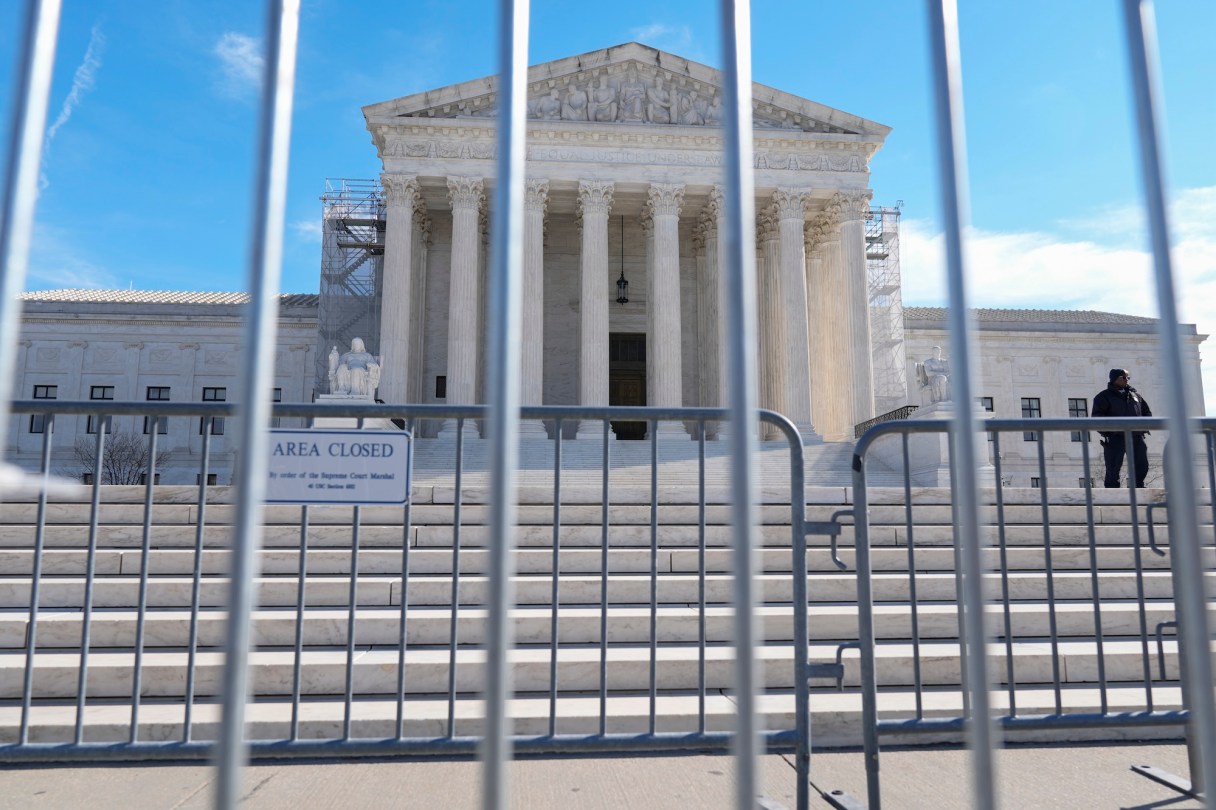
It just got harder for the Supreme Court to save Donald Trump from criminal prosecution for his involvement with the violence at the Capitol on Jan. 6, 2021. In a straightforward opinion, a unanimous panel of the U.S. Court of Appeals for the D.C. Circuit rejected Trump’s claim that a former president should be immune from being prosecuted criminally for conduct undertaken while in office.
When the case goes to the Supreme Court, as it almost certainly will, the justices won’t be able to reject the appellate court’s common-sense conclusions with a straight face. And the issues are so straightforward that it would be embarrassing for the high court to delay long enough to push Trump’s criminal trial until after November’s election — after which, if Trump wins, he could dismiss the charges.
In rejecting Trump’s immunity arguments, the D.C. Circuit panel, made up of two Democratic appointees and one pre-Trump Republican, went back to the basics of American constitutional law. The court cited Marbury v. Madison, the great granddaddy of all constitutional decisions. In that 1803 case, the Supreme Court first held that it had the authority to consider the constitutionality of congressional acts.
In Marbury, Chief Justice John Marshall stated that when Congress imposes specific duties on the president, he becomes “the officer of the law” and “is amenable to the laws for his conduct.” From this it followed, said the D.C. Circuit, that a president who violated criminal laws laid down by Congress could not claim that his status as head of the executive branch gave him a free pass to violate those laws.
For good measure, the court quoted a later Supreme Court opinion, U.S. v. Lee, which explained that “no man in this country is so high that he is above the law.” The law, that 1882 opinion stated, “is the only supreme power in our system of government.” It would be hard to find more ringing endorsement of the principle of the rule of law. The D.C. Circuit was making the point that, by claiming immunity, Trump was trying to set himself up as above the law, thus violating the most basic principle of legality itself.