
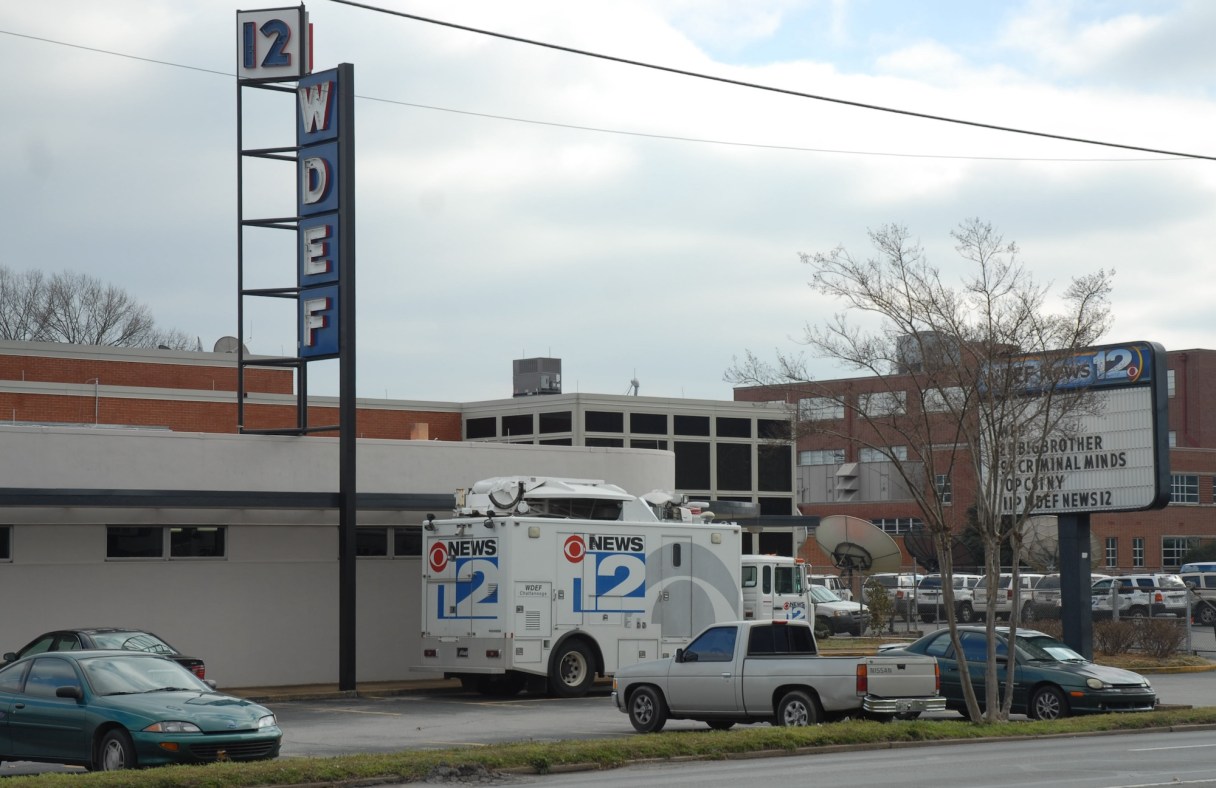
Once acquiring a joint license for Chattanooga’s WDEF-TV in the mid-1950s, President Carter Parham assumed management of the city’s first television station. He immediately reached out to Harold “Hap” Anderson from Lincoln, Nebraska, and offered him the position as station manager. The two men had met at an industry trade show, and Parham was impressed by Anderson’s combined technical knowledge and management skills. Anderson arrived in Chattanooga with Otis Segler, sales manager. Completing the management team were Dave Anderson, production director; Rich Miller, staging director; Dick Phipps, continuity director; and Emory Williamson, art director.
Before the official “flipping of the switch,” Phipps explained during a news conference that the decision to follow Anderson had been an easy one for the team: “He’s liked by everyone who meets him. So why did we all move to Chattanooga? Hap asked us to.” Morris Quave, program director, echoed Phipps’ comments. Anderson had arrived in late January, and the two had been working closely for three months. “With the assistance of these men and the other members of the staff …,” he said, “we’re going to try and give Chattanooga the best video entertainment we possible can.”
And it was an impressive local team assembled to bring WDEF-TV on-air. Many of the names are recognizable to early viewers: B.C. Baker, chief engineer; Robert Briscoe, studio supervising engineer; Mort Lloyd, news director; Luther Masingill, chief announcer; Herschel Nation, sports director; Drue Smith, public affairs director; Hal Siegel, local news director; and Jim Hill, weather news reporter.
One of WDEF-TV’s most interesting new programming models was created due to a Federal Communication Commission directive requiring that all stations operating on a noncommercial, nonprofit basis provide “educational and cultural” content. In addition to the public affairs programming that Drue Smith provided, the format for Chattanooga’s first “kiddie program” had already been created.
Each day 5-5:30 p.m., Monday through Friday, “Chickarooney and Friends” provided educational entertainment designed for children ages 3-6. After interviewing 10 prospective “on-air personalities,” Mrs. Jack McCune was chosen mistress of ceremonies. Before moving to Chattanooga with her family in 1949, she had worked in radio in Boston, Philadelphia and Milwaukee. Locally, she originated a Chattanooga radio program sponsored by the Humane Education Society, in which “Aunt Prattle” entertained young listeners with stories featuring the antics of adventurous “critters.” A second story-telling series, broadcast by WDEF radio, known as “Beaver Tales,” was added within the following year, sponsored by the Junior League.