
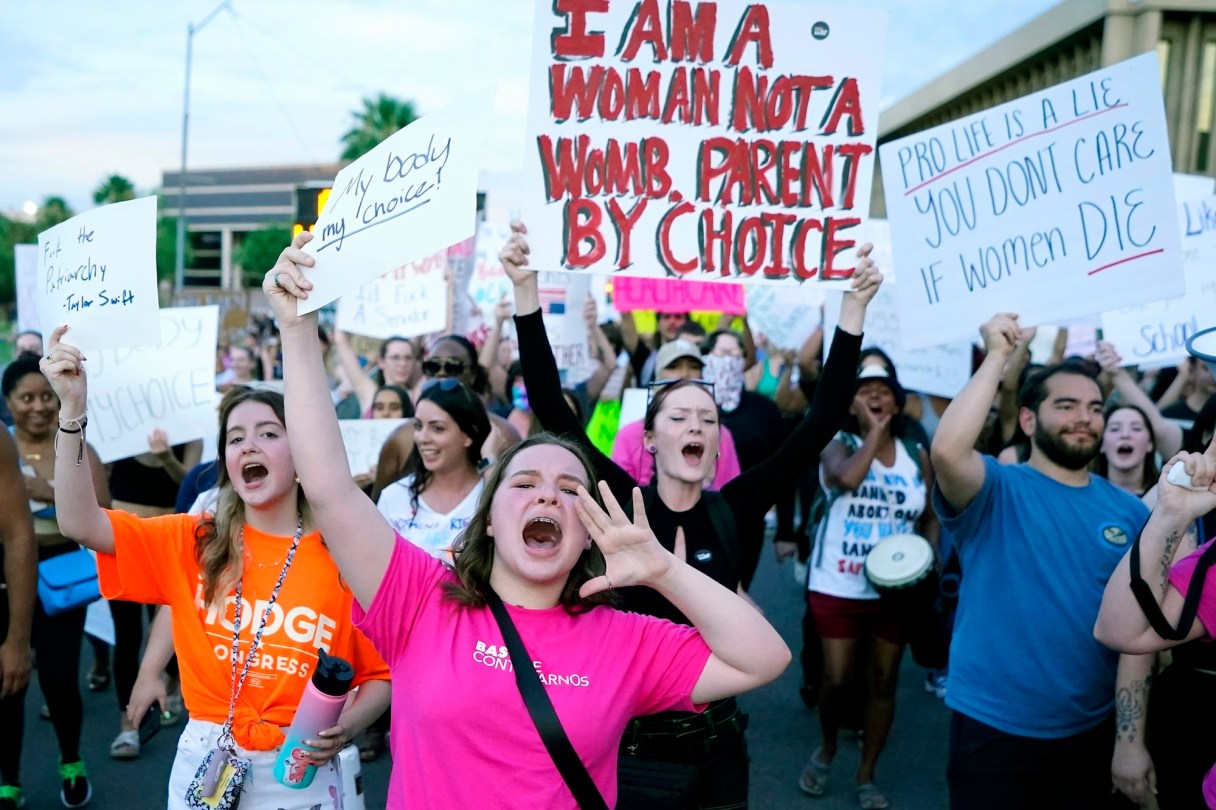
I am 19 weeks pregnant, a legal scholar and a resident of Arizona, whose highest court last Tuesday upheld a 160-year-old law banning nearly all abortions, even in the case of rape or incest. In doing so, the court held that Arizona’s 2022 law, which allowed abortion up through 15 weeks into pregnancy, was no longer valid after the Supreme Court struck down Roe v. Wade that same year.
Many have already explained the obvious legal and common-sense deficiencies in the majority opinion. Even some pro-life advocates have opposed the absolute ban for going too far.
Perhaps most powerful among these criticisms is that the law at issue was passed in 1864, decades before women had the right to vote and Arizona existed as a state. And as the dissenting justices persuasively argued, the majority opinion erred in not reconciling the 2022 law with the pre-statehood law. The court’s decision declines to leave “both fully intact and operative,” even though it could have interpreted the 2022 statute as an exception or amendment to the 19th-century one, continuing to allow physicians to provide this health care through 15 weeks without incurring criminal penalties.
After reading the decision, however, I realized that I had been unconsciously clutching my stomach — a sign that my objections went beyond legal analysis. I understood then that I was not just analyzing the court’s words as an academic. I was feeling them as a pregnant person in Arizona.
Three out of the four Arizona Supreme Court justices who issued the decision are men. They will not have to feel the loss of personhood that I and so many other Arizonans felt Tuesday morning. They will not have to plot a trip across state lines to access health care they may need. They will not be forced to set aside their bodily autonomy. And they will not be forced to choose what could be an agonizing life for their unborn child.