
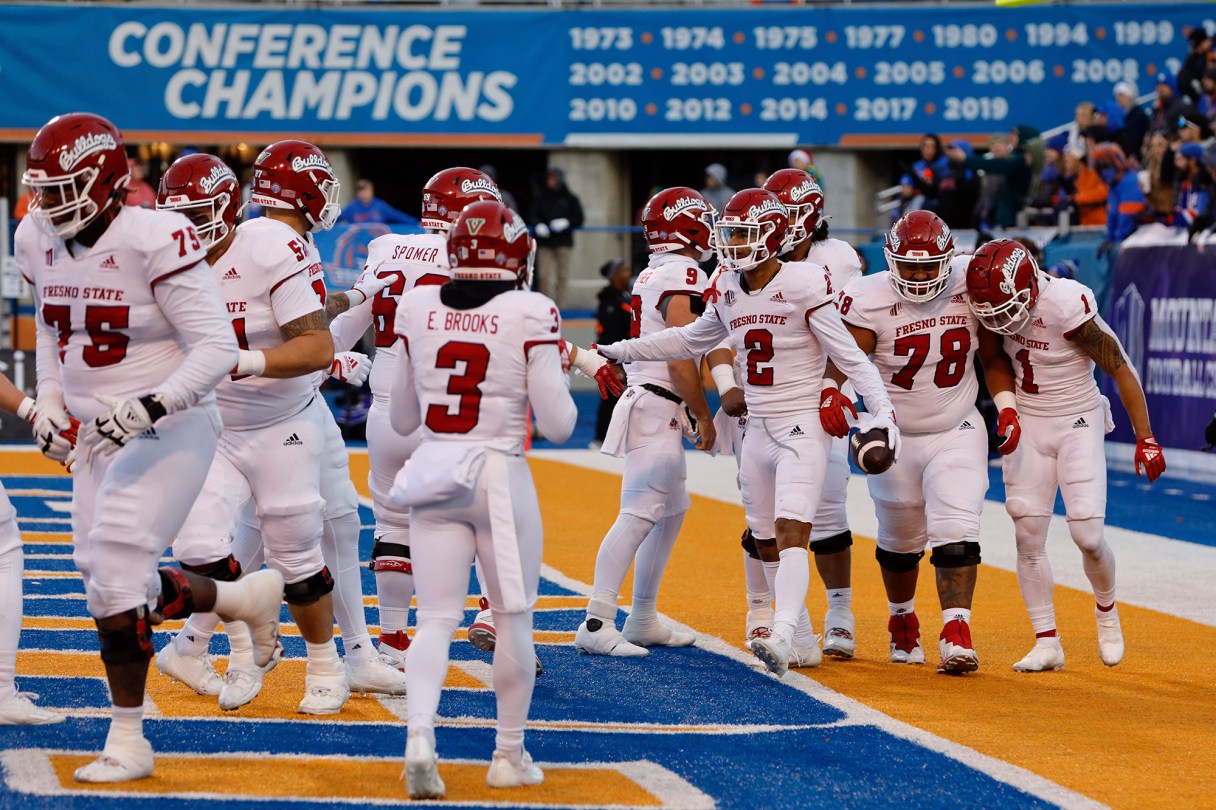
SCOTTSDALE, Ariz. — A postseason tournament involving only programs from inside the Football Bowl Subdivision but outside the power conferences could work only if it doesn’t interfere with the 12-team College Football Playoff, the commissioner of the Mountain West said.
Gloria Nevarez told the AP she has seen the presentation that has been making the rounds among Group of Five administrators about a G5 playoff of sorts that would be funded by private equity, but she has not personally been pitched on the idea.
“Certainly real. Certainly intriguing,” Nevarez said Wednesday night after the Mountain West spring meetings wrapped up in Scottsdale. “We are committed to the CFP. Anything would have to be significant enough to even think about stepping away from the CFP.”
The nine FBS conferences and powerful independent Notre Dame locked in an agreement on the CFP earlier this year that runs through the 2031 season. The playoff will be a 12-team event this season and next, and it could expand to 14 as soon as 2026.
The deal guarantees the five highest-ranked conference champions, regardless of league, will have a spot in the field. That should lock in the winners of the Power Four — the Atlantic Coast, Big 12, Big Ten and Southeastern conferences, with the depleted Pac-12 out of the picture for now — plus the best champ from the Group of Five — Conference USA and the American Athletic, Mid-American, Mountain West and Sun Belt conferences.
“The piece that’s really most important to us is that access piece. The five and seven,” Nevarez said, referring to the seven automatic bids and five conference champions that will make up the field.
The Mountain West commissioner was not as happy with the revenue distribution agreement for the new CFP deal, which leaves her schools making about the same amount (around $1.8 million) per year as they were in the previous four-team CFP, despite the total value of the system more than doubling to $1.3 billion annually.
“We were all disappointed in the financial outcome of the CFP, no doubt,” Nevarez said. “But that aside, we’re very excited collectively as a league that the enterprise stayed together, that we have the access.”
San Diego State athletic director J.D. Wicker, whose team has played for three Mountain West titles and won two since 2015, said with two years left on the current CFP agreement there are too many other challenges facing college sports to consider a new postseason model.
“We feel like we can go and be competitive. Are we going to win a national title in football? Probably not. But can we get into the playoffs and win a game or two? Yeah, absolutely,” he said Thursday.
A G5 tournament might not replace access to the CFP, but it could become a new element to the postseason that gives the conference champions that don’t make the 12- or 14-team field the football equivalent to college basketball’s National Invitation Tournament. It could possibly even incorporate some lower-tier bowl games.
Incoming AAC commissioner Tim Pernetti said last month at his introductory news conference he was interested in exploring new postseason opportunities. Anything that totally separates the G5 from the P4 will be a hard sell, though.
“I think any new idea that can enhance the excitement around college football’s postseason is worth discussing. The idea of a G5 (playoff) is something that at this point, I don’t sense a lot of enthusiasm for from the leadership of those conferences,” said Nick Carparelli, the executive director of Bowl Season, the organization that advocates for bowl games. “I’m not going to speak for them, but what I’ve heard is there is there’s one playoff and it’s the CFP, and that’s what they’re aspiring to be a part of.”