
“Fairness is more important than freedom. Do you strongly agree, agree, disagree or strongly disagree with this statement?” As my students entered the classroom one day last month, they were presented with this prompt and asked to write a short response.
Once their written responses were complete, I assembled them along an invisible spectrum at the front of the room. Those who strongly agreed stood farthest to the left, near the window where my first-block classes watch the sun rise over White Oak Mountain. Those who strongly disagreed stood near my desk on the opposite wall, and those with more moderate views gathered in between the two extremes.
Not surprisingly, most of the students in each class posted themselves along the right end of the spectrum, indicating their view that freedom is more important than fairness. In one class, though, a lone student (whom I will call Kelly) bravely took a stand on the left. When I asked Kelly to explain her stance, she used homelessness as a case in point. Shouldn’t people at least have a place to live, she asked. Isn’t it important to see that everyone as least has that basic need met? Kelly also pointed out that, as of July 2022, sleeping on public property, including in public parks and under bridges, is now illegal in Tennessee. Why should people without shelter be punished instead of helped?
I’m sure that if everyone in the room were given the opportunity to respond to Kelly’s argument, several complex and divergent views would have emerged. As it was, the gist of the view from the most vocal students boiled down to this: Homeless people are to blame for their seemingly unfair situation. They made decisions — took drugs, committed crimes — that caused them to lose their homes and get evicted. While I did not agree with this opinion, I also did not feel prepared to respond to it in a constructive way.
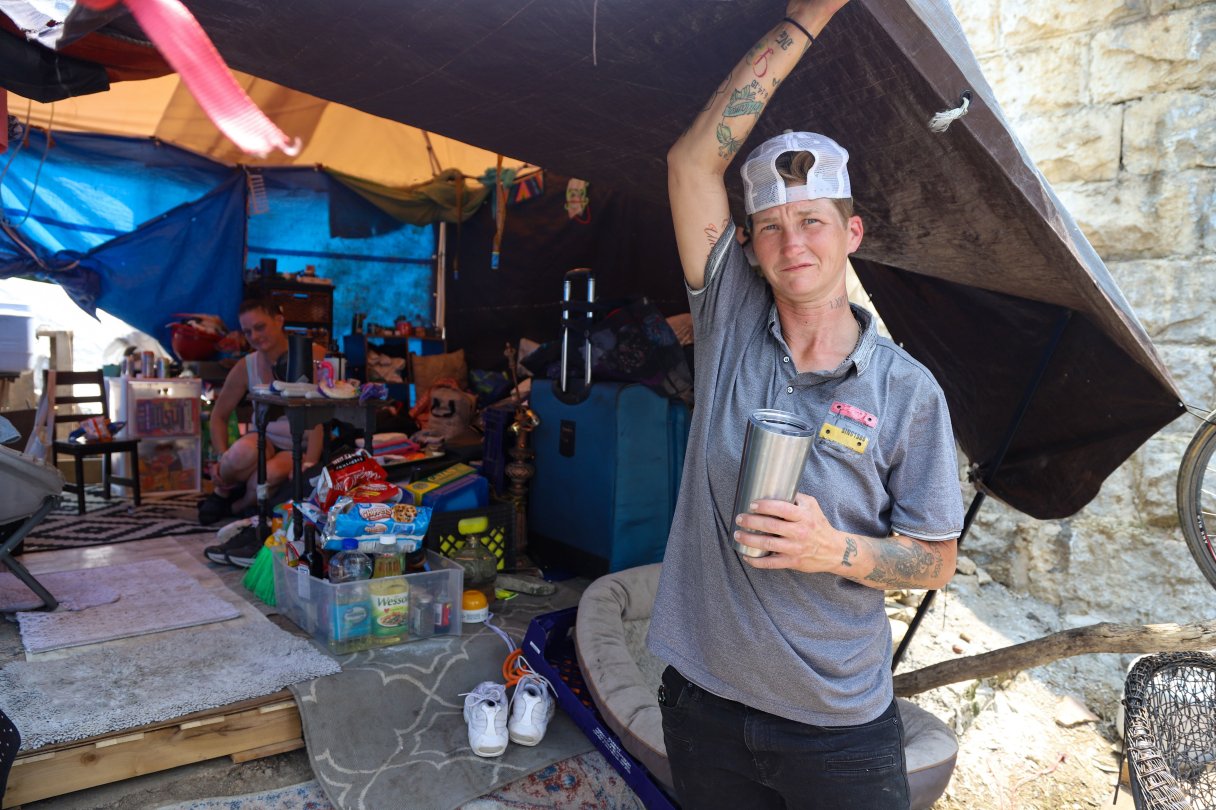
So when I interviewed Niki Keck and Ann-Marie Fitzsimmons of Help Right Here a couple of weeks ago, I was eager to hear their thoughts. These two women, whose unity of purpose is so strong that they see themselves as one person, work with and for the homeless community in Chattanooga. Both former educators at Chattanooga School for the Arts and Sciences, Niki and Ann-Marie began working together in 2017, and two years later, after producing a documentary on homelessness with some of their students, they formed Help Right Here. In 2021, they visited Seattle and were inspired by the city’s “sanctioned encampments, transitional villages and permanent, supportive housing.” When they returned, the city of Chattanooga gave them the opportunity to manage an encampment at 12th and Peeples Street, which they ran until earlier this year.
With the recent closing of the camp and successful housing of most of the camp’s residents, the work of Help Right Here has shifted to post-housing support. One of the things that both Niki and Ann-Marie stressed when I spoke with them was the lack of family or other social support that many homeless people experience. Without such support, Niki says, it is easy to fall between the cracks when life gets difficult. “Maybe we experience a terrible accident and end up in the hospital, and during that time we can’t pay our medical bills or house payments, and we lose our place and end up on the streets because we have nobody to take us in.”
Of course people sometimes make poor decisions, she says, but that is not the primary reason that people end up homeless. “A lot of people are born behind the eight ball,” Ann-Marie adds, “so they’re having to claw their way out from the start.” The work of Help Right Here is to be the family that people on the streets need, to follow them through the cracks and help them find their way back out.
One of the more frustrating misconceptions about the homeless community, according to Ann-Marie, is that they are lazy. To emphasize the drive and resourcefulness of many of the homeless people she and Niki know, Ann-Marie says, “If there is ever a zombie apocalypse, that’s who we’re going with.” On a more serious note, she explains that criminal records — which, as my student pointed out, can be earned simply by sleeping on public property — and lack of money for transportation present significant barriers to employment. “They’re trying,” she says.
Niki agrees. “They’re survivors,” she says. “But I also think it’s important to remember that they are just like you or me. They have the same needs and wants. They’re humans. I think people forget that.”
To learn more about and support the work of Help Right Here, go to helprightherechattanooga.org or search Help Right Here on Facebook.
L.B. Blackwell is a high school English teacher who lives in Chattanooga with his wife and two daughters. Email him at themundaneway@gmail.com.