
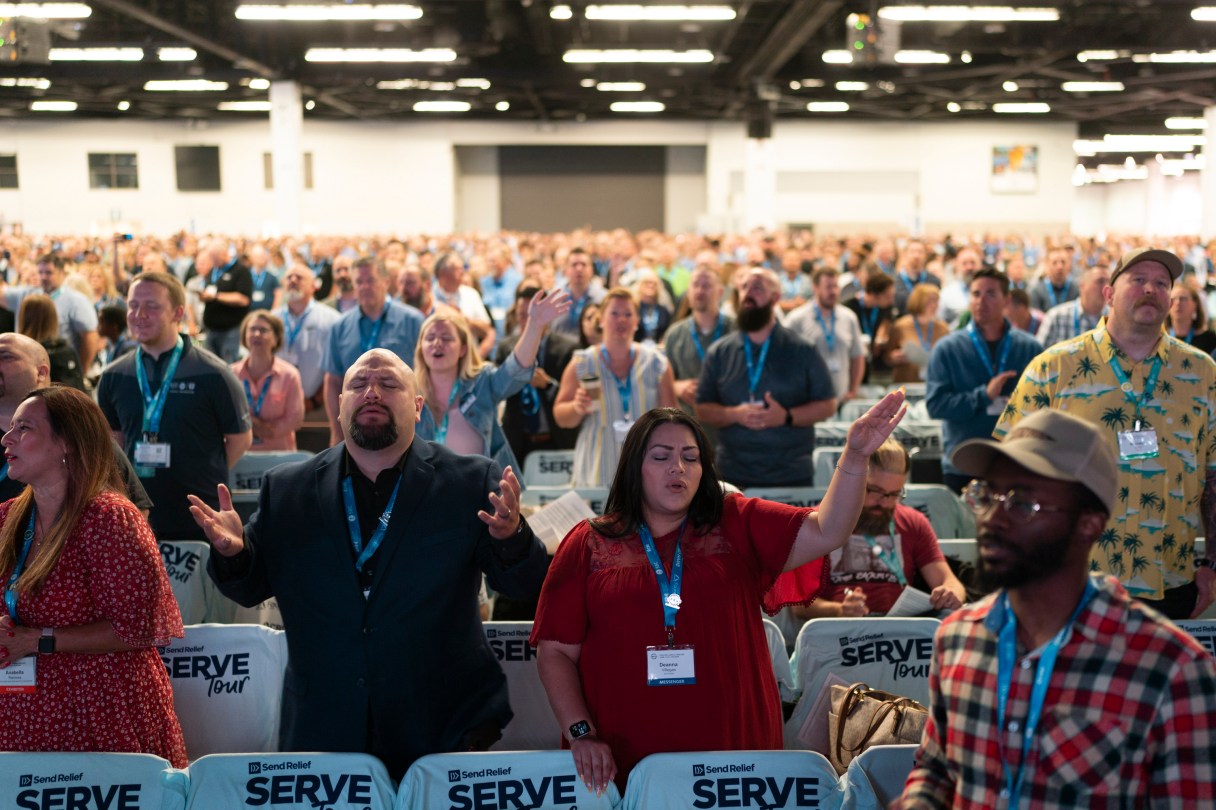
On this, top patriarchs of the Southern Baptist Convention agree: The Bible, which is the inerrant word of God, makes clear that even as women have much to offer, they have little to no place behind the pulpit.
What the men disagree on, however, is how vociferously to state that view and how narrowly to enforce compliance with it inside their aging and shrinking Southern Baptist tribe.
(READ MORE: Southern Baptist membership continues to shrink)
In an upcoming vote that pits the religious group’s strong tradition of local church autonomy against a potent desire to stand against liberal drift, Southern Baptist delegates will decide whether to amend their constitution to state explicitly that only churches with solely male pastors of “any kind” are welcome in their ranks.
The Baptist Faith and Message, with which Southern Baptist churches are supposed to closely identify, has for more than two decades said the office of pastor is limited to men.
Yet some have wondered if that limit only applied to “lead pastors.” Today, even as churches push the boundaries of many aspects of that confession, (which also says, for example, that “the church should not resort to the civil power to carry on its work”), the female pastor debate in particular has approached a boil, as some Southern Baptist congregations give women pastor titles and roles, while an ultraconservative faction says its rejection of that practice is rooted in unambiguous passages of the Bible that leave no room for debate.
(READ MORE: Growing number of Southern Baptist women question roles)
Though it bears little resemblance to more centralized Christian denominations, the Southern Baptist Convention, the nation’s largest Protestant group, was for a time the epicenter of Southern religious life. It remains to many the face of the evangelical movement in America, even as nondenominational churches grow in influence.
By pooling resources of local churches, the convention seeks through a sprawling collection of entities — seminaries, mission groups, a retirement plan, a policy arm — to help local Baptist churches accomplish what they could not do alone, as they collectively seek to bring the word of Jesus to the world.
Backers of the Law Amendment say the notion of women pastors represents an intolerable corruption of that holy word. Those who oppose it, however, say this is a lower-order issue, open to debate, and certainly not worth dividing over.
A key divide has emerged nonetheless. Last year, the convention overwhelmingly voted to affirm the ouster of congregations, including its legendary Saddleback Church, for having a woman pastor. And at a gathering in Indianapolis, which begins June 9, delegates will make their second — and thus binding — vote on the proposed Law Amendment, which could result in the departure of scores more churches and has become a partisan litmus test among outspoken Southern Baptists.
“How do you decide who’s in what camp in the SBC? That is the dividing issue right now,” said Ryan Burge, a pastor and political scientist who has written several books on contemporary religious trends, in a recent phone interview.
While the Roman Catholic Church retains its all-male priesthood, many Christian denominations allow and celebrate women pastors. And the very existence of the debate sticks out in an American society where, according to a 2020 Pew Research Center study, most adults believe women’s rights have not come far enough.
Obstacles to gender equality, respondents said, included diverging social expectations for women and men, and an absence of women in positions of power.
Many Americans, of course, also don’t see the Bible as a source of moral authority and chaffe at passages that say things like, “I do not allow a woman to teach or exercise authority over a man, but to remain quiet.”
But even within the Southern Baptist Convention, where the Bible is regarded as God’s revelation of himself to man and a perfect treasure of divine instruction, some find the women pastor debate misguided.
Ronnie Phillips Jr. is the senior pastor of the Hixson megachurch Abba’s House, which has female pastors — who preach, officiate weddings, make hospital visits — and a charismatic streak that distinguishes it from most Southern Baptist-affiliated congregations.
He said he’s grown disillusioned with the Southern Baptists Convention, which he believes failed to fully address its past racism, sexual abuse scandals and its mistreatment of charismatic Christians over the years. Yet he maintains ties because he believes Southern Baptist missions are worthy and because of his affinity for the state and Chattanooga-area Baptist associations.
In a phone interview, Phillips said he believes the Bible makes clear that a church’s lead pastor should be a man, but by email he sent an array of Scriptural citations that to him establish firm basis for women pastors.
“I just can’t believe, honestly, the Baptists are still arguing about this in 2024,” he said.
CRUCIAL STAND
Dennis Culbreth of the Hamilton County Baptist Association did not respond to a call or email seeking comment, and several Chattanooga Southern Baptist pastors told the Chattanooga Times Free Press they are not sufficiently familiar with the Law Amendment debate to offer an informed view, nor are they particularly plugged into the affairs more generally of the Southern Baptist Convention.
Yet to outspoken activists around the nation, making their case on Baptist media, behind pulpits and in seminary halls, the amendment marks a crucial stand against a secularizing U.S. culture that has become profoundly confused about gender roles — which they see as an essential basis of God’s plan for humankind.
The debate is not new. Spurred on by the feminist movements of the mid-20th century, some Southern Baptist institutions were ordaining women decades ago, said James Hudnut-Beumler, a Vanderbilt University religious historian.
But, he said in a phone interview, a potent backlash against those and other liberalizing tendencies coalesced in the ensuing “fundamentalist takeover,” in which ultraconservatives moved, with considerable success, to remake a vast religious association in their image, chasing out many moderates in the process.
As an active participant in that takeover and co-author of the Baptist Faith and Message 2000 — which unlike previous versions of the confession stated explicitly that the position of pastor was reserved for men — longtime Southern Baptist Theological Seminary President Al Mohler stands today as a kind of godfather to those who carry on that movement.
“I think we all know that in an increasingly secular society, all kinds of pressures are going to continue to come up against us, which means that Southern Baptists are going to have to be more clear about doctrine and about what we believe the Bible clearly teaches than was the case in the past, ” Mohler said in a recent video in which he sought to marshal support for the Law Amendment.
“We’re having to say things out loud that previous generations of Southern Baptists didn’t even have to say,” he added. “One of the things we have to say is that the office of pastor is limited to men as qualified by Scripture.”
That crucial point, Mohler said, has been forced by churches that do not bother to hide that they are out of sync with the Southern Baptist Convention on the issue.
And while, he said, the convention could not force any congregation to do anything — those that did not want to abide by the rules could leave — it did have the responsibility to clearly establish the boundaries within which its churches could cooperate.
MUCH UNCLEAR
Ties to the Southern Baptists are upheld by a volunteer committee tasked with assuring the convention seats members of churches that are in “friendly cooperation” with the body.
The Law Amendment would give that committee guidance to affirm only the ties of a church that “affirms, appoints or employs only men as any kind of pastor or elder as qualified by Scripture.”
Ultraconservatives said the amendment seeks to clarify how the Baptist Faith and Message should be applied. Yet in a church network in which women play all sorts of ministry roles, much remains unclear about what real-world effect that narrow, forceful interpretation of the confession would have.
The convention said it has ties to roughly 50,000 churches. In a recent article, its press arm noted a June 2023 report finding that, from a “randomized” sample of 4,000 of those churches, roughly 100 had female pastors of some kind.
The vast majority of those women were in an associate role, such as youth pastor or pastor of music and education. Some Law Amendment proponents have said it would not ban women from such roles, but the measure’s “any kind of pastor” wording has left others doubtful.
In a recent opinion article published by the Baptist Press, Jeff Iorg, the new president of the Southern Baptist Convention’s executive committee, noted ongoing confusion over whether the proposed amendment is meant to apply to the “title” of pastor — which he said a church could superficially change by calling a woman pastor a “minister,” for example — or the “function” of pastor, which he said raises other enforcement and governance questions.
Either way, he said, the measure would force an interpretation of a doctrinal statement that may result in the exclusion of hundreds of churches and the alienation of others.
“Multiple pastors have told me that while they are not formally leaving the SBC over this issue, they are quietly disengaging,” Iorg wrote. “They are too focused on the demands of pastoral ministry to participate in denominational infighting over something they do not perceive as worth the battle.”
Iorg said he personally believes pastors should be men and has carried out that belief in his work planting churches. Yet he said the Southern Baptists were more diverse than many realized; conventionwide, he wrote, congregations take an array of approaches to baptism, church governance and the relationship between church and state, which in some cases seems to put them out of alignment with the Southern Baptist confession.
Such issues seem more important than the female pastor debate, he wrote. Yet Southern Baptists seem willing to tolerate diversity on those matters.
Tennessee Baptist Mission Board President Randy Davis describes himself as a firm complementarian — a reference to the belief that God intends distinct but complimentary roles for men and women — and he said he affirms the Baptist Faith and Message passage on male pastors, adding he believes it speaks to the senior pastor role.
Citing the convention’s rejection last year of churches with female lead and campus pastors, he doubted the Law Amendment was necessary.
“We are not on the slippery slope of liberalism,” he wrote.
Moreover, he added, the measure risked imposing a creed on Southern Baptist churches, threatening the convention’s prized value of local church autonomy.
“The Law Amendment brings the SBC to the brink of becoming a legalistically narrow road that chokes participation rather than being a Great Commission superhighway promoting missions and traveled by churches of all sizes and cultures,” he wrote, urging readers to zoom out and consider what he said was a more reasonable perspective.
“We must collectively and cooperatively mobilize if we are to be a part of seeing some from every tribe, tongue and nation come to faith in Jesus Christ,” Davis wrote. “We must lay hold of God’s Great Commission vision that unites us and drives us into a spiritually lost world.”
Got a news tip?
Contact this reporter at aschwartz@timesfreepress.com, or the newsroom at news@timesfreepress.com.
Contact Andrew Schwartz at aschwartz@timesfreepress.com or 423-757-6431.