
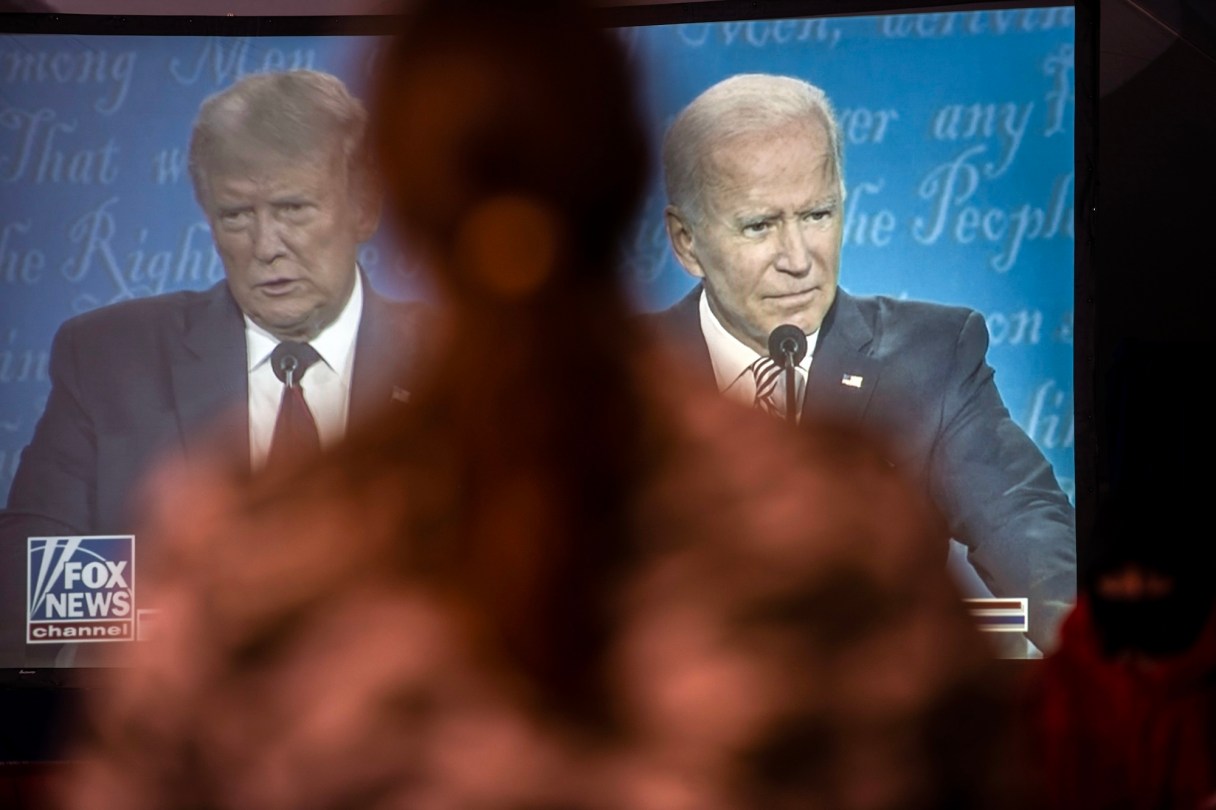
The Biden and Trump campaigns have agreed to two presidential debates. Who among us can contain our excitement?
Well, it depends on what you mean by “us.” In my corner of the professional world — pundits, commentators, political junkies — there was much rejoicing. Watching the Sunday shows, you could be forgiven for thinking church bells must have rung out to celebrate the news across the nation, as if some medieval queen had given birth to a male heir.
Meanwhile, among normal people, that sound you didn’t hear was the great mass of humanity shrugging.
Now, I understand why journalists and junkies are excited. For starters, presidential debates inflate the egos of journalists, giving them ample opportunity to talk grandly about the fourth estate’s important role in democracy. They’re also great for ratings: The first, thoroughly awful 2020 debate was watched by 73 million people.
The drama of politicians offering unscripted — though often rehearsed — answers to complicated questions has a Super Bowl-like quality for political nerds. That listening to either of the current presumptive nominees talk is like watching a race car driver behind the wheel of a vehicle without brakes just adds to the excitement. The prospect of a spectacular crash always has a certain dark appeal, and in a Trump-Biden matchup, crashes are assured.
Lost amid the hoopla over the latest debate agreement is the fact that pretty much all presidential debates are tiresome and counterproductive spectacles.
The first presidential debates, between John F. Kennedy and Richard Nixon, were in 1960 (when Biden and Trump were, respectively, 17 and 14 years old). All anyone remembers about the Kennedy-Nixon debates is the first one, which Nixon lost, according to lore, because he was without makeup, unshaven and sweaty. Again, according to lore, people who listened to the debate on radio thought Nixon won, while people who watched it on television were so impressed by Kennedy’s suave style and good looks that they thought he won. Nixon, who was underweight and exhausted during his first appearance, got some rest and good makeup and won the next two debates, which nobody remembers.
In other words, the lesson from the beginning was that style was more important than substance. It has ever been thus.
We think, partly because we are told as much over and over again, that televised debates convey important information to voters. But television makes certain information seem more important than it is, often subliminally. For instance, in most presidential elections, the taller candidate wins. Does height in some way correlate with superior policies?
Obviously, television presence is part of modern presidents’ job description. But televised presidential debates magnify that qualification beyond all reason. Yes, yes, presidents need to be good communicators. But at no point during their actual presidencies are they ever expected to bicker with a political foe for 90 minutes in front of millions of people.
The political skills we are testing for are not the political skills the job requires. The candidate who forcefully, confidently or amusingly lies is often rewarded by debates, while the candidate who tells the truth awkwardly, hesitantly or with appropriate complexity is often penalized.
The debate “highlight” reels the networks routinely run are full of one-liners, gaffes and falsehoods often treated as true by sympathetic journalists. But I’ve never seen a really thoughtful explanation of the national debt or another serious problem celebrated as a great moment in debate history.
The prospect of a Biden-Trump rematch is especially deserving of an “Ugh, really?” But the truth is that all presidential debates deserve the same.