
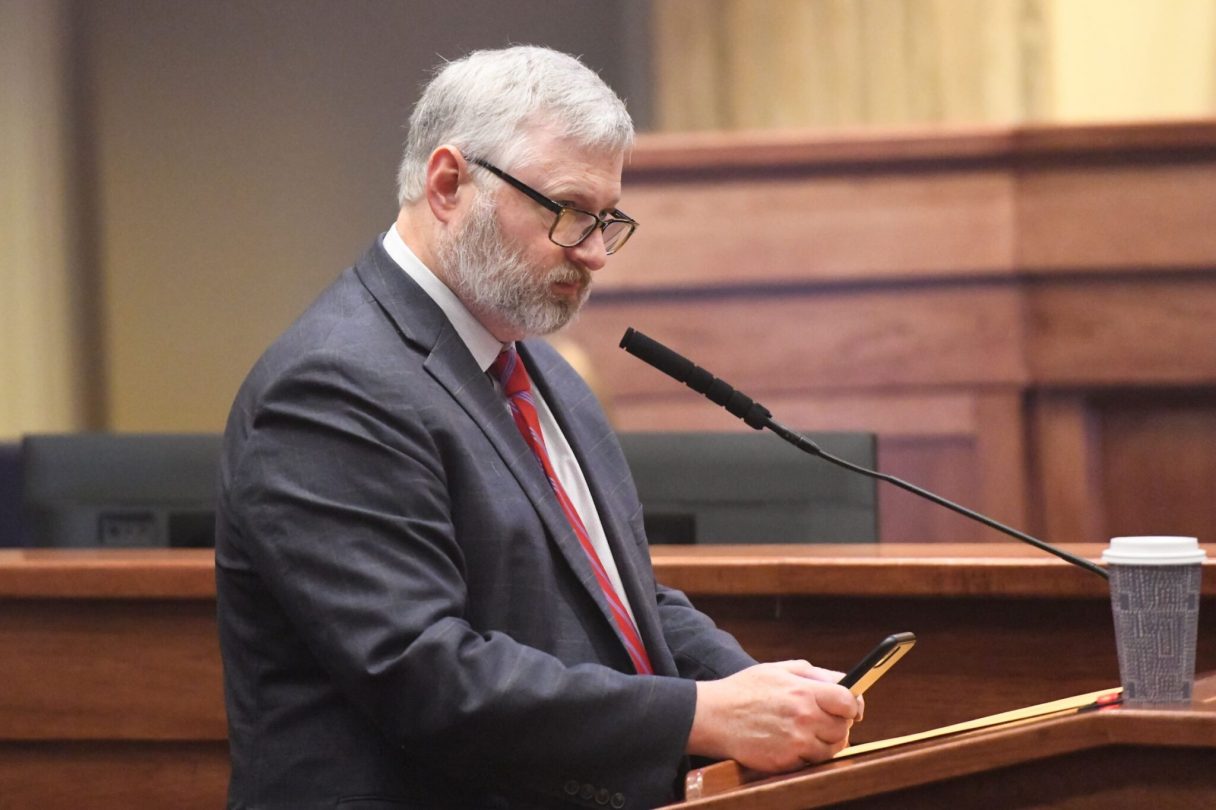
An Alabama senator has prefiled a bill that would allow the Alabama attorney general or governor to appoint local police chiefs if they believe there is a public safety threat in the town.
SB 3, sponsored by Sen. Will Barfoot, R-Pike Road, the chair of the Senate Judiciary Committee, would allow the attorney general or governor to appoint an interim head of a police department after reviewing federal, state and local crime statistics if the number of employed police officers is less than 30% of the average employment for the past decade and after consulting with the local district attorney, sheriff and crime victims.
Messages seeking comment were left with Barfoot on June 24, Wednesday and Thursday. Rep. Reed Ingram, R-Pike Road, who plans to file a companion bill in the Alabama House of Representatives, said in an interview the state “takes all the liability and responsibility” for housing those convicted of felonies within cities.
“The county tries them with some part of state money,” he said. “The municipality doesn’t pay anything. Then when they are sentenced, we have to house them and today, we are building mega prisons because we don’t have enough room to house them.”
(READ MORE: Alabama Senate approves bill setting timelines for responses to public records requests)
Montgomery Mayor Steven Reed sharply criticized the proposal in a statement.
“At a time when we should all be working together, I would hope that Rep. Ingram and Sen. Barfoot would work with our entire local state legislative delegation to provide solutions as opposed to introducing local preemption bills that undermine municipal authority and interfere with a city’s right to govern itself,” the statement said.
Greg Cochran, executive director of the Alabama League of Municipalities, which represents cities, said June 24 the organization had not reviewed the bill.
The attorney general or governor would oversee the interim chief and pay his or her salary.
“The appointing authority may petition the circuit court of the county in which the municipality is located for the recoupment of any costs incurred in enforcing this section, including the payment of the interim police chief’s salary,” the proposed legislation states.
The municipality would continue to fund the operations of the police department.
(READ MORE: Alabama Senate OKs bill loosening regulations for religious vaccine exemptions)
The bill does not say how a municipality would regain its ability to appoint a police chief. It would allow a local sheriff to be appointed to the job. If a sheriff was appointed, the bill says he or she “shall be entitled to additional compensation … not to exceed $75,000 a year.”
“We are going to work with the mayor, parachute out,” Ingram said. “You get your recruitment back up, when we are able to help you with recruitment. We don’t want to stay in that position because we are going to pay for that position. The state is going to pay for that position.”
Legislators in recent years have imposed harsher penalties on those convicted of crimes, including retail theft and criminal acts perpetrated as part of a criminal enterprise.
Legislators also passed laws that lengthened sentences, including one that reduced the incentives to reduce the time that people in prison could receive for good behavior. The Legislature in 2022 removed the requirement for gun owners to purchase pistol permits, money that sheriffs’ departments used to fund their operations.
Ingram said the bill was not overreach.
“We are taking all the liability when a crime happens in their jurisdiction,” he said. “I think we need some skin in the game, and they need some skin in the game. We have got to protect these citizens.”
Rep. Kenyatté Hassell, D-Montgomery, said the legislation is “not needed,” and said legislators should instead look at reducing the availability of firearms.
“Let’s have some common sense,” Hassell said. “Let’s say we have all the police officers we need. Let’s say everybody we need filled, staffed, we got a guy right now walking around with an assault weapon, with his shirt off in a neighborhood, nobody is saying anything to him. The person is walking up and down on the street with an assault weapon.”
Read more at AlabamaReflector.com.