
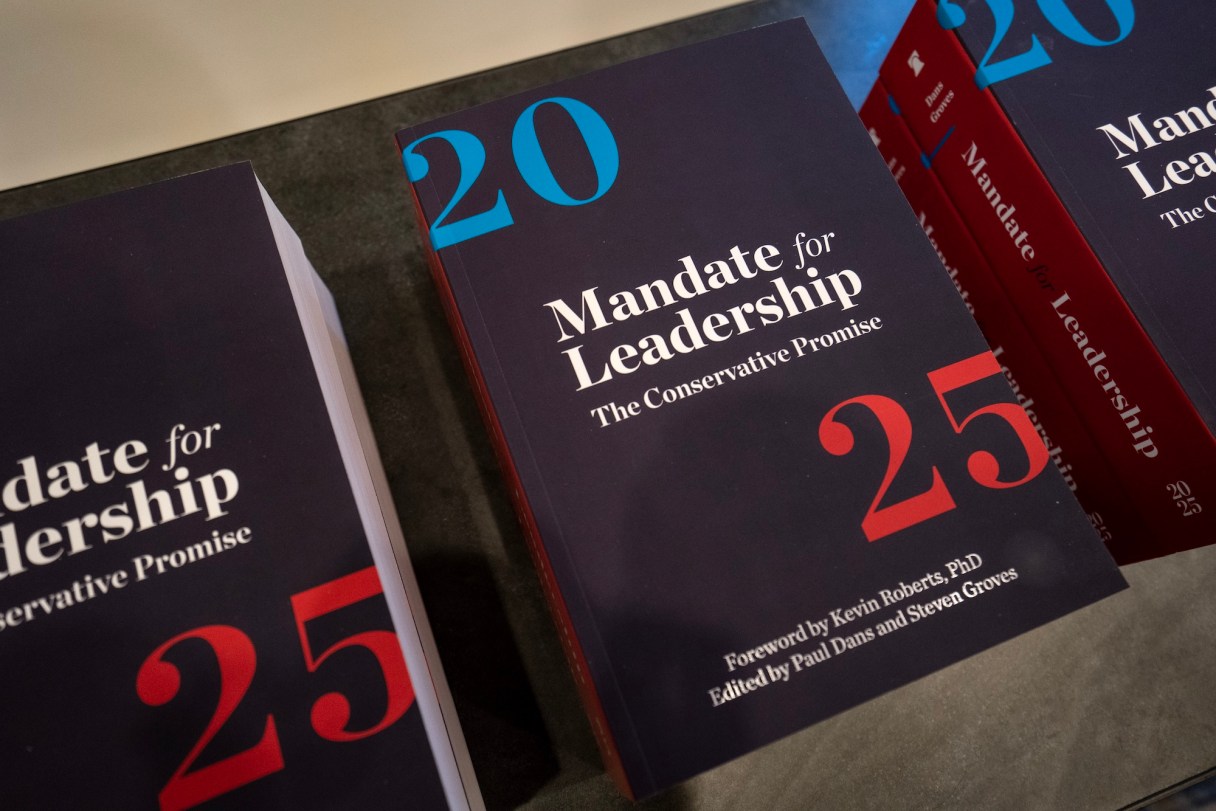
Project 2025 is the staffing and policy planning organization led by the Heritage Foundation. It published “Mandate for Leadership,” a 900-page document of policy recommendations, for the next Republican administration. Project 2025’s unpopular conservative policy positions have come under fire.
As a result, former President Donald Trump and his allies have attempted to distance themselves from the Heritage Foundation’s Project 2025. “I know nothing about Project 2025,” Trump posted on his social media website. “I have no idea who is behind it.” Others, such as U.S. Sens. Marco Rubio and JD Vance echoed the sentiment.
Despite what Trump says, it is fair to use Project 2025 as a preview for Trump’s second term. The Heritage Foundation is closer to Trump than it has been to any presidential candidate since Ronald Reagan.
The think tank, which was founded in 1973, formed in opposition to Richard Nixon’s and Gerald Ford’s administrations. It was filled with conservative insurgents, upset that their allies in the Republican Party got most of their policy advice from centrist experts.
Heritage quickly formed an alliance with another conservative insurgent, Ronald Reagan. During his 1980 campaign, the think tank published the first edition of “Mandate for Leadership.” It was wildly successful. Heritage claimed that the Reagan administration implemented at least half of its hundreds of policy recommendations across federal agencies.
It also made staffing a core part of its strategy to influence Republicans in government. Heritage credits its co-founder and former president, Edwin J. Feulner, as the originator of the phrase, “People are policy.” It maintained a Rolodex of conservative policy experts.
Heritage’s strategy was successful because parties out of power have little time to do real policy planning. Campaigns release broad policy ideas for a few salient issues, but the federal government’s policy agenda is vast. Presidents, even those more interested in the details of policy than Trump, cannot supervise the vast majority of policy work that their thousands of appointees will spend their four years on.
After Reagan left the White House, Heritage remained one of the most influential conservative organizations on Capitol Hill but was often at odds with the administrations of George H.W. Bush and his son, George W.
That all changed when Trump was elected president. Heritage had drifted even further toward the far right under Jim DeMint’s leadership, but Trump needed allies in Washington. As I describe in my book, he appointed more people from Heritage than any other organization other than his campaign.
The new alliance worked. Heritage claims that the Trump administration appointed more than 60% of the policy recommendations in the 2016 “Mandate for Leadership” in his first year, more than even the Reagan administration.
Project 2025 is just the latest incarnation of Heritage’s policy planning and staffing for Republican administrations. It is closer to Trump than ever before. Heritage brought in numerous top Trump administration officials to coordinate its planning, including a former director of the White House Presidential Personnel Office, John McEntee, and former Office of Management and Budget Director Russ Vought.
It is patently absurd that Trump and his allies are now trying to distance themselves from Project 2025.
Given that the 2024 Republican Party platform is light on details, voters should read the 2024 “Mandate for Leadership” as the best guide for what they can expect if he is elected again.
E.J. Fagan, an assistant professor of political science at the University of Illinois at Chicago, wrote the book “The Thinkers: The Rise of Partisan Think Tanks and the Polarization of American Politics.”