
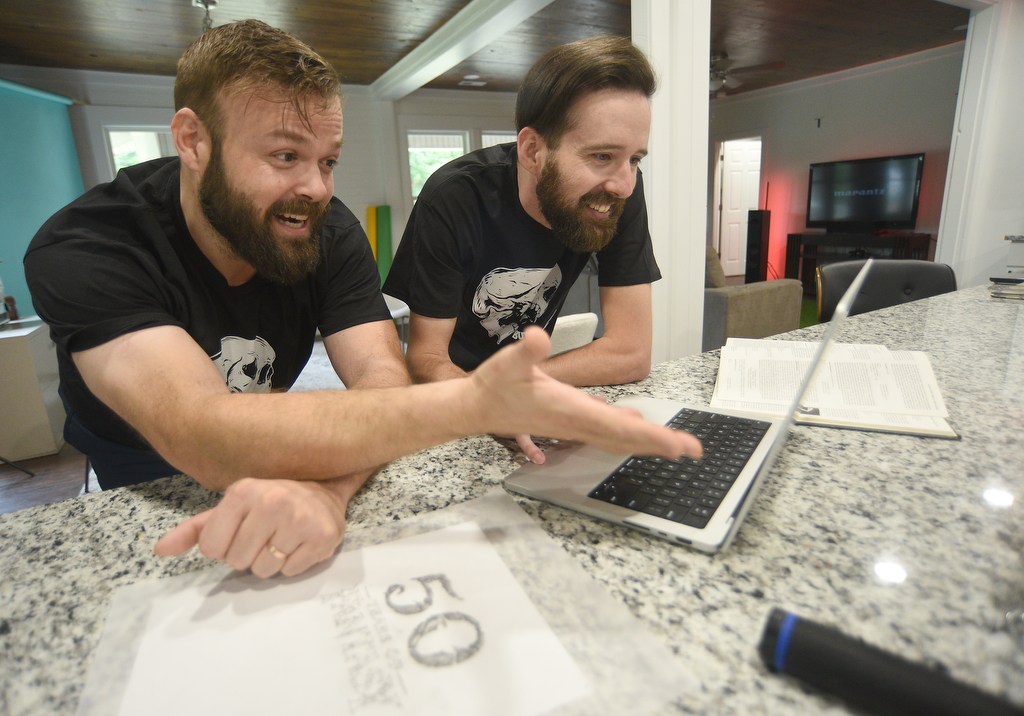
Blake DeRusha has worked in the Chattanooga area in photography, marketing and as an audio engineer. He’s a musician, too, and music videos, he said, were his entré into the narrative filmmaking realm.
Another passion that shaped him: Dungeons & Dragons, the fantasy role playing game where players create a character who undertakes grand adventures on the table — and, perhaps, more importantly, in the players’ own minds.
Now, through the in-production crowdfunded documentary “50 Years of Fantasy,” DeRusha seeks to probe D&D’s cultural legacy and the communities it shaped. In a Q&A, he and the film’s producer, Chris Moreland, spoke on how the game shaped their own friendships and, directly or indirectly, the imaginations of countless millions around the world.
Q: You’ve been playing D&D for a couple of decades. How’d you get into it?
BD: My dad introduced me to the game. He himself had never played, but he bought me a basic set for, I think, my 11th or 12th birthday. Me and my brother played that for weeks on end.
Then I eventually got the core books and started playing with my friends in high school.
Q: D&D has had a bit of a connotation as the kind of thing nerds do. Was that true when you were doing it?
BD: Yeah, I think up until about 2017, 2018 when “Stranger Things” came out, that was still the case. “Stranger Things” came out and all of a sudden, everyone wanted to play Dungeons & Dragons.
(READ MORE: Dungeons & Dragons’ opens with $38.5 million, takes down John Wick)
Q: How has that jump to the mainstream affected the game?
CM: I think it has been hidden in the mainstream. I don’t think it’s not been in the mainstream.
If you’ve ever played a video game, you’re playing with a mechanic (a term for the rules and dynamics that govern a game) that was created by Dungeons & Dragons.
Blake interviewed Gerald Brom, and Brom (who illustrated many D&D games) is one of the most prolific fantasy artists of all time. You’ve probably seen his work if you’ve played World of Warcraft or Diablo or any of these games. His work is prominent, whether you know it or not.
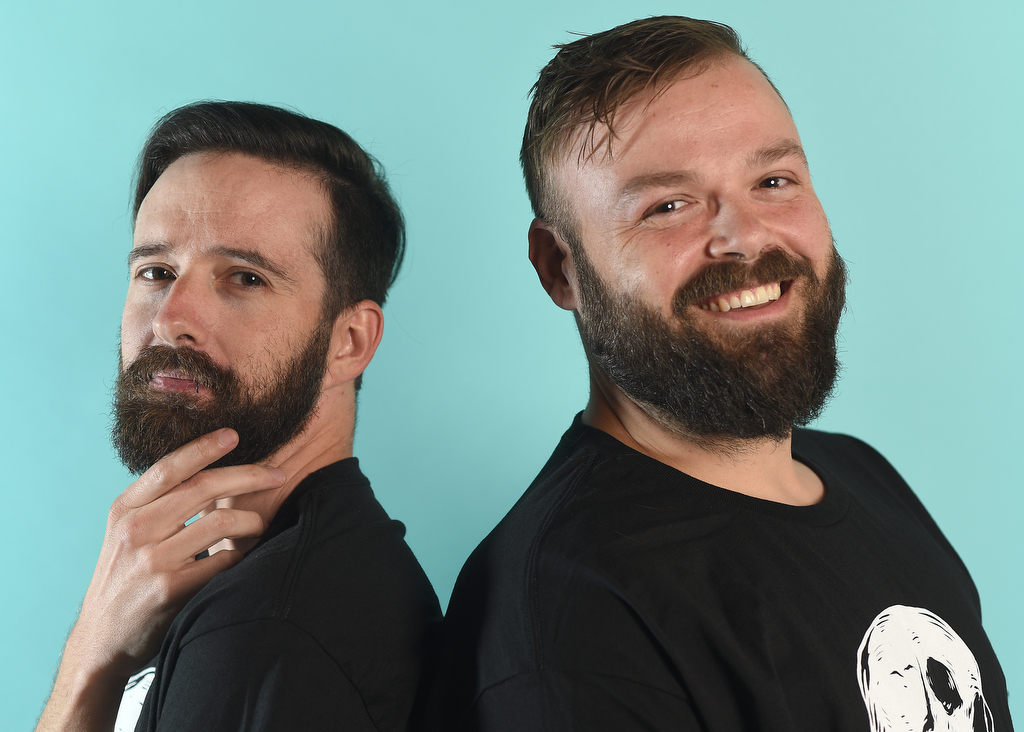 Staff photo by Matt Hamilton/ On July 23, Blake DeRusha and Chris Moreland, right, are pictured at their studio in Rossville.
BD: I love that the Duffer brothers, who produced “Stranger Things,” focused on, of course, the 1980s — the heyday of Dungeons & Dragons. And that spurred a lot of the existing community to go back and revisit the older versions of the game.
Q: Presumably as you go with the film, you’ll develop more a fleshed-out idea of the deeper themes. But I assume you have a proto-thesis at this point. You say you’re going to tell the story of the people who play the game, the drama and all of that, but what’s it really all about at this point?
BD: It has evolved significantly since March. We were talking about drawing attention to what’s called the OSR (Old School Renaissance) — people playing the older editions or versions of the old editions.
And then as we started doing interviews and talking to people. We … talked to David Johnson, previously from Blizzard Activision, who worked on Call of Duty, and he’s a huge fan, and we started talking with him and a bunch of his friends. And we realized that this could be a much larger scope.
We’ve shifted into focusing on the community and the people, because the real story behind Dungeons & Dragons is that no matter how good or bad the IP holder (the company that owns the rights to the game) is doing, the community itself keeps it alive.
CM: The value lies in the worlds they’re creating with the game. No matter which edition you play — and there is a lot of drama in an edition wars conversation that goes on all the time, for cultural and subcultural reasons — but what we’ve found is that people find community in the world building. That’s the common thread: The community you’ve built is what’s most important throughout this entire process.
Q: Growing up, what did playing this game look like? Was there like, the same crew? Where did y’all do it?
BD: Early high school — so freshman, sophomore year — I had a group of friends that was fairly static. We would get together at my parents’ house on a Friday night.
Q: In Hixson?
BD: Yep, and so we would come over to my house or over to my buddy’s house, and we would probably stay up for like eight to 10 hours. It’d be the wee hours of the morning before we finished playing.
Then when I moved down to Dade County, I didn’t have as many friends, and I was trying to find a group, and it was harder to find people.
People were coming in and out. But that’s all the beauty of the game — it’s storytelling. So if someone can’t make it to a game, then you all collectively come up with a reason why their character isn’t there that time. Maybe they’re off on their own adventures, or whatever it may be.
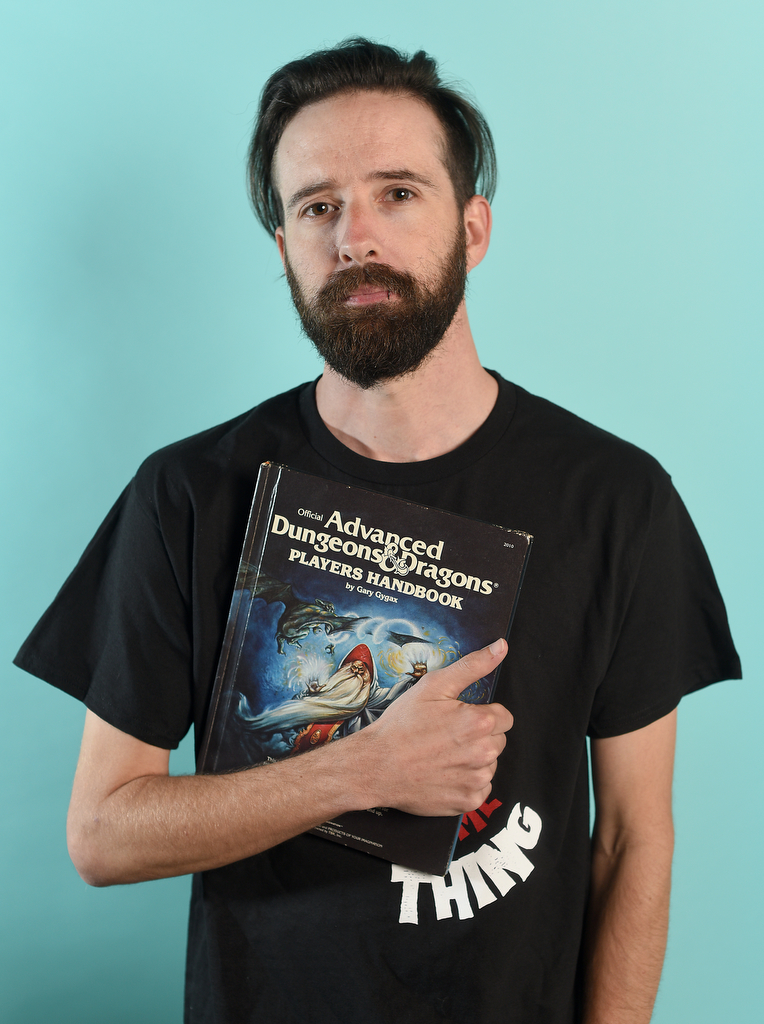 Staff photo by Matt Hamilton / On July 23, Blake DeRusha holds a copy of the Advanced Dungeons and Dragons Players Handbook at his studio in Rossville.
Q: What did this game do to your friendships?
BD: It made our friendships. We were very, very focused on the game. We would pass each other in the halls in school and hand each other notes about things we wanted to do in the next game or breakdowns of what had happened in the previous game. It was a constant conversation.
Q: When you went down to Dade County, was it hard to find new people to play with?
BD: I was pretty much the only person that I knew at the time who really played in Dade County. So I brought everybody in kind of on the ground level, explaining the game — how to play it — and eventually I had two or three people who would come pretty consistently.
Everyone else that ended up showing up would show up for maybe two or three games, and some of them would lose interest. Some of them would be busy and come back.
It was a lot harder for me to keep a group together, and then as I got older, of course, having to work and coordinate schedules with adults, it gets a little more difficult.
Q: Are there aspects of the game you’re like, good at or not that good at? I was visiting some people, and they had this running D&D game and invited me in as a guest. Everyone else was doing all these funny accents and stuff and just had a whimsical imagination, where I just felt like, “Man. I’m bad at this! Maybe I’m just not that quick and creative, I’m not that good at accents!”
BD: I think that’s a common thread actually. A lot of people when they get into the game, there’s this hesitancy to fully engross yourself, commit to the role.
I will say that at most of my tables, we haven’t really done accents or anything. We talk about our characters in the third person. It’s more descriptive. You’re playing as players around the table. The actual game itself is occurring in your imagination.
But I also think that imagination is a muscle that you have to exercise. The more you engage in that type of play, the more your imagination wants to push the boundaries of that, and see what it can do with it.
Contact Andrew Schwartz at aschwartz@timesfreepress.com or 423-757-6431.