
(Editor’s note: First of four parts)
On Thursday, April 30, 1945, the Robert Sparks Walker Audubon Society announced that it was developing the Walker Farm near Brainerd. The resulting nature preserve was christened the Elise Chapin Wildlife Sanctuary. Sarah Key Patten, chair of the project, stated that one of the first actions would be preservation of the old “Indian cabin,” believed to have been the birthplace of Too-an-tuh, the famed Cherokee naturalist known as “Spring Frog.” Robert Sparks Walker speculated: “The Indians loved beauty of scene and must have chosen this homesite because of the blending of the green of the pines, the deep brown of the gums, the gold and red of the maples and sumac and the sapphire of the beautiful little river.”
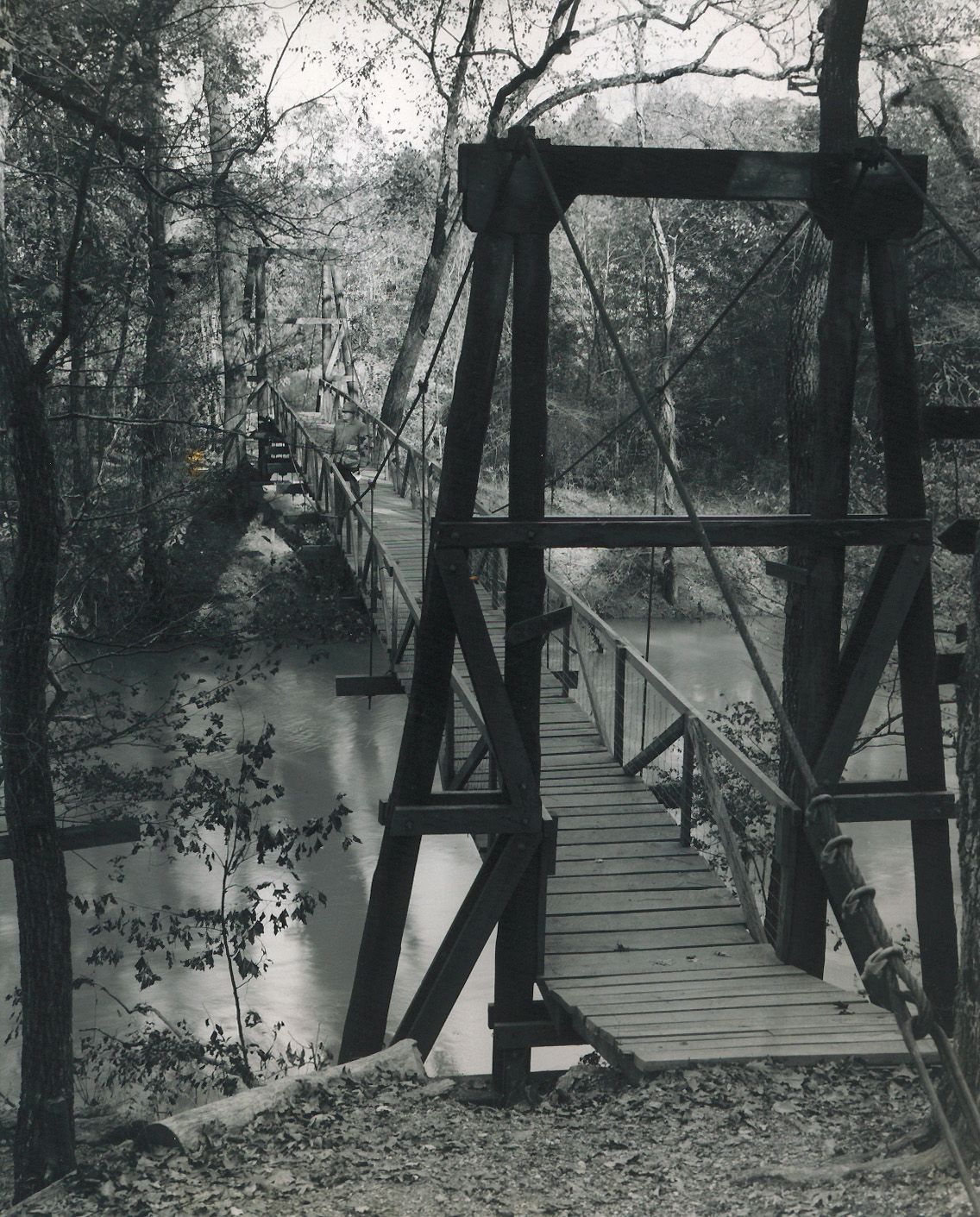
Work began immediately on two projects: a stone gateway arch to the sanctuary, which would have Elise Chapin Wildlife Sanctuary “engraved” upon it, and a “suspension foot bridge across the Chickamauga Creek on a steel cable 200 feet long.” Chicago architectural firm Vitzthum and Burns, recognizable to local citizens as the architects of the American Trust and Banking Company building in downtown Chattanooga, had been awarded the contract for the stone entrance. The firm’s principals assured the board that the arch “will be one of the most imposing stone entrances to any park or special grounds” in the region.
With plans for the farm to become an educational site for families, Hamilton County students and other visitors, library committee chair Gertrude Andrews encouraged donations of books to create a “nature library” at the sanctuary. One hundred and twenty books were collected, but more were needed. Miss Raymo, Chattanooga Public Library staff member and wildlife sanctuary volunteer, suggested copies be delivered to the nature library. She processed the donations.
The Walker farm also was known as the site of Chief Little Owl’s village. Little Owl was the brother of Dragging Canoe, the Chickamaugan warrior who resisted settler intrusion into Cherokee land and fought to negate the Treaty of Sycamore Shoals, which sold thousands of acres of land controlled by the Cherokee to the speculative Transylvania Land Company. Interestingly, there is now some question about whether the site was, indeed, one of the Chickamaugan towns. Documentary evidence from the 16th century Tristan de Luna expedition strongly suggests that it was the location of an earlier Napochi Indian village.
With the excitement following the announcement of the development, President Walter Johnson reported Audubon Society membership increased by several hundred members, assisted by the diligent efforts of Mrs. Clifton Wright, membership chair.
The board members decided that, once the Elise Chapin project was underway, the next push was to decide how the Hutcheson Bird Sanctuary on Missionary Ridge might be best used to increase public awareness. To further that aim, Dr. Wilbur K. Butts, a board member, authored a booklet entitled, “A Key to the Land Birds of Chattanooga.” Six months later, John L. Hutcheson Jr. donated an additional six acres, so that the Hutcheson Sanctuary now extended from South Crest Road down the west slope. A committee was formed to promote usage of the property and provide the infrastructure necessary to attract and identify local birds. Mrs. E.Y Chapin agreed to chair the committee with assistance from Mrs. A.M. Patterson (treasurer), Mrs. C.M. DuBois (secretary), Mrs. Sarah Key Patten, Miss Mary Tom Peacock, Robert Sparks Walker, Walter Johnson, Dr. Butts and Alfred Mynders.
By November 1945, major reconstruction had been completed on Too-an-tuh’s cabin, including a strengthened structure, new chimneys and roof, and the replacement of windows and doors. Patten announced that the site was now ready to be “the central attraction of the Elise Chapin Wildlife Sanctuary,” but that the road leading into the sanctuary needed some repairs. With a commitment from Hamilton County to make access “smoother,” Patten felt citizens would be visiting the site by early spring, when the beauty of the landscape would be “breathtaking.”
At the spring 1946 Audubon Society board meeting at Spring Frog Cabin, Sarah Key Patten asked members to discuss the proper furnishings for the cabin, since it should reflect the life of the naturalist. Additionally, the board announced that a series of six lectures, given by nationally known naturalists and scientists recommended by the National Audubon Society, would be offered over the next few months.
Linda Moss Mines, the Chattanooga and Hamilton County historian, chairs the regional America 250 Commemoration. For more on local history, visit Chattahistoricalassoc.org.