
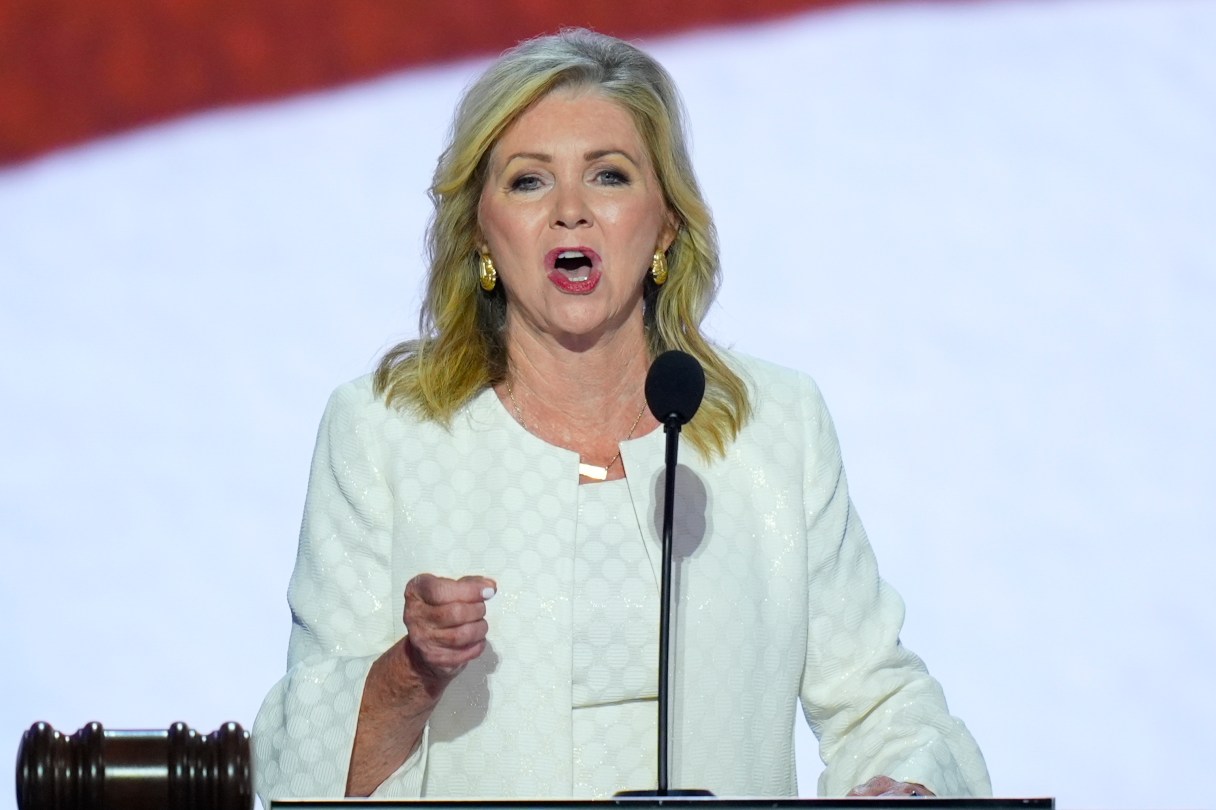
U.S. Sen. Marsha Blackburn, R-Tenn., teamed up with U.S. Rep. Claudia Tenney, R-N.Y., on Wednesday to introduce the DOGE Acts.
The series of legislation is in tandem with President-elect Donald Trump‘s proposed Department of Government Efficiency, an outside group looking at cutting government spending and regulations to be led by businessmen Elon Musk and Vivek Ramaswamy.
(READ MORE: Tennessee Sen. Marsha Blackburn to introduce DOGE Acts)
The DOGE Acts include the Federal Freeze Act, the Commission to Relocate the Federal Bureaucracy Act, the Federal Employee Performance and Accountability Act, the Stopping Home Office Work’s Unproductive Problems Act and a three-bill package of 1%, 2% and 5% across-the-board spending cuts, according to a release sent by Blackburn’s office.
“The American people have had enough of outsized bureaucracy and wasteful government spending,” Blackburn said in a statement. “The DOGE Acts are the first step to achieving government efficiency by requiring federal employees to get back in the office, moving federal agencies into the heartland of America, cutting bloated federal spending across the board and freezing federal hiring and salaries until we can rightsize the federal government.”
Tenney’s communications director did not respond when emailed by a reporter.
The Federal Freeze Act would freeze federal employee salaries for a year, direct federal agencies to cap how many workers can be employed over three years and cut back on the number of employees at federal agencies, according to the release.
EBBS AND FLOWS
Kenneth Chilton, a professor of public administration at Tennessee State University, said the debate about the role of unelected bureaucrats and the administrative state has ebbed and flowed over time.
“In reality, the number of federal employees has remained relatively steady over the years,” Chilton said by phone.
In 2023, the federal government added 85,000 jobs, according to the Bureau of Labor Statistics, after adding 8,000 jobs in 2022.
By comparison, employment in hospitals rose at a faster pace, increasing by 194,000 in 2023 compared with 146,000 in 2022. Residential specialty trade contractors added 57,000 jobs in 2023, below the growth of 96,000 jobs in 2022.
Some trades lost jobs while the government was growing in 2023. According to the bureau, furniture, home furnishings, electronics and appliance retailers lost 41,000 jobs in 2023, building material and garden equipment and supplies dealers lost 34,000, and health and personal care retailers lost 15,000.
Another DOGE Act, the Federal Employee Performance and Accountability Act, would implement performance-based payment for federal employees.
Rhonda Beard, a Chattanooga-area human resources professional, said a performance-based pay structure is a good idea. She said people are motivated to do more if they feel like they are going to be rewarded more.
The Stopping Home Office Work’s Unproductive Problems Act would require federal agencies to revert to pre-COVID-19 remote work levels within 30 days. Agencies would not be able to permanently expand remote work without submitting plans to Congress certified by the Office of Personnel Management. The act, originally sponsored by U.S. Rep. James Comer, R-Kentucky, passed the U.S. House of Representatives in February 2023.
Preventing federal employees from working remotely could impact people with physical disabilities who can only work remotely, Beard said, or parents who rely on the flexibility of remote work to be able to put their children on the school bus or pick them up throughout the day.
Changing the pay structure or tweaking work requirements for federal employees may be easier to implement than some of the other legislation bundled into the DOGE Acts, Chilton said.
NEW LOCATIONS
The Commission to Relocate the Federal Bureaucracy Act would create a plan to move federal agencies unrelated to national security outside of the Washington area into different states.
“There will be initial costs associated with that. You’ve got to relocate people, you’ve got to end leases potentially, you’ve got to create new office space or rent somewhere else,” Chilton said, “so some of the envisioned cost savings in the short term might not be as high in the long term.”
The package also includes three bills to make cuts to discretionary appropriations unrelated to security for the 2026 fiscal year.
Chilton said discretionary spending is a smaller portion of the federal budget. Cuts would have to be made to entitlement programs to significantly lower the budget, he said.
“Trump has already come out and said he’s not touching Social Security or Medicare,” Chilton said. “From some of the language in the bills, some things like the Department of Defense, Homeland Security are exempt, and given current legislative priority, it seems like we’re probably going to be spending more on some of those agencies.”
(READ MORE: U.S. Rep. Fleischmann joins new DOGE caucus)
Chilton said it’s always worth looking into opportunities to cut and reinvent the role of government and the size of bureaucracy.
“But getting meaningful change,” he said, “has proven in the past difficult to do.”
Contact Sarah Dolgin at sdolgin@timesfreepress.com or 423-757-6556.