
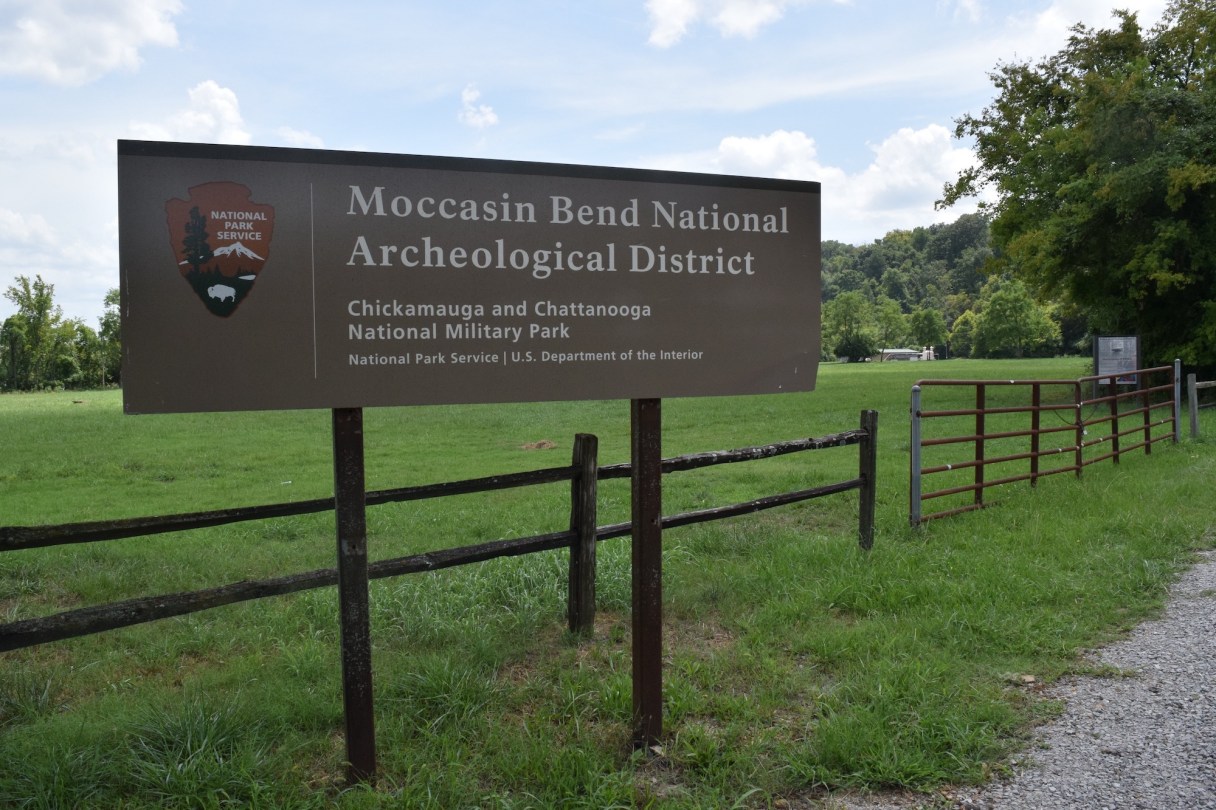
The summer of 1995 was a memorable one for Moccasin Bend. I had just become chairperson of the state mental health hospital board, and we were all surprised one morning in June to learn that workers from the University of Tennessee at Chattanooga were preparing nearby land for athletic fields. The plans called for a 10-acre sports complex including softball, track, and soccer/football venues. Concerned that the acreage of the Bend was up for grabs, however legitimate the needs and however much we admired and supported the university, our board began searching for ways to protect the Bend and stave off future incursions.
We invited archaeologist Dr. Major McCullough to our board meeting. UTC had in the meantime graciously shelved its work on the athletic fields. Nevertheless, McCullough reminded us that Congress had passed 1950 federal legislation protecting up to 1,400 acres. That initiative was blocked by Gov. Frank Clement with his refusal in early 1953 to write the final $100,000 check, but McCullough urged that a precedent had been set for a national park as the best long-term way to protect the Bend’s special Native American and Civil War resources and prevent a split-up of its land.
At the end of June, Bruce Babbitt, U.S. secretary of the interior, came to Chattanooga to speak to the Outdoor Writers Association at the Trade Center. While here, he visited Moccasin Bend and advised, “You’ve got something really great here. Take care of it.” He suggested in public statements forming a National Heritage Area, a loose form of conservation and preservation. Our hospital board didn’t think that cut the mustard. Babbitt then privately affirmed to hospital executive Leighton LeBoeuf, archaeologist Jay Mills and me that only a national park offered permanent protection for the Bend and was the best way to go. We thought that advice did cut the mustard and reinforced our board’s plan to pursue a national park.
The tribes entered the picture about that time. City and county officials had for some time debated different ideas for the Bend, including an outdoor amphitheater, a zoo, a tourist park, and an Indian village in addition to a national park. It became apparent that the national park was not everybody’s first choice but was almost everybody’s second choice, especially after Native Americans with ties to the Bend including the Five Civilized Tribes began to express their support for federal protection.
One of our board’s early acts that summer was a full-blown news conference on the hospital front lawn, where we announced that federal protection was the best solution. It seemed city and county leaders, who were still uncertain about the best course for the Bend, doubted a hospital advisory board knew enough and was in a position to decide the fate of the Bend. Still, we were convinced on the necessity of a national park and proceeded to enlist public support.