
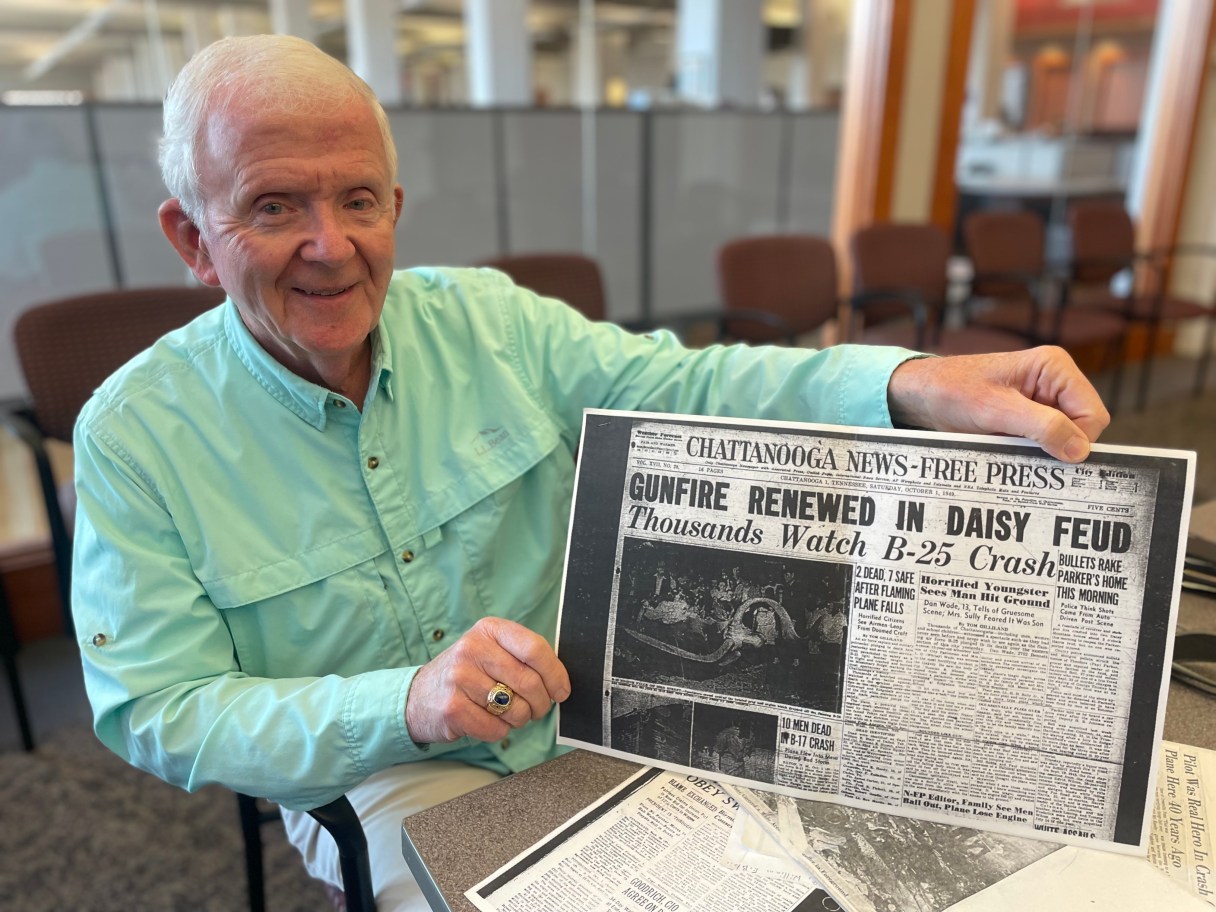
At around 4 p.m. Sept. 30, 1949, then 5-year-old Dean Hutson was playing in the front yard of his parents’ house on South Crest Road.
Hutson, who had been home from kindergarten since lunchtime, was startled by a rumbling sound coming from the sky, and he looked up to see a large airplane overhead trailing smoke.
“At first, I thought it was a skywriter,” says Hutson, 80, of Signal Mountain. “Then I began to see the parachutes opening up, and I ran inside and told mother, ‘There’s an airplane out there with smoke coming out of the back of it, and there are white umbrellas falling from it.'”
Meanwhile, a few doors down from the Hutson home, a mother called up to her daughter to stop roller skating in the house, mistaking the rumbling notes emanating from above for a child roller skating on a second-story wood floor.
A few seconds, later a thunderous explosion rocked the neighborhoods of Ridgedale and East Ridge as a B-25 bomber in route from Augusta, Georgia, to Spokane, Washington, slammed into an empty field near the Bachman Tubes, killing the pilot.
Seventy-five years ago last month, the Chattanooga area experienced one of the most dramatic airplane tragedies in the city’s history.
A U.S. Army pilot, Capt. William Blair, was transporting six airmen and two other crew members from Georgia to Washington state when the left engine on his aircraft caught on fire. The crew tried to extinguish the fire but soon concluded the effort was futile.
By the time 5-year-old Dean saw the airplane approaching his neighborhood from the Glenwood area, the passengers, on Blair’s orders, began to bail out of the airplane. One, whose parachute was not attached correctly, fell 6,000 feet to his death, hitting the playground of the former Ridgedale School.
(READ MORE: Remember When, Chattanooga? What local anchorman died in an airplane crash?)
“One landed in a backyard, another got stuck in a tree, another landed on the roof of the (former) Ridgedale School, one glanced off a bank building, one was caught in telephones lines,” according to a newspaper report.
Once the airplane was empty except for himself, Capt. Blair began the difficult task of finding a spot to down the airplane, which had a wingspan of more than 67 feet. It must have occurred to him at some point that he could save civilians on the ground but not himself. He would have passed directly over McCallie School as the B-25 began to loose altitude.
Hutson remembers that the whole incident unfolded so slowly that cars on the ground began to follow the aircraft.
“Crest Road was blocked with automobiles,” Hutson recalled in an interview last week. “People had been following this plane. When it crashed in East Ridge, it was gridlock.”
Perhaps because there were so many witnesses, Capt. Blair, who lost his life in the crash, became a local folk hero. Plaques were displayed in his honor, and the American Legion post in East Ridge was named for him.
One plaque read, in part, “In an act of heroism, the pilot, Captain William E. Blair, stayed with the plane and steered it away from Missionary Ridge School into an uninhabited area over the eastern entrance of the Bachman Tubes to avoid any loss of life except his own.”
Hutson said he has lived with memories of the fateful day for 75 years. For an impressionable child, it’s not an incident easily forgotten.
(READ MORE: WATCH: Federal investigator arrives at Chattanooga Airport after crash landing)
He has noticed that as the years have gone by, fewer people seem to remember Capt. Blair’s sacrifice. Local news organizations that used to mark the anniversary of the crash at least once a decade, have stopped doing stories.
Still, each year Hutson pauses on Sept. 30 to think about the sacrifice of Capt. Blair, who left a wife and two young children.
“Thinking back now, I might not be here (if not for Blair’s actions),” Hutson said. “Generations of people that are alive today who could have been killed. If it had crashed into McCallie School, there were a lot of people on campus at 4 o’clock in the afternoon.”
The late Bill Casteel, reporter and columnist at The Chattanooga Times, summed up Blair’s fate in a 1979 retrospective article.
“He died instantly while others landed safely,” Casteel wrote.
As a result, numerous lives were saved on a perilous fall afternoon in the shadow of Missionary Ridge.
Life Stories publishes on Mondays. Contact Mark Kennedy at mkennedy@timesfreepress.com or 423-757-6645.