
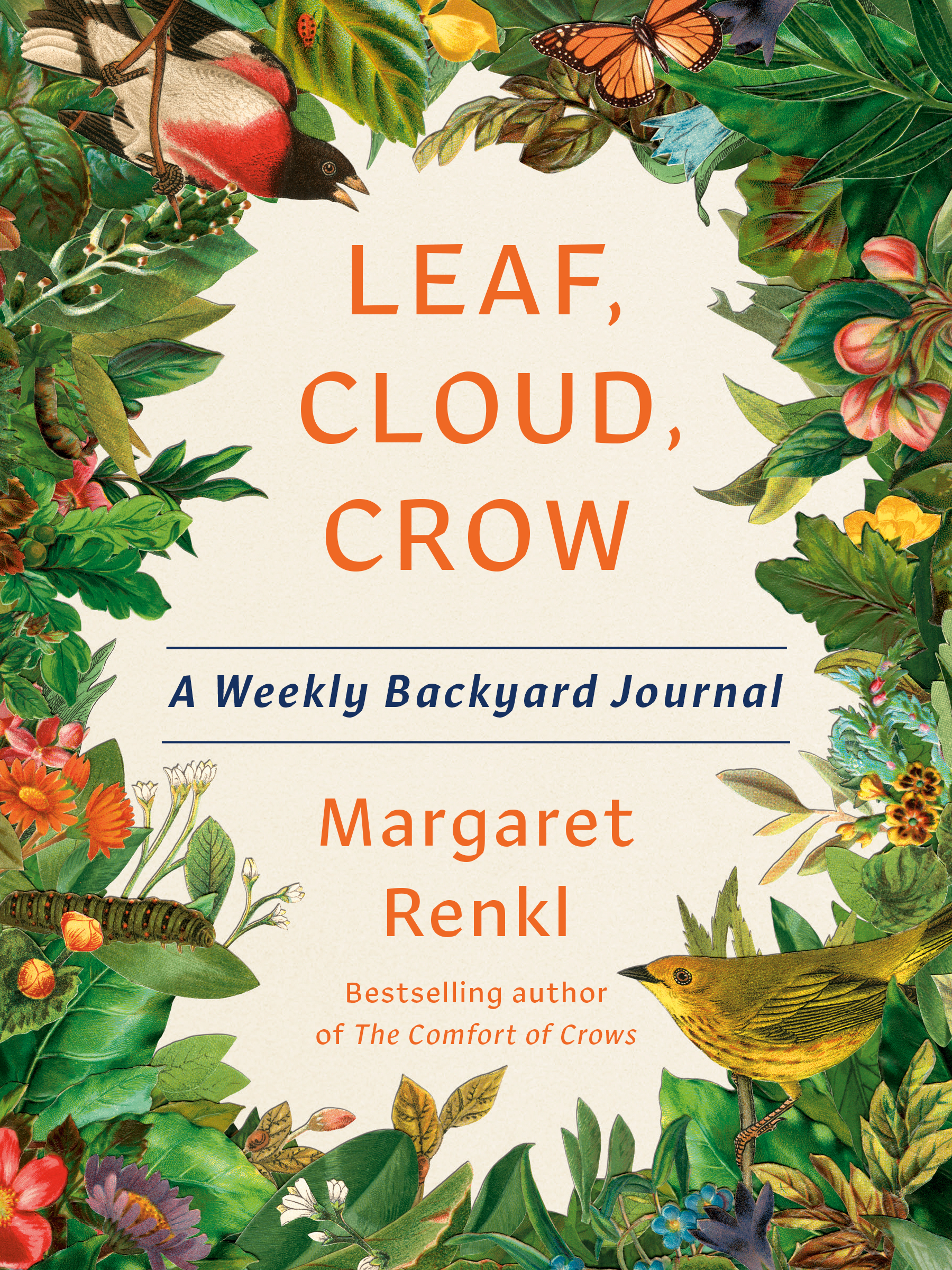
“LEAF, CLOUD, CROW: A WEEKLY BACKYARD JOURNAL” by Margaret Renkl (Spiegel & Grau, 248 pages, $24).
Perhaps Nashvillian Margaret Renkl needs no introduction, but with the selection of “The Comfort of Crows” as the 100th title in the wildly popular book club hosted by Reese Witherspoon, the spotlight is once again on Renkl’s unique blend of ferocity and tenderness. Her New York Times essays regularly remind readers of the crossroads encountered as we attempt to attend carefully to a world that can feel so tenuous.
For those trying to make a habit of paying such careful attention, perhaps “Leaf, Cloud, Crow: A Weekly Backyard Journal” can help. A companion to “The Comfort of Crows,” this journal is organized by season, encouraging readers to look closely at the plants and creatures that surround them, “to understand them more intimately, and to love them more fully.” Each week includes a short excerpt from “The Comfort of Crows,” a related prompt for reflection and pages for recording thoughts, sketches or any other moment of inspiration.
As with everything Renkl does, there is also an urging to do whatever you can to make a difference, a reminder that “change begins with looking directly at what’s happening. First love, then heartbreak, and finally action. And always, always hope.” She answered questions about “Leaf, Cloud, Crow” by email:
Q: Each week, your journal provides a prompt with lined pages for response as well as a blank page. How do you see these two elements working together?
A: That was my brilliant editor’s idea. In fact, this whole journal was Joey McGarvey’s idea. We were quite far along in the process when she brought up the possibility of making the last page in each entry a place to add small drawings or paintings or collages, similar to the way the art exists in conversation with the words in “The Comfort of Crows.” That thought would never have occurred to me — my brother, Billy Renkl, got every shred of visual talent our gene pool has to offer — but I immediately saw the wisdom in Joey’s suggestion.
Q: The introduction offers this journal as a means to a “gift of time.” How does observing nature change your relationship with time?
A: So far as I know, at least, all the other earthly creatures still live in communion with their own biological rhythms and with the rhythms of nature, and so do people in developing nations: the vast majority of the living world, in other words. Here in the U.S., we mostly don’t. We live at the speed of the internet, at the speed of an automobile with a map app that pings when a state trooper is deploying a radar gun nearby. We live indoors, in climate-controlled rooms, and the way we live is destructive to both the planet and us.
Too many of us live with the pounding heartbeat and racing thoughts of constant, low-grade anxiety, as though being poisoned by adrenaline were a human being’s normal state. But when we put away our screens and move outdoors, when we sit still and listen to the birds in the trees — or in the sky, or on the sooty windowsills of city buildings, or in big-box parking lots — we seem to have no choice but to slow down. Time begins to pass at the speed of the Earth, not the speed of the internet. Muscles unclench. Heartbeats settle. Minds calm down and remember how to focus. Time slows.
Q: How might a practice of looking long at the world and reflecting ward off despair and generate change?
A: I’m not totally sure it will for everyone, honestly, but it has always done so for me. To study the natural world is to learn that death is a part of life, that efforts aren’t always immediately rewarded, that tragedy can strike at any moment. But persistence is hard-wired into nature. If a house wren destroys the bluebirds’ nest, the bluebirds grieve — I’m convinced they grieve — but they also build a new nest. Not right away, and not always in the same spot, but they carry on. They try again. I take a lot of comfort from seeing some version of that persistence unfold in species after species. And season by season, of course, the cycle itself is a kind of persistence.
Q: During a reading event for “The Comfort of Crows,” you described your motivation as a writer and public figure with the phrase, “not courage but cussedness.” What’s the distinction there for you?
A: Being a woman in any public role these days is always an invitation to calumny and sometimes to danger, but I try not to think about that. It does take a certain amount of cussedness to ignore the bullies, however, to keep talking when some people would prefer for you to shut up. Luckily, born-and-raised Southerners have a leg up in the cussedness department.
Note: Margaret Renkl will appear at the 2024 Southern Festival of Books in Nashville Oct. 26-27.
To read an uncut version of this interview — and more local book coverage — visit Chapter16.org, an online publication of Humanities Tennessee.
 Spiegel & Grau / “Leaf, Cloud, Crow: A Weekly Backyard Journal”