
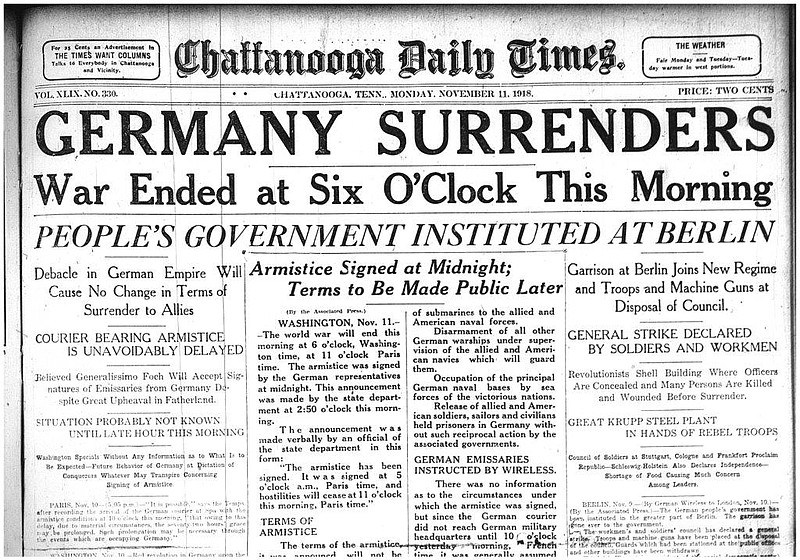
When Germany signed the armistice at 11:11 a.m. (U.S. time) on Nov. 11, 1918, at Le Francport near Compiene, France, church bells across Europe rang in jubilee. The conflict that had ravaged the continent since the 1914 assassination of Archduke Franz Ferdinand, heir to the Austro-Hungarian Empire, had finally ended. Casualties totaled more than nine million military dead and 23 million wounded, almost eight million civilian lost, and more than 1.5 million mortalities in the Armenian genocide.
Following congressional approval of President Woodrow Wilson’s request for a declaration of war against the Axis powers (Germany, Austria-Hungary and the Ottoman Empire), the United States had joined the Triple Entente (Great Britain, France and Russia) in April 1917. Gen. John J. “Black Jack” Pershing, commander in chief of the American Expeditionary Forces, led more than one million American troops in support of the French and British forces, worn down by more than three years of combat.
After the armistice was signed, the combatants met the following June and signed the final peace document in the Hall of Mirrors at Versailles, France. American citizens meanwhile celebrated the victory while mourning their casualties: 53,402 battle deaths and 63,114 noncombatants (porters, stevedores). By late spring 1919, most U.S. troops had returned home and rejoined family and friends.
In Chattanooga, city officials commemorated the Great War veterans’ service by staging a Fourth of July “Victory-Peace Celebration.” The Sunday, June 29 Chattanooga Daily Times invited “All Soldiers, Sailors and Marines of Chattanooga, Hamilton County and Rossville, Georgia” to “an elaborate program” including a parade, presentation of medals, lunch, pageant, evening barbecue and closing fireworks. The day began at 10 a.m. and ended with 9 p.m. illuminations that “represented the efforts of over 2,000 people who have given their unlimited time” to make the celebration “interesting and enjoyable.”
The schedule and directions for participation were detailed in the Times article. The parade was to be formed at the Hamilton County Courthouse with military veterans “massing” by detachments — white and “colored” — and stepping off “down Sixth Street to Market, south on Market to the Western and Atlantic Crossing, then countermarch[ing] on Market to Seventh Street.” At Seventh each detachment was assigned to a specific church for musical entertainment and luncheon. During the meal, the veterans were to be awarded medals for their service and tickets for the “drawing of prizes” later at Warner Park.