
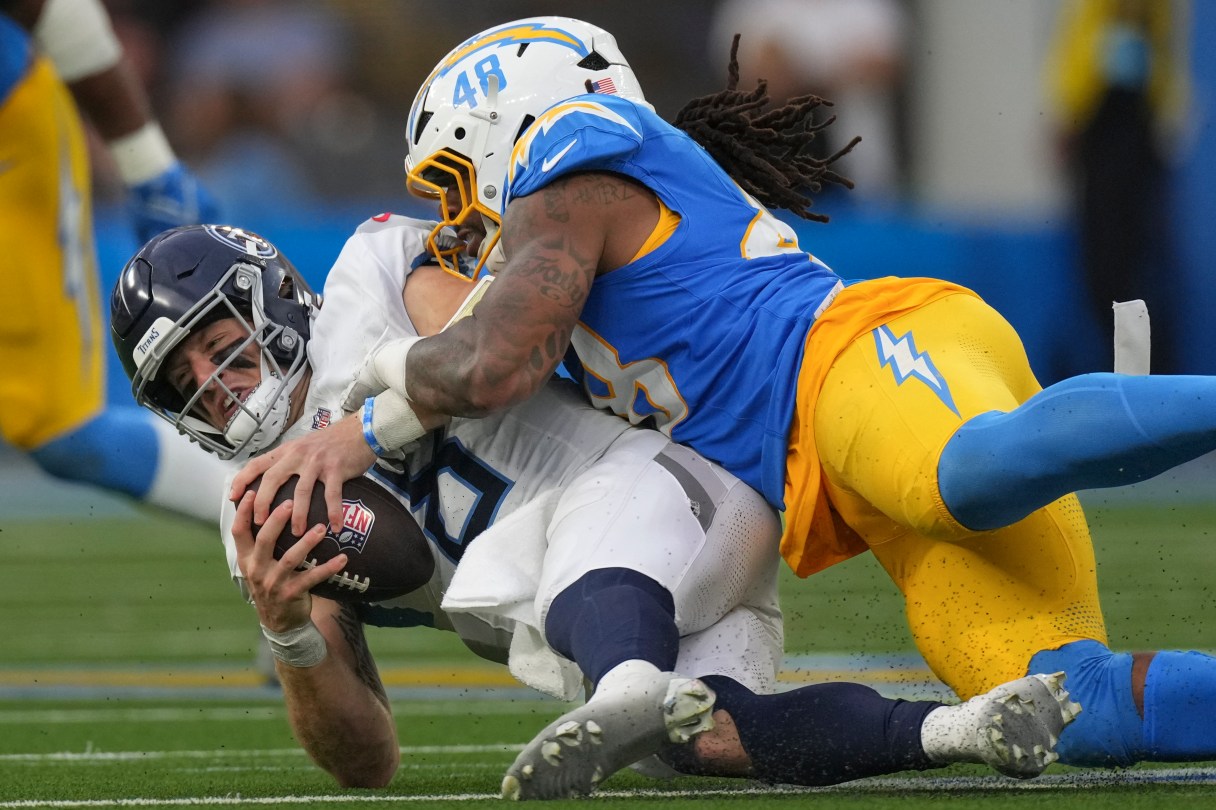
NASHVILLE — Check the stats. The Tennessee Titans’ struggles after halftime of games in 2024 are easy to see.
Defensive lineman Jeffery Simmons said that’s why the Titans are 2-7 with the regular season now past halftime, too.
“Especially in the second half of our games, it’s like we’re not finishing,” said Simmons, a two-time Pro Bowl selection who has spent his entire NFL career with the Titans after they selected him out of Mississippi State in the first round of the 2019 draft. “We have to be able to suffocate teams for four quarters.”
That’s the pressure placed on Tennessee’s defense from an offense that struggles to find the end zone at any point after the opening kickoff, but especially after halftime. The Titans rank 27th in the NFL in averaging a mere 17.4 points a game, and in the final 15 minutes, closing time for winning (or losing) games, Tennessee is last in the league with its average of just 2.9 points in the fourth quarter this season.
The Titans got 12 of their 26 total fourth-quarter points in their biggest win of the season, 31-12 against the host Miami Dolphins on Sept. 30, and they also got a touchdown in the final minute 0f this past Sunday’s road loss to the Los Angeles Chargers — but with Tennessee down by 17 before those points in an eventual 27-17 result, that score was more garbage time than closing time.
First-year head coach Brian Callahan has been growing in his first season calling plays — he was the Cincinnati Bengals’ offensive coordinator the past five years but did not have that play-calling role on game day — but he said the Titans have to be better at scoring in the second half of games than they were in the first part of this season.
Even another touchdown a game would be a huge step forward as the Titans prepare for Sunday’s visit from the Minnesota Vikings (7-2), whose scoring defense is the league’s third best at 17.4 points allowed per game — yes, the same as Tennessee’s scoring average. Minnesota ranks 10th in the NFL in scoring an average 24.6 points a game.
“We’ve been in position to score those (touchdowns) and we haven’t, and thus have not won as many games as I think we are capable of winning,” Callahan said. “But that’s going to be big.”
The Titans can help themselves if they quit hurting themselves with too many turnovers, sacks allowed or penalties. Only the Las Vegas Raiders have a worse turnover margin this season, Tennessee quarterback Will Levis has been sacked an average of 3.6 times per start, and the Titans were flagged nine times just against the Chargers.
Levis, who took over as the starter as a rookie at midseason in 2023, had to learn a new offense when Callahan was hired in January, replacing the fired Mike Vrabel. The quarterback then hurt his right shoulder early in the win at Miami, and although after an open date for the team the following week he returned to the lineup in the next game against the Indianapolis Colts, he threw a late interception in that 20-17 home loss to open AFC South Division play — and later admitted his shoulder wasn’t quite healthy enough for action.
The Titans held Levis out the next three games, and backup Mason Rudolph led them to a 1-2 record in that span. Levis got to watch and learn, and when he returned as the starter last Sunday at Los Angeles, he completed a career-best 78.3% of his passes. The Titans also protected the ball, with the loss to the Chargers the first game this season in which Tennessee did not commit a turnover.
The final touchdown may not have made a difference in the outcome of the game, but Levis and the offense got some much-needed 2-minute drill work against a good team — the Chargers improved to 6-3 with their fourth win in the past five games — and the league’s top scoring defense (13.1 points allowed per game).
“The quarterback’s job is to lead us down and score points, and we need to do more of that to give ourselves a chance to win,” Callahan said of Levis. “And that’s going to be a big part of what we look like over the second half of the season.”
Levis certainly seemed to be more comfortable in his return, when he was 18-of-23 passing for 175 yards and two touchdowns, both to offseason signee Calvin Ridley. An overturned defensive touchdown for the Titans late in the first half changed momentum in that game.
It won’t be any easier Sunday against the Vikings, who give a lot of looks on defense, Levis said. A quarterback easily could spend a lot of time trying to anticipate what they might show him, but that’s not the focus for the Titans.
Said Levis: “It’s going to be more so our jobs, our responsibilities and everyone getting to the right space at the right time.”