
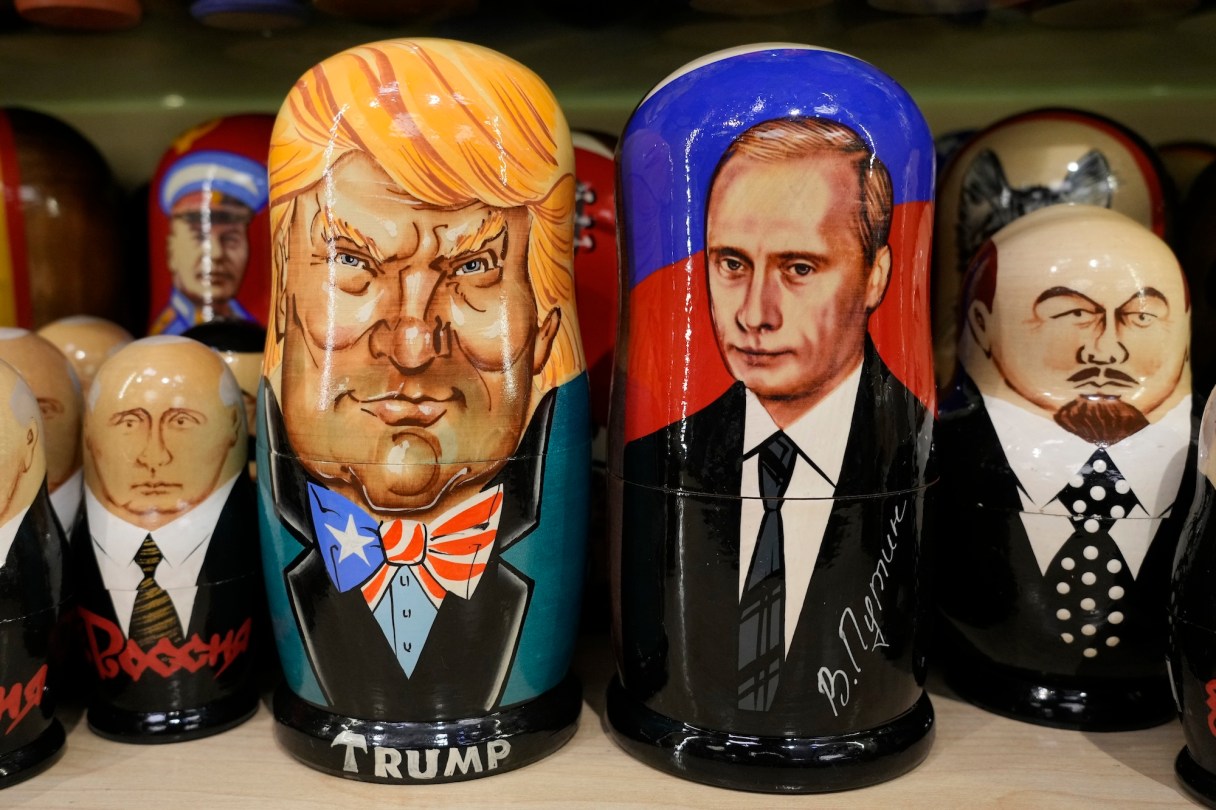
Donald Trump has refused to rule out using force to acquire Greenland from Denmark or the Panama Canal from Panama. Don’t rule out that he might just mean it.
The mere thought that America would extort or go to war with a close NATO ally to illegally change their sovereign borders seems ridiculous. Presumably, it is. Yet the threats also sound familiar. As the president-elect and some of his team members warm up for the White House, they’re speaking and behaving more like President Vladimir Putin’s Russia by the day.
So, what if that really is how Trump plans to rule in his second and final term? He has, after all, expressed admiration for Putin on multiple occasions and is already trying to organize a bilateral summit. The Kremlin says it’s willing.
Putinism has at least three defining characteristics. The first is a profound disdain for democratic constraints, facts and social liberalism, in favor of personal oligarchy, manipulation and anti-“wokery.” The result is a Russian political economy in which Putin dispenses power, truth and wealth as though they were his personal patrimony. Loyalty is the number one qualification for favor, with cash and fear the two-part glue that holds the system together.
The second characteristic is a mafia-style mindset, in which all relationships are approached as questions of allegiance or ownership — whether within Russia or with other countries. They invariably are either transactional or coercive.