
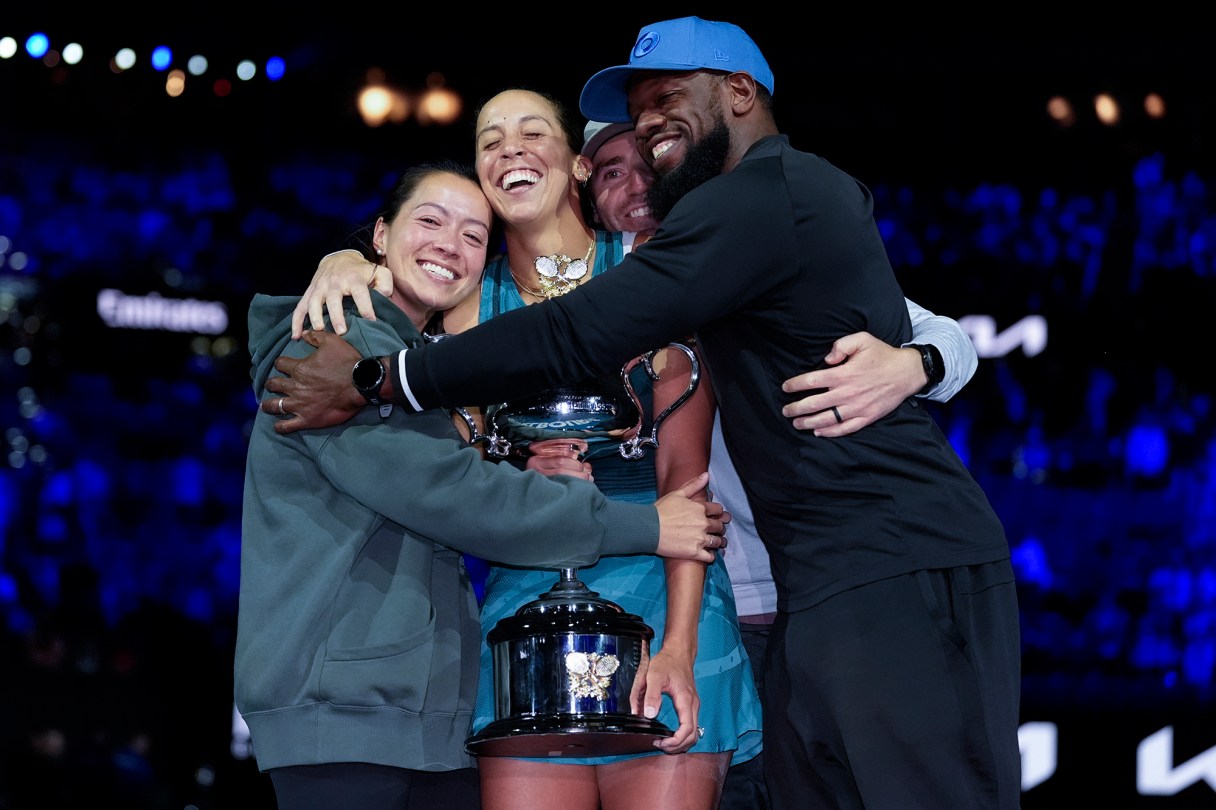
MELBOURNE, Australia — When she stepped into Rod Laver Arena on Saturday night, Madison Keys strode right past the Daphne Akhurst Memorial Cup, the trophy that goes to the Australian Open women’s singles champion and was placed on a pedestal near the entrance to the court.
Keys didn’t break stride. Didn’t stop to stare. That same bit of hardware then was placed near the net for the coin toss before the start of the match, close as can be to where the American player stood. Close enough to touch. Close enough to feel real.
Also right there was top-ranked Aryna Sabalenka, the two-time reigning champion at Melbourne Park, an opponent who would not make things easy on this cool, breezy evening.
Exactly 2 1/2 hours — and one 6-3, 2-6, 7-5 victory over the 26-year-old from Belarus — later, there was Keys, beaming the widest smile while holding that silver trophy with both hands, a Grand Slam champion for the first time at age 29. Keys was considered a future tennis star before she was a teen, and this was her second chance to play for a major title: The first ended in a lopsided loss at the 2017 U.S. Open, an experience that taught her she would need to be able to play through nerves.
It was only after accepting she might never capture a Grand Slam title, and would be fine with that — a change that came after years of therapy — that Keys actually got there.
“From a pretty young age, I felt like if I never won a Grand Slam, then I wouldn’t have lived up to what people thought I should have been. That was a pretty heavy burden to kind of carry around,” said Keys, who reached her first major semifinal a decade ago in Australia.
“So I finally got to the point where I was proud of myself and proud of my career, with or without a Grand Slam. I finally got to the point where I was OK if it didn’t happen. I didn’t need it to feel like I had a good career or that I deserved to be talked about as a great tennis player,” she added. “I feel like finally letting go of that kind of internal talk that I had just gave me the ability to actually go out and play some really good tennis to actually win a Grand Slam.”
Sure did. Keys, born in Illinois and now based in Florida, is the oldest woman to become a first-time major champ in singles since Italy’s Flavia Pennetta, who was 33 at the 2015 U.S. Open (and announced her retirement immediately afterward). This was the 46th Grand Slam tournament for Keys, the third most before winning a women’s major title, behind only Pennetta’s 49 and Marion Bartoli’s 47 when the French player won Wimbledon in 2013 at age 28 (and retired less than two months later).
Keys didn’t take an easy path over the past two weeks, either. Before this three-set victory came one against No. 2 Iga Swiatek in the semifinals, saving a match point along the way. Not since Serena Williams in 2005 had a player defeated both of the WTA Tour’s top two at the Australian Open.
“Winning that match the other night against Iga was really kind of a big hurdle,” Keys said. “I always believed that I could do it, but to do it that way — really I thought to myself after the match that I can absolutely win on Saturday.”
To do that, though, Keys, who is ranked 14th and was seeded 19th in Melbourne, needed to prevent Sabalenka from earning what would have been her third women’s trophy in a row at the Australian Open — something last accomplished by Martina Hingis from 1997-99 — and her fourth major title overall.
When it ended, Keys covered her face with her hands, then raised her arms. Soon, she was hugging her husband — Bjorn Fratangelo, who has been her coach since 2023 — and other members of her team before sitting on her sideline bench and laughing.
Keys had to wait for this moment, yes, but it did arrive.
“I didn’t always believe that I could get back to this point,” she said later after sipping Champagne at her news conference. “But to be able to do it and win, it means the world to me.”
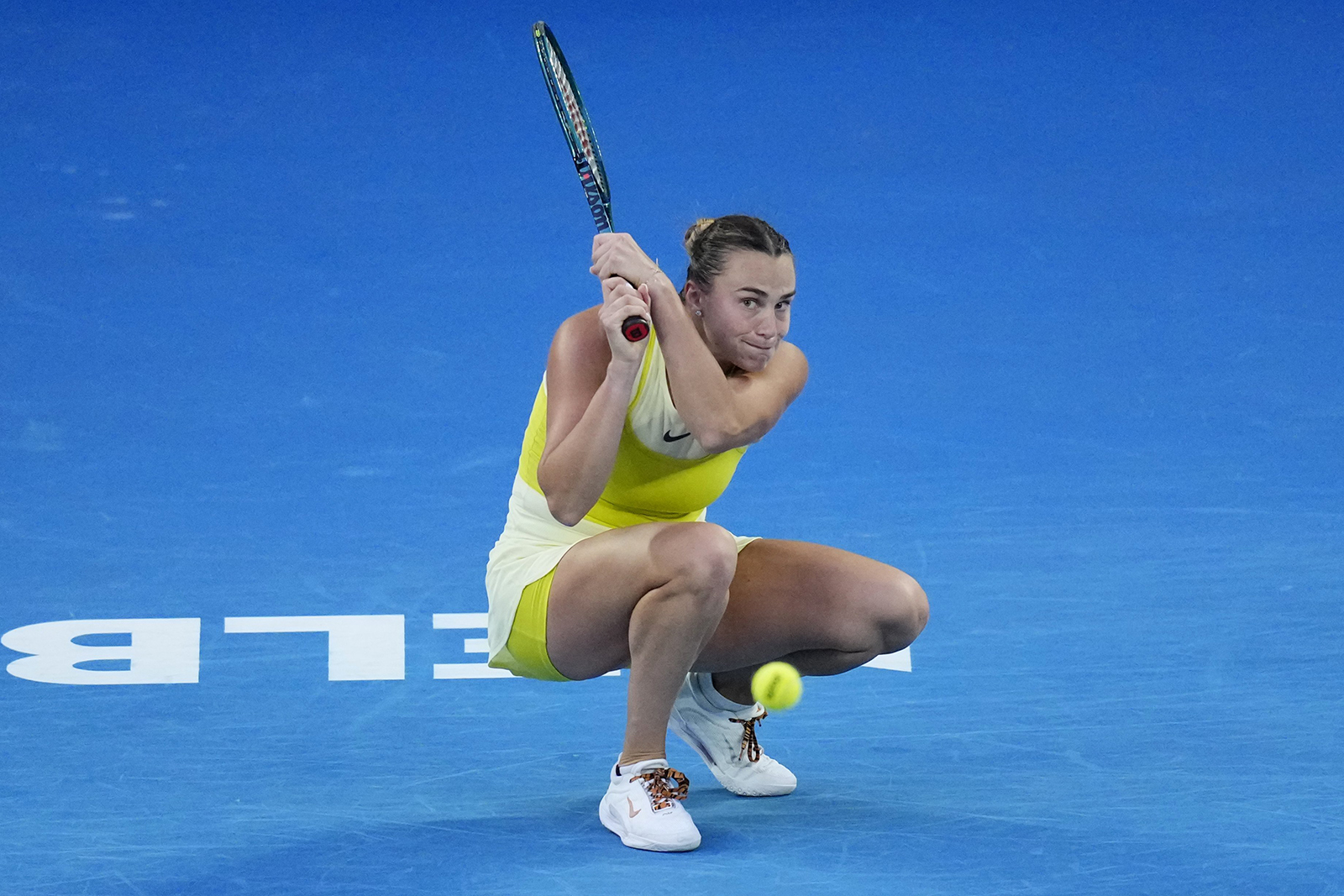 AP photo by Vincent Thian / Aryna Sabalenka crouches as she follows through on a backhand return to Madison Keys during their Australian Open final Saturday at Melbourne Park.
Sabalenka had chucked her racket, covered her head with a white towel and briefly left the court before returning for the awards ceremony. She later explained was gathering her emotions so she could “be respectful” in public.
“It’s OK. I mean, I’m the one who knows that after tough losses, there is good wins,” said Sabalenka, who had entered the final with a 4-1 head-to-head record against Keys. “So I’ll keep working and make sure that next time, if I’ll be in this situation, I’ll play definitely better.”
Keys broke three times in the first set, helped in part by Sabalenka’s four double faults and 13 total unforced errors, but don’t think this was merely an instance of Sabalenka being her own undoing. Keys had a lot to do with the way things were going.
For a stretch, it seemed as though every shot off the strings of Keys’ racket — the one she switched to ahead of this season, at Fratangelo’s urging, to protect her oft-injured right shoulder and to make it easier to control her considerable power — was landing precisely where she wanted.
Near a corner. On a line. Out of the reach of Sabalenka.
Also important was the way Keys, whose left thigh was taped for the match, covered every part of the court, racing to get to balls and send them back over the net with intent.
Never one to hide her emotions, Sabalenka kicked a ball after netting a volley and dropped her racket after missing an overhead. She went to the locker room before the second set, and whether that helped clear her head or slowed Keys’ momentum — or both — the complexion of the match soon changed.
Keys’ first-serve percentage dipped from 86% in the first set to 59% in the second. Sabalenka raised her number of winners from four in the first set to 13 in the second. She also began accumulating, and converting, break points.
When she sent a backhand down the line to force an error by Keys for a break and a 2-1 lead in the second, Sabalenka shook her left fist and gritted her teeth. The action in the third set was tight and tense, without so much as a single break point until its final game, when Keys came through with one last forehand winner.
Here’s how close the match was in the end: Keys tallied just one more point than Sabalenka, 92-91, and each finished with 29 winners.
Despite her initial obvious frustration, Sabalenka managed to show a sense of humor during her speech after the match by squeezing in a joke with her support team.
“As always, that’s your fault, guys. I don’t want to see you for the next week. I really hate you!” Sabalenka said with a laugh. “Thank you very much for everything you’re doing for me and blah, blah, blah.”