
This story was originally published by the Nashville Banner. Sign up for their newsletter at nashvillebanner.com/newsletters.
A little more than an hour before a scheduled interview last week with Rob McGuire, the acting U.S. Attorney for the Middle District of Tennessee, the Nashville Banner had to email a spokesperson to confirm that McGuire still had his job.
News broke Feb. 13 that President Donald Trump’s administration had fired at least a dozen U.S. attorneys the night before. The dismissed prosecutors mainly were appointed by former President Joe Biden and confirmed by the Senate. Historically, such appointees are asked to resign by the new administration but not summarily terminated. Under Trump — who saw the two federal criminal cases against him dropped after his election in November — the Department of Justice has fired prosecutors who worked on cases involving Trump supporters who stormed the U.S. Capitol on Jan. 6, 2021, and threatened a purge at the FBI.
But McGuire, the spokesperson confirmed, was still at his office in the Fred D. Thompson U.S. Courthouse and Federal Building in downtown Nashville, which opened in 2022. That’s likely because McGuire was not appointed to the office by Trump’s predecessor, but inherited it through a series of events he said he never anticipated. In September, Biden-appointee Henry Leventis announced he’d resign ahead of the presidential election after leading the office for around two years. Tom Jaworski took over as the district’s acting U.S. attorney and asked McGuire to be his deputy. A few months later, Jaworski announced his own departure, and McGuire was the next lawyer up.
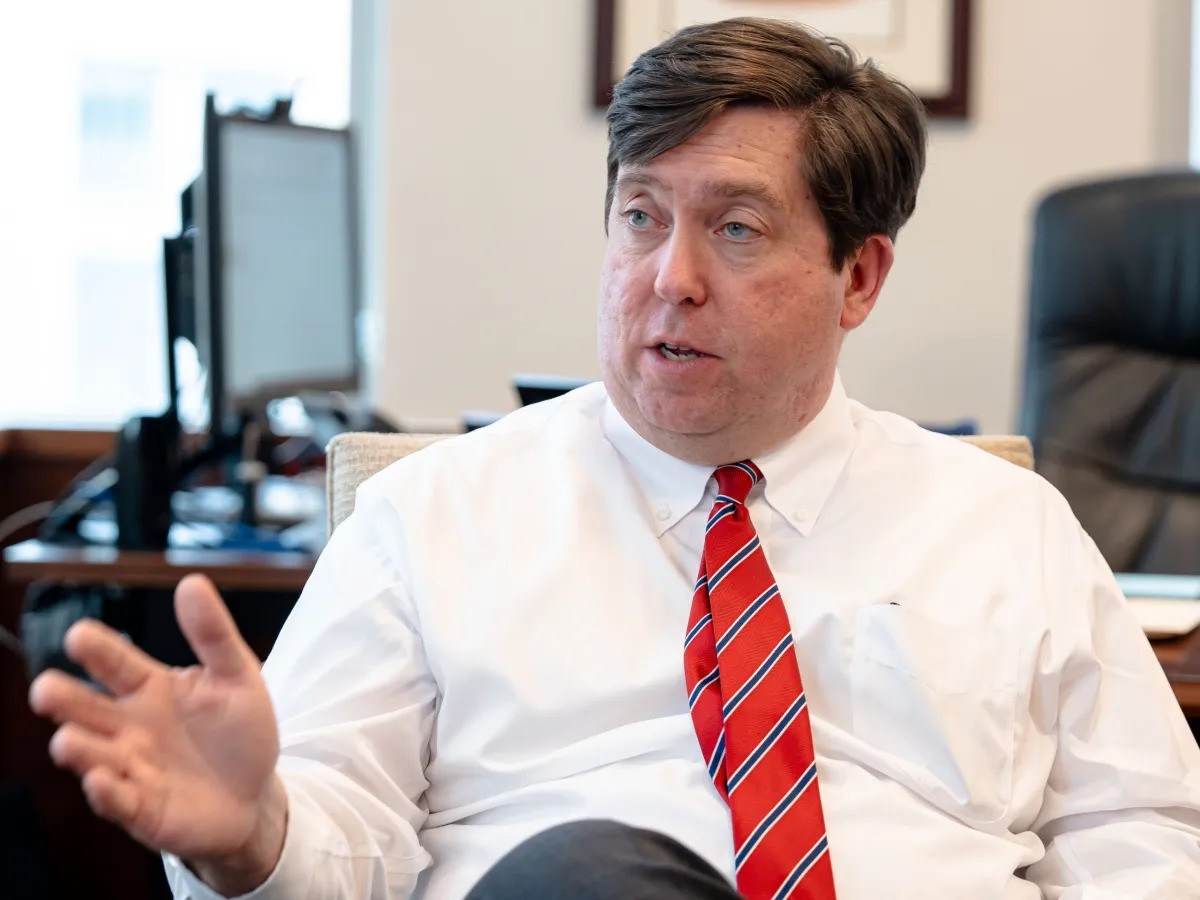
“Here I am, kind of the accidental acting U.S. attorney,” McGuire told the Banner last week from his mostly bare corner office.
A decade after losing the race for Davidson County District Attorney in 2014 — or as he put it, placing second, “which is good in the Olympics” — McGuire is the top law enforcement official in Middle Tennessee.
After moving into his new workspace, he said, he put up some family pictures and other knickknacks. But most of his things are still in his old office and he expects to return there soon. The Vacancies Reform Act of 1998 limits how long an acting U.S. attorney like McGuire can hold the position to less than a year before someone must be appointed to the role. McGuire, a Democrat, isn’t likely to get that phone call from the Trump administration. But when asked if he’d want the job full-time, he didn’t hesitate to say “no.”
“Because they make you leave,” he said. “If you are a presidentially appointed, Senate-confirmed U.S. attorney, it’s a four-year term, it’s at the pleasure of the president, and then when it’s over, you have to leave the Department of Justice. I don’t want to leave the Department of Justice.”
(READ MORE: Hundreds rally in Miller Park for second protest against Musk, Trump)
McGuire said he wants to continue working as a prosecutor and, more specifically, wants to get back to spending more of his time in the courtroom. He spoke animatedly about the honor of “standing in the well of a courtroom representing a victim or their family” and the “rush” of sparring with defense attorneys and judges.
That’s what he went to law school to do, he said. After graduating with his law degree from Vanderbilt University in 2001, McGuire joined the Nashville DA’s office as an assistant prosecutor. He spent 13 years there, working mostly on violent crime cases.
In 2014, then-District Attorney Torry Johnson announced his retirement after 26 years in the job and endorsed McGuire as his successor. However, the first open DA race in nearly 50 years attracted other candidates to the Democratic primary, a de facto general election in blue Davidson County. Longtime defense attorney Glenn Funk decided to run, as did Diane Lance, a former prosecutor and aide to then-Mayor Karl Dean. The three-way contest broke up an initial block of support for McGuire from people in the local political and legal community. Although people inside the office were eager to support McGuire, Funk was better-funded and found more support across the county. He won 46% of the vote, beating McGuire by 10 points, and was reelected for another eight-year term in 2022.
LESSON FROM LOSS
McGuire left the DA’s office and became a defense attorney in private practice. It was an unplanned career detour, but one that he said made him a better prosecutor.
“When I was an ADA, I sort of thought, ‘I understand how important constitutional rights are and the rights of the defendant,'” he said. “You sort of understand that intellectually. But then, when you are in a county jail with a person who is incarcerated and charged with a crime, and you’re talking to them about their rights and helping them through that process, it becomes more visceral. It becomes more real.”
In 2018, he returned to the other side of the bar, joining the U.S. attorney’s office. Almost seven years later he is leading the office of 81 people through Trump’s return to the White House. Several nails are visible on the wall in the reception area, waiting for portraits of the new president and other top government officials.
Every day since Jan. 20 has produced evidence that this is not a typical presidential transition, with Trump flooding the zone with executive orders, threatening retribution against perceived enemies and deputizing the richest man in the world, Elon Musk, to order mass firings of government workers. But McGuire deflected the notion that this is an extraordinary period from the perspective of his office, framing recent events as in line with the ebbs and flows that come with being a prosecutor under various presidential administrations.
(READ MORE: Trump pardons Chattanooga-area Jan. 6 defendants)
Asked about Trump’s pardons of Jan. 6 rioters — several of whom were prosecuted in the Middle District of Tennessee — McGuire noted Biden’s last-minute pardons, which included two people he’d prosecuted. He didn’t personally work on any of the Jan. 6 cases, but said that prosecutors ultimately have to accept such decisions that are above their pay grade.
“We’re like, ‘well, he’s the president and I’m not,'” he said. “He decided to pardon this person and whether I agree with it or not, it’s not up to me. I did my job. I prosecuted the case and however someone decides to handle that is up to them. Our job is to follow the law and the evidence and that’s what we’ll continue to do as well as we can.”
SHIFTING PRIORITIES
He spoke in a similar tone about the DOJ’s new direction under Trump and his attorney general, Pam Bondi, a shift that has alarmed many current and former officials according to The New York Times.
“Different administrations have different priorities, and different U.S. attorneys have different priorities,” McGuire said. “Right now, violent crime and immigration enforcement are huge priorities of the Department of Justice, so that animates a lot of the work that we do. The public elects the officials, and the officials say, ‘this is what we want to see more of or less of.'”
For instance, under Leventis, McGuire said, the office particularly emphasized white-collar crime. One of Bondi’s early moves could dramatically reduce the DOJ’s focus on prosecuting that type of conduct. What the Trump administration has said it wants to see more of is immigration enforcement. The Banner reported this week on undocumented immigrants with no criminal record who have been detained during routine check-ins with Immigration and Customs Enforcement. But the U.S. attorney’s office, McGuire said, has little to do with deportations. He said the administration’s directives will translate to more attention from prosecutors on people who were previously deported after committing a serious crime and have since returned to the country illegally.
“We clearly want to enforce the law as it relates to immigration across the board,” he said. “But in the same way that you’re going to spend more time prosecuting a first-degree murder over the theft of a stick of gum, you’re going to focus on the folks in our community who have demonstrated through their past history that they may pose a danger to the public.”
(READ MORE: Marjorie Taylor Greene leads first meeting of the House Oversight DOGE Subcommittee)
Another likely source of conflict highlighted by Bondi’s directives following her confirmation is competing views of the DOJ’s role in a presidential administration. While federal prosecutors have historically seen themselves as representing the government instead of serving as a president’s personal law firm, Bondi has ordered department employees to perform “zealous advocacy” of the Trump administration’s policies.
However, when asked about the tension between those ideas, McGuire suggested it won’t change much about how he approaches his job.
“I’ve always been a violent crime prosecutor,” he said. “That is what I’m naturally focused on and that is something this justice department is really prioritizing. From that perspective, it’s easy for me — as someone who has done this for almost my entire career — to really dig in on those issues.”
STAYING FOCUSED
Still, some of the office’s recent moves have attracted scrutiny in light of the new administration’s apparent intent to offer leniency for political allies. McGuire filed a motion in court last month to withdraw local prosecutors from a criminal investigation into U.S. Rep. Andy Ogles, the Republican congressman who proposed amending the U.S. Constitution to allow Trump to serve a third term. The filing said the main DOJ office in Washington, D.C, will now handle the case. The Middle District office has declined to comment further on the matter.
In response to a question about whether he had any concerns about Trump asking him or his office to act improperly, or worse, McGuire said he intends to “keep his eye on the ball.” He said that meant pursuing cases like the one his office highlighted in a large media event last week. McGuire and other officials discussed an unsealed indictment alleging that eight Venezuelan nationals had people brought across the southern border and “operated an illegal commercial sex and sex trafficking enterprise out of Nashville motels from July 2022 through March 2024.”
“One of the reasons we wanted to try to make a big announcement about that case is because there is a woman being sexually trafficked right now,” McGuire told the Banner. “More than one. In Nashville. And we need the public’s help to stop that. That is plenty for me to work on. There’s a lot to do already and that’s what I’m going to focus on.”
As McGuire was speaking to the Banner, prosecutors in New York were resigning in defiance of the administration’s order to drop the corruption case against New York City Mayor Eric Adams, which they said amounted to using prosecutorial power to blackmail an elected official into supporting the president’s policies. By the following day, seven DOJ officials in New York and Washington had resigned in protest. Then, earlier this week, nearly 1,000 former federal prosecutors signed a letter expressing “alarm” at the Trump administration’s recent actions.
For now, McGuire suggested, he is keeping his head down and trained at the work on his desk. But with Trump in office, the atmosphere is rarely stable.
This article first appeared on Nashville Banner and is republished here under a Creative Commons license.