
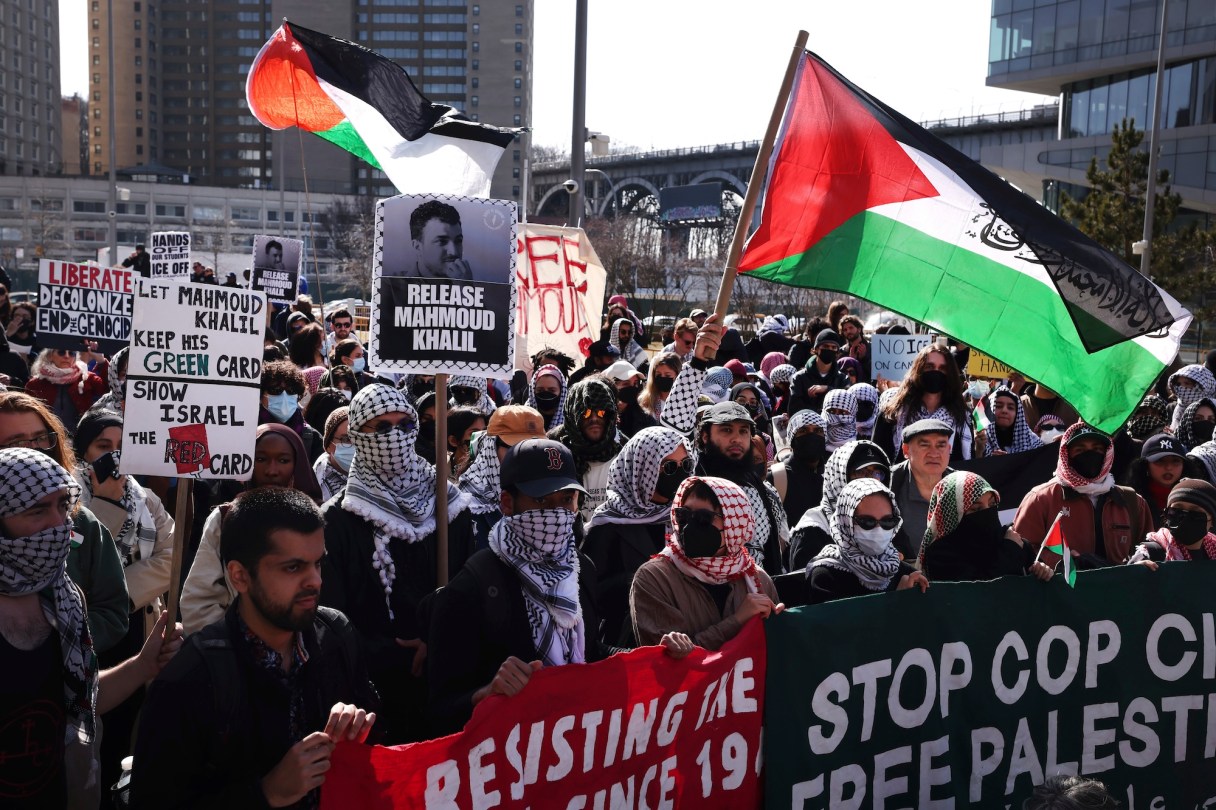
I have been outspoken about my concern about increasing antisemitism on college campuses. But the solution cannot be to deport those who express messages that President Donald Trump, or anyone else, dislikes. Arresting and seeking to deport a Columbia University student for his speech activities clearly violates the 1st Amendment — and does nothing to combat antisemitism on campus.
Mahmoud Khalil, a Columbia University student and Syrian national, was recently arrested in New York by federal immigration authorities. He is lawfully in the United States, possessing a green card. The only known basis for his apprehension is his having been a leader of pro-Palestinian demonstrations at Columbia last spring and allegedly to have said objectionable things about Israel and Zionists.
Trump was explicit in his posts on Truth Social that the arrest and planned deportation were entirely about Khalil’s speech. Trump wrote: “We know there are more students at Columbia and other Universities across the Country who have engaged in pro-terrorist, anti-Semitic, anti-American activity.” He said, “We will find, apprehend, and deport these terrorist sympathizers from our country — never to return again.”
This follows an executive order that called for revoking student visas for individuals suspected of sympathizing with Hamas. The White House said: “To all the resident aliens who joined in the pro-jihadist protests, we put you on notice: come 2025, we will find you, and we will deport you.”
Trump’s statements, his executive order and his actions against Khalil show a profound disregard of the 1st Amendment. All in the United States — citizen and noncitizen — have freedom of speech. No one can be punished under the law, including by deportation, for the ideas they express.
The Supreme Court long has stressed that the Constitution protects the ability to express views that many find deeply objectionable. It has declared, “If there is a bedrock principle underlying the First Amendment, it is that the government may not prohibit the expression of an idea simply because society finds the idea offensive or disagreeable.”
Even if Khalil’s speech was hateful, and even if it was antisemitic, it was protected by the 1st Amendment. The Supreme Court repeatedly has made clear that hate speech is constitutionally protected and cannot be a basis for punishment by the government.
Thus, even those who loathe what Khalil said should fervently defend his right to say it and oppose the Trump administration’s actions. As I constantly explain to my students, the only way my speech will be safe tomorrow is to protect the speech that I detest today.
I recognize that criticisms of Israel, at times, have become antisemitic, using awful stereotypes about Jews. (It also must be stressed that criticism of Israel’s policies is no more antisemitic than it is anti-American to criticize the federal government’s policies.) When there is antisemitism on campus, schools have a duty to respond. But this must be achieved in a way that does not violate the 1st Amendment.
While the actions of the Trump administration will greatly chill speech, they will not address the problem of antisemitism on campuses. My hope is that Jews, whether liberal or conservative, will say loudly: Do not do this in our name or to protect us. We know all too well how government power can be used against a minority group.
Erwin Chemerinsky is dean of the UC Berkeley Law School. His latest book is ” No Democracy Lasts Forever: How the Constitution Threatens the United States.”