

KNOXVILLE — It’s hard to know what to expect from a Tennessee basketball game these days.
Lots of scoring. Not much scoring. Shooting the lights out. Can’t buy a bucket. Questionable defense. Elite defense.
The only constant, it seems, is to expect more fouls to be called in the second half compared to the first 20 minutes.
Tennessee has played eight consecutive contests in which more fouls have been called after halftime, and in most of those cases the difference has been drastic. In this past Saturday’s 81-76 victory over Vanderbilt in the Food City Center, the Volunteers and Commodores combined for nine first-half fouls and 23 second-half infractions.
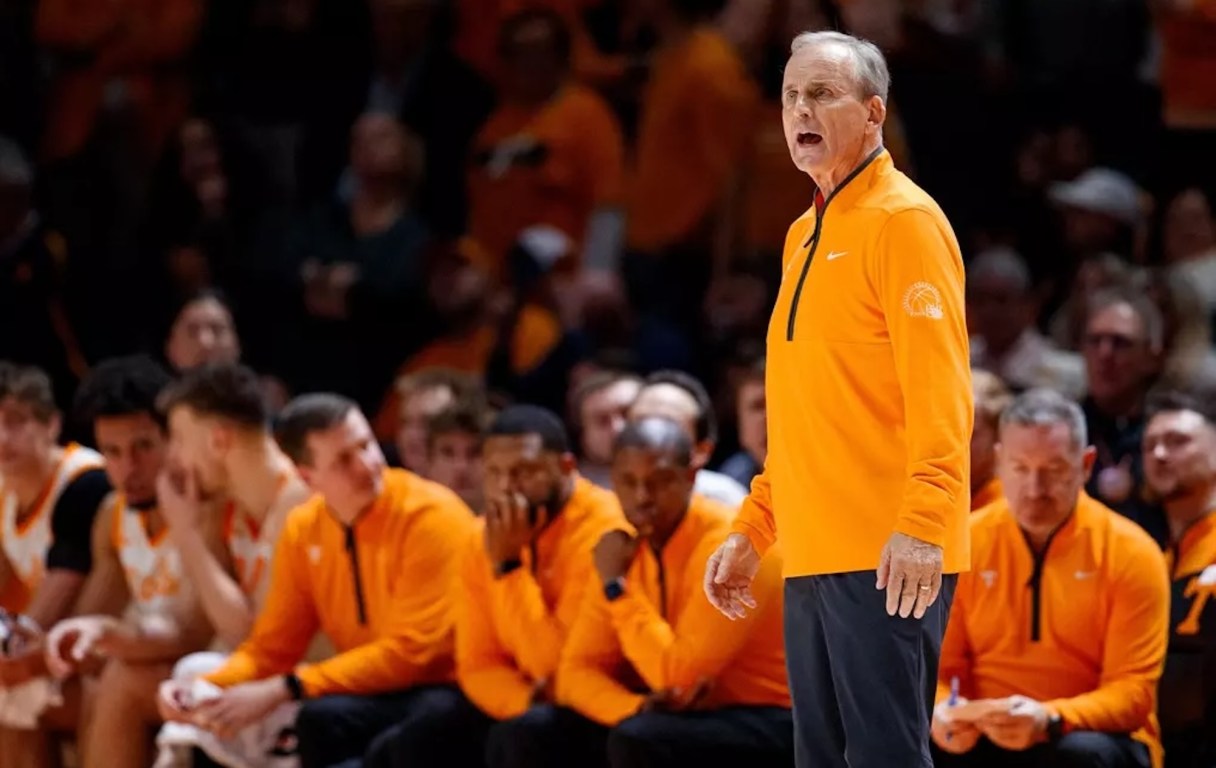
“My only thing about fouls is there are certain things that have to be called every single time, and a big part of that I think is freedom of movement,” Tennessee coach Rick Barnes said Saturday. “In the NFL, they have that pass interference rule where they get it where they get fouled or interfered, and the reason that’s such a bad rule is because every referee gets to call it the way they see it.
“What I love about the NBA officiating is that there are certain things that are a foul on the first play and the last play and in the first game or the last game. That’s where I think we’ve got to get to.”
The Vols certainly stiffened defensively after falling behind 44-31 at halftime Saturday, but the increase in foul calls didn’t do Vanderbilt any favors, either. The Commodores were called for six fouls in the first half and six in the first four minutes of the second half.
Vanderbilt’s two best inside players, 6-foot-8 sophomore Jaylen Carey and 6-7 junior Devin McGlockton, wound up fouling out.
“I can just say for anybody that you always want consistency and just let it be the way it is from the first minute to the last minute,” Commodores coach Mark Byington said. “There were a lot today, and we got in foul trouble early. It hurt having my guys in foul trouble, but at the same time, these refs do a good job.”
It was the second consecutive weekend for Tennessee to experience a noticeable uptick in whistle frequency. In their 70-52 whipping of Oklahoma in Norman on Feb. 8, the Vols only had two fouls at halftime but added five more in the next four minutes.
That game had eight combined first-half fouls and 15 after the break, while the other profound differences in recent Tennessee contests include 31 of the 43 combined fouls against Missouri, 18 of the 26 against Mississippi State, and 22 of the 35 in the first meeting against Kentucky occurring in the second half.
“It’s always a difficult game to officiate when shots aren’t going in or when one team is scoring and the other team is not,” Barnes said. “Today you had two teams that drove the ball really, really hard, and both teams were trying to get fouled. Both teams were in ball screens a lot.
“We knew we had to be more aggressive in the second half and get to the foul line and try to score some with the clock not running.”
Intentionally fouling late in games obviously can tilt fouls toward the second half, but that has not been a factor during this stretch. Tennessee had two such fouls during the waning moments of last Tuesday’s 75-64 loss at Kentucky, and Vanderbilt’s only one Saturday transpired with seven seconds remaining.
Perhaps this is just a unique stretch Tennessee is experiencing, or perhaps it is something the Vols should prepare for next month at tournament time.
“I had an official one night say to me, ‘If he hadn’t scored a basket, I would have called a foul,'” Barnes said. “I said, ‘What’s wrong with the old-fashioned three-point play?’ That I don’t understand, because I believe you’re supposed to officiate the rules of the game, but nobody does it any better than our league.
“I don’t think there is a harder league to officiate than this league right now because of the parity and talent, and I do think the officials are working hard to try to be consistent as far as calling things on both ends. That’s all the coaches look for. In the end, you’ve got to believe it evens out.”
The stretch run
Tennessee, which is sixth in the latest Associated Press poll, is 21-5 overall and 8-5 in Southeastern Conference play.
The Vols do not have a midweek game before closing their league schedule at Texas A&M, home against LSU, home against Alabama, at Ole Miss, and home against South Carolina. Three of those five foes are ranked this week, with Texas A&M at No. 7, Alabama at No. 4 and Ole Miss at No. 24.
Contact David Paschall at dpaschall@timesfreepress.com.