
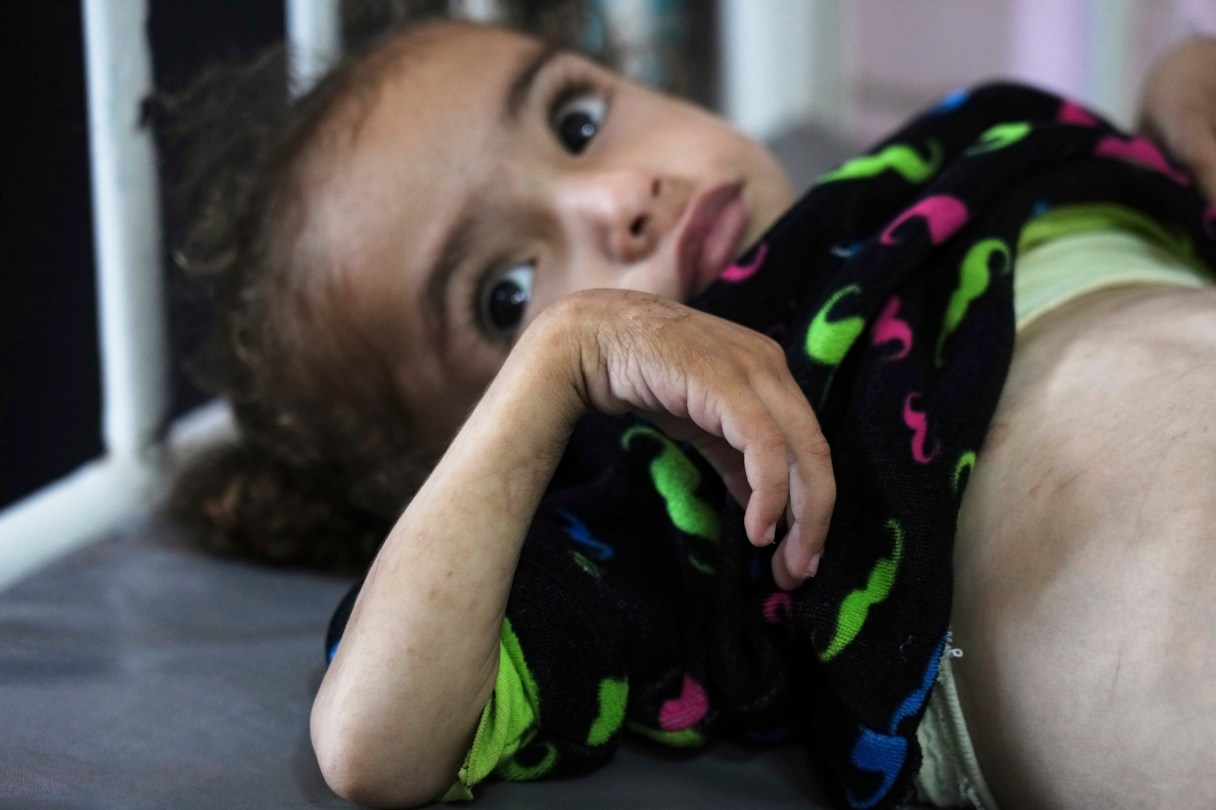
KHAN YOUNIS, Gaza Strip (AP) — Grabbing her daughter’s feeble arm, Asmaa al-Arja pulls a shirt over the 2-year-old’s protruding ribs and swollen belly. The child lies on a hospital bed, heaving, then wails uncontrollably, throwing her arms around her own shoulders as if to console herself.
This isn’t the first time Mayar has been in a Gaza hospital battling malnutrition, yet this 17-day stint is the longest. She has celiac disease, an autoimmune disorder that means she can’t eat gluten and requires special food. But there’s little left for her to eat in the embattled enclave after 19 months of war and Israel’s punishing blockade, and she can’t digest what’s available.
“She needs diapers, soy milk and she needs special food. This is not available because of border closures. If it’s available, it is expensive, I can’t afford it,” her mother said as she sat next to Mayar at Nasser Hospital in Khan Younis.
Mayar is among the more than 9,000 children who have been treated for malnutrition this year, according to the U.N. children’s agency, and food security experts say tens of thousands of cases are expected in the coming year.
Experts also warn the territory could plunge into famine if Israel doesn’t stop its military campaign and fully lift its blockade — but the World Health Organization said last week that people are already starving.