
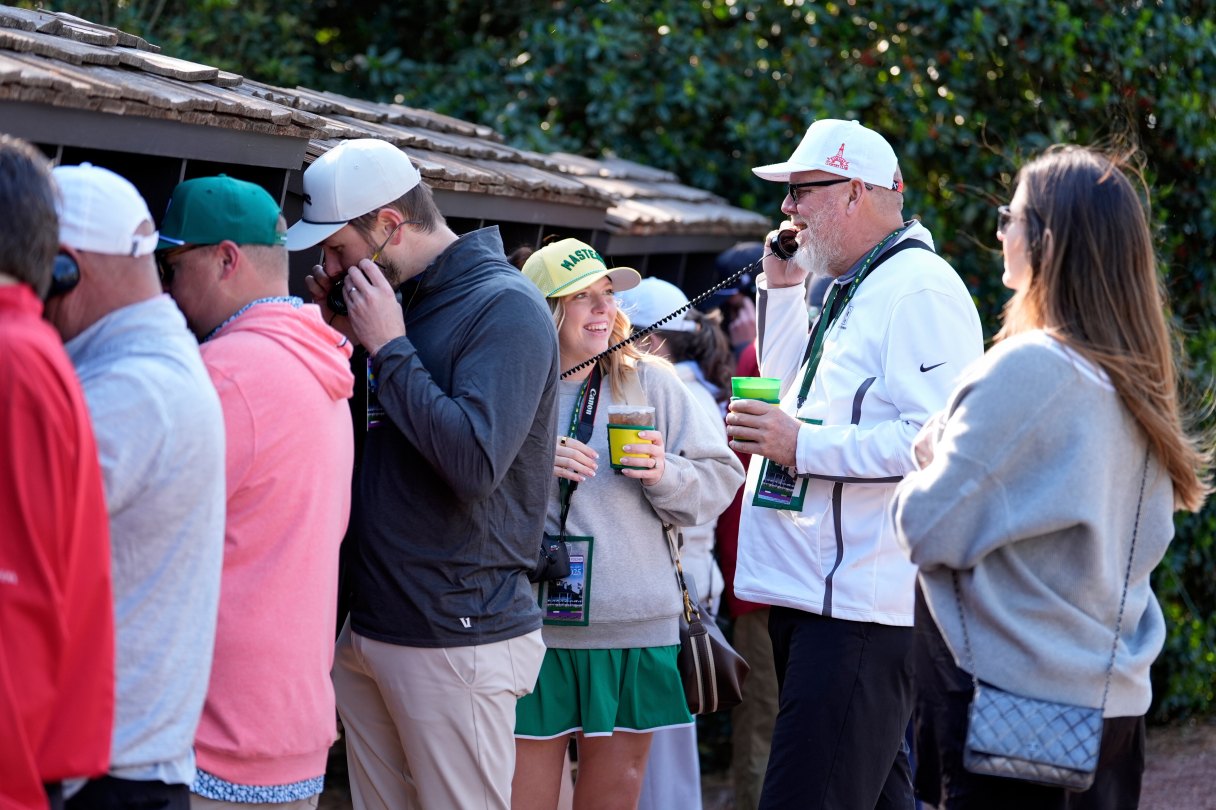
AUGUSTA, Ga. — Attending the Masters is a new experience for Thomas Abraham this week, and it isn’t just about the golf.
The 16-year-old from Houston had the rare opportunity to use a public telephone for the first time.
“It was kind of cool,” said Abraham, who phoned a friend while attending Wednesday’s Par 3 Contest with his father, Sid. “I’ve never used one before. I figured it out. If I had to use one of those (rotary) phones, I probably would’ve had to ask my dad.”
Augusta National Golf Club famously requires its patrons to leave their cellphones and other electronic devices behind. In place of those security blankets, there are several banks of public telephones, those devices from days gone by. They are a foreign sight for many in the younger generation who have never seen a phone with an attached cord, much less used one of them.
A big difference from the old days of pay phones: No need for change, itself an increasing rarity. Calls are complimentary from these courtesy phones.
Abraham is not unlike most teenagers — or adults, for that matter — who are very much attached to the world through their cellphones. At some point, chances are, patrons check for their phone by patting their pockets, reaching for the clip on their belts or searching wherever it usually is.
And when they can’t find it?
“It’s kind of panic mode. … I went to reach in my pocket, and it wasn’t there,” Abraham said, recalling a moment on the 18th hole. “Then I remembered it’s in the car.”
He wasn’t alone.
“I’ve checked my pockets for my phone no less than 10 times today,” said Ryan O’Connor from Little Rock, Arkansas. “I was sitting in the bleachers on the 16th green, and someone dropped a water bottle and it made a loud noise, and I instinctively reached for my phone. Not there.”
The lines of people at the public phone bank can stretch up to 10 deep at the height of the Masters. While they provide an outlet for those looking to touch base with the world outside of the revered course’s gates, there are some challenges that come with them — remembering phone numbers, for one thing.
Bill Kehoe, 50, from Raleigh, North Carolina came prepared. As he approached the public phones, Kehoe whipped out a sheet of paper with a handful of names and numbers written on them with a black Sharpie. He picked up the receiver on the phone, punched in the number “1” to start the call, then looked down at the paper and entered the remaining numbers to complete the free call.
“I can’t even remember my own phone number, let alone anyone else’s number,” Kehoe joked. “They’re all saved in my phone.”
One of the calls he made was to his 14-year-old son Connor, an eighth grader who was on a school field trip to Washington, D.C. Connor had asked his dad to call at a prearranged time while he was on a bus, and his classmates were shocked when his caller ID popped popped up as “Augusta National Golf Club.”
“You could hear all of the kids like, ‘Oh, that’s so cool!,” Kehoe said with a laugh. “But then they all started asking for merchandise, so I had to hang up.”
The reasons patrons disrupt their round of watching golf to make a call vary.
One person was calling to hear about the day’s dramatic movement in the stock market. Another said he was checking in with work. Several others were simply touching base with family or loved ones.
Tyler Johnson and his wife Lauren called home to Roswell, an Atlanta-area suburb, to check on their 5-year-old son, who is staying with his grandparents, “just to make sure there’s no blood,” Tyler said with a laugh. As mom and dad alternated talking to their son, they took pictures of each other talking on the black public phone, an odd sight these days.
“I think the last time I used one of these was 1999, before Y2K, I think,” Tyler joked.
While not having a cellphone is an inconvenience for some, others have come to relish the liberating feeling of being disconnected from the world for a little while.
Fletcher Lord from Little Rock texted his wife after he arrived at the course around 6 a.m. and reminded her not to expect to hear from him all day. He then set out to enjoy a few refreshments on a sunny, 70-degree day amid the serene backdrop of blooming azaleas and tall pines.
“Once you get over the anxiety of not having your phone, it’s a very freeing feeling because it forces you to just be here in the moment,” Lord said.
O’Connor agreed. He phoned one of his old friends from high school just to see if he’d pick up. He did.
“He didn’t recognize the number obviously, but when he saw Augusta National pop up, he said I better pick this one up,” O’Connor said.
Then it was off to enjoy the day.
“Is not having a phone a pain?” O’Connor said. “No, I think it’s actually good for me. Those emails will be there when I get back home.”