
PARIS — The biggest difference Coco Gauff sees between the player who lost her first Grand Slam final at the 2022 French Open at age 18 and the one who will play for the clay-court Grand Slam’s women’s singles trophy again Saturday at 21 — this time against No. 1 Aryna Sabalenka of Belarus — is the way she views the importance of the occasion.
Three years ago at Roland-Garros, the young American was making her debut on that sort of stage and with that sort of prize at stake. It felt like the outcome meant absolutely everything, a burden that was a lot at the time and made her nervous.
Now, the No. 2-ranked Gauff said, she understands “how minuscule” the tennis result Saturday is in the scheme of things.
“Everybody is dealing with way bigger things in life than losing a final,” she said after beating 361st-ranked French wild-card entry Loïs Boisson, 6-1, 6-2, in the semifinals Thursday.
“I’m sure there are hundreds of players that would kill to win or lose a final, so just knowing that (makes) me realize how lucky and privileged I am to be in this position,” Gauff said. “At first, I thought it would be the end of the world if I lost, and, you know, the sun still rose the next day. … Regardless of the result, the sun will still rise.”
Here’s another key difference: The Gauff of today is a Grand Slam champion. She won the 2023 U.S. Open women’s singles final; her opponent just so happened to be Sabalenka.
“I just remember kind of feeling,” Gauff said, “like I was holding my breath to the match point.”
Their head-to-head series is tied 5-5 entering the first No. 1 versus No. 2 matchup in a French Open women’s final since U.S. star Serena Williams beat Russian counterpart Maria Sharapova in 2023.
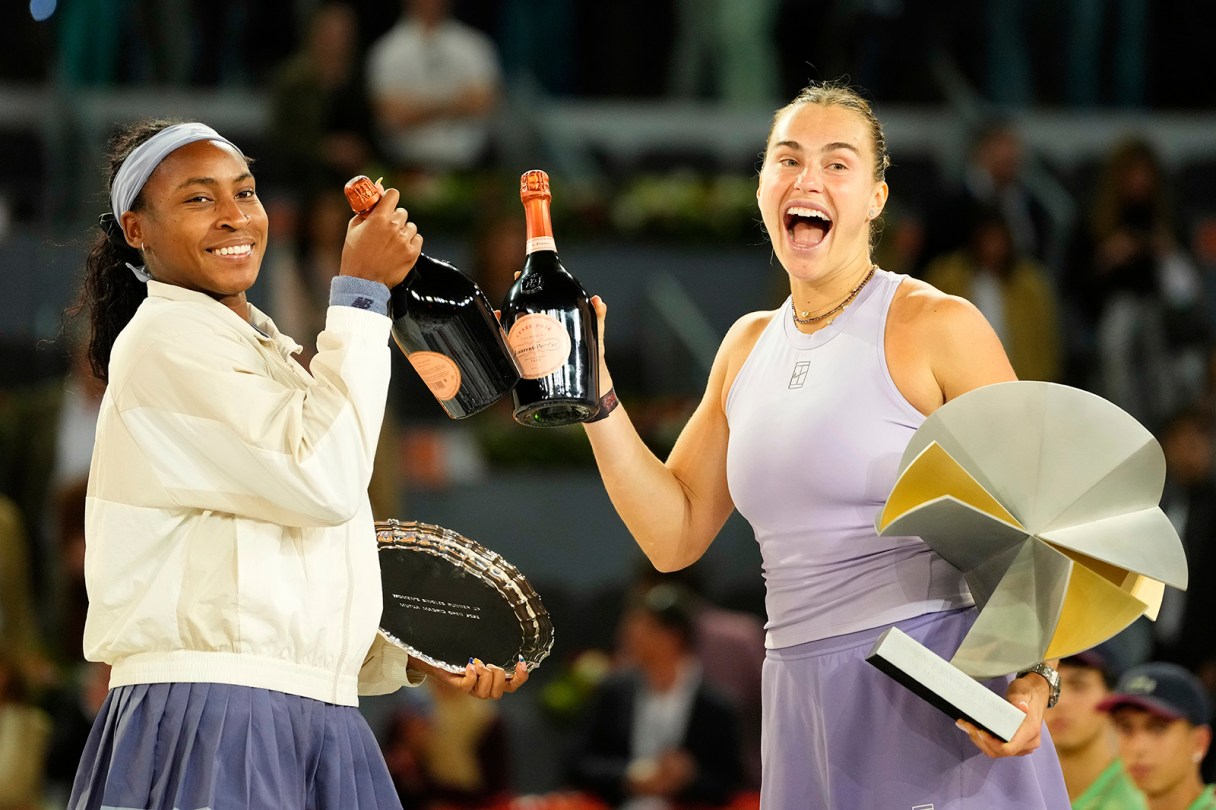
The 27-year-old Sabalenka beat Gauff in their most recent meeting last month at the Madrid Open, which is played on the type of red clay used at Roland-Garros. So she is well aware of Sabalenka’s many talents, which were on full display during a 7-6 (1), 4-6, 6-0 semifinal victory Thursday that ended Polish star Iga Swiatek’s bid for a fourth straight French Open title.
“She can come up with some big shots and big winners pretty much at all areas of the court,” Gauff said of Sabalenka. “She’s a fighter, as well. She’s going to stay in the match regardless of the scoreline.”
After getting pushed to a third set by Swiatek, who had won 26 matches in a row at the French Open, Sabalenka was pretty much perfect down the stretch. Even she called the lopsided nature of that last set “shocking for me.”
She didn’t make a single unforced error; Swiatek had 12.
“The pace was from her (was) super fast,” Swiatek said. “It was just hard to get into any rally.”
Sabalenka took over the top ranking on the WTA Tour from Swiatek last October and has remained there. Sabalenka is 40-6 this season with three titles and, while her three major championships all came on hard courts — at the 2023 and 2024 Australian Opens and the 2024 U.S. Open — the work she’s put in to improve on clay is clearly paying off.
“I can go flat. I can (play) with the spin. I can go back and play in defense,” Sabalenka said. “That’s what works the best on the clay court for me.”
The truth is, regardless of the surface, Sabalenka still appears to be most comfortable when she hits the ball as hard as possible.
Her high-risk style offers a contrast to Gauff, who has been making an effort to be more aggressive with her forehand but usually is at her best when she is making opponents hit shot after shot because she can get to everything with her speed, instincts and defense.
“She’s going to come out swinging,” Gauff said. “I just have to expect that and do my best to kind of counter that.”