
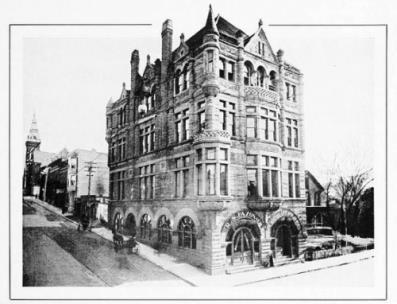
(Editor’s note: First of two articles)
Chattanooga emerged from the nation’s great conflict earlier than many cities and became known, during the final quarter of the 19th century, as the “Dynamo of the South.” By the late 1860s, when local leaders had placed ads in newspapers from New York City to Minneapolis that welcomed “carpetbaggers” and their families, numerous former Union soldiers had already begun an exodus to the “Gateway to the South.” Attracted by Chattanooga’s surrounding beauty, strategic location, and promise — often based on personal experiences while stationed here during the Union occupation — the influx of the enterprising coupled with abundant capital made the city’s rapid recovery an inspiration for others.
By the 1880s, Chattanooga boasted a number of private clubs, where men might “retire” in the evenings to talk business, but most organizations appeared to be more focused on social events than on being business crucibles. The Jackson Club, Cobweb Club, Turn Verein (a German society) and others seemed inadequate, but on Aug.28, 1889, the Chattanooga Daily Times carried an announcement that a group of businessmen had applied to charter a Mountain City Club. The request was signed by Chancellor T.M. McConnell, R.M. Barton Jr., D.J. O’Connell, Alexander W. Chambliss, J.M. Phillips, former Mayor John Bailey Nicklin, Harry S. Probasco, Z.C. Patten and H. Clay Evans, among others.
Within a week, the initial membership met to elect “temporary” officers to guide the process, choosing Barton, president; F.S. Hyde, vice-president; Phillips, secretary; and Probasco, treasurer. A second meeting was scheduled to draft rules, by-laws, and a constitution and explore the possibility of purchasing a lot near the city center for a “handsome club building.” The leadership planned a recruitment process by which 119 invitations were delivered to “the best known and most highly respected citizens,” offering a charter membership for $100 with annual dues of $100. By the following day, 63 had responded, paying the dues to join the newest group that promised to become “the model club of the South in every respect.” Within a week, 86 members had joined with 14 more expected by Sept. 15.
The Nov. 4, 1889, Chattanooga Daily Times carried a lengthy announcement that the Mountain City Club had purchased a 50-foot by 90-foot lot on the northwest corner of Cherry and Seventh streets for $10,000 and had plans to construct a clubhouse. “A better location could hardly have been secured,” and an advertisement in the same issue stated the club’s leadership “invited plans” based on specifications to be submitted no later than Dec. 1. Charles A. Lyerly, F.F. Wiehl and D.J. O’Connell served on the construction oversight committee, guaranteeing the “first-class gentlemen’s club wanted for some time by many citizens.” As Lyerly noted in the notice, the Mountain City Club membership quickly tackled this project with the “usual Chattanooga grit, enterprise and enthusiasm.”