
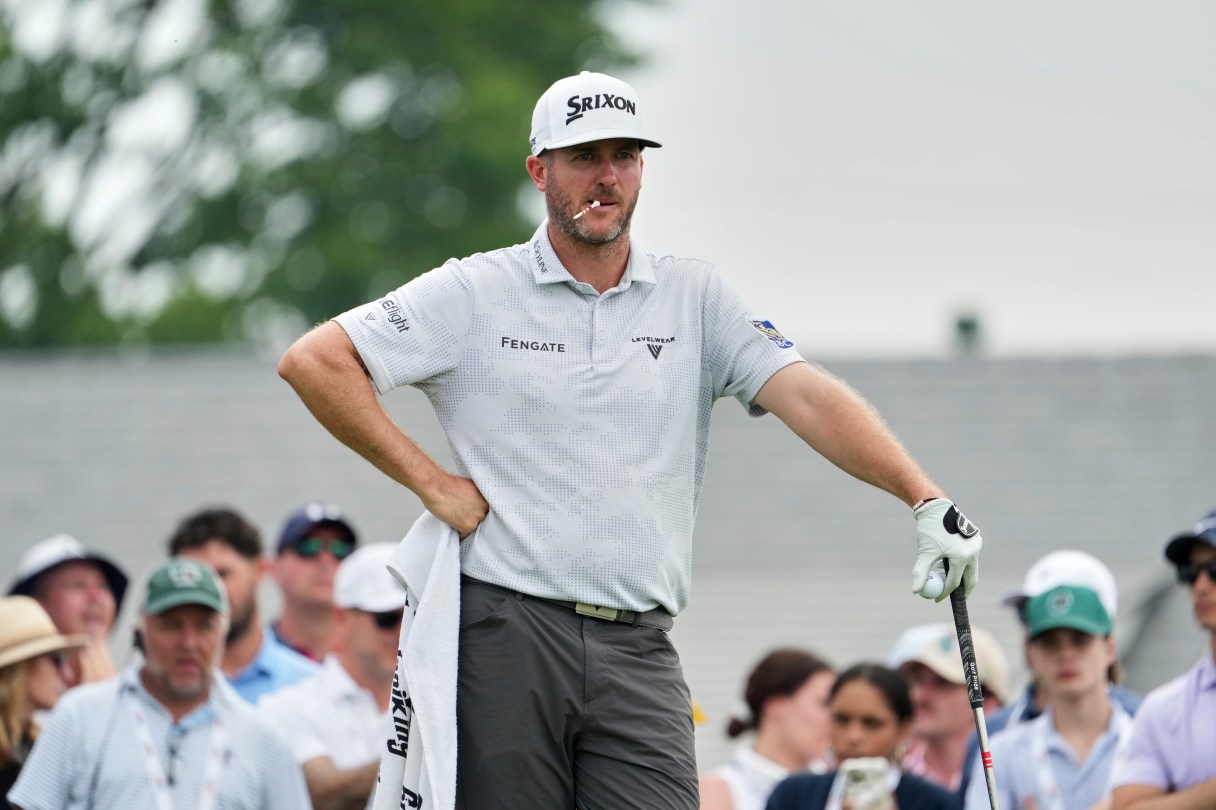
OAKMONT, Pa. — Thriston Lawrence walked onto the 10th tee box at 2:20 p.m. Friday to begin his second round at the U.S. Open with his name near the top of the front page of the leaderboard.
Nearly six hours and 73 shots later, the South African golfer’s name wasn’t so high. And his round still wasn’t quite over.
Welcome to Oakmont Country Club, where one of golf’s toughest tests began with two of the sport’s longest days — or three, in the case of Lawrence and a dozen others still on the course when play was suspended at 8:15 p.m. as a storm passed through.
Lawrence was standing over a four-foot par putt in the middle of a downpour for a 4-over 74 when the horn blew, 5 hours, 55 minutes after his scheduled tee time.
He turned to ask an official if he could putt out. When the answer came back “No,” he marked his ball and hustled with umbrella in hand to the clubhouse.
“Overall, I played nicely, but frustrating day because it felt like we were out there for seven hours,” Lawrence said.
Close enough.
While the late dash of weather didn’t help, the pace at the sprawling par-70 layout carved into a hilly slice of Western Pennsylvania so big it’s divided by an interstate highway spared no one.
Not top-ranked Scottie Scheffler, who admitted it “it felt long to me,” after taking 5 1/2 hours to put together a 71 on Friday morning that left him 4 over for the tournament, seven shots behind leader Sam Burns.
Not first-round leader J.J. Spaun, who needed 5 hours, 40 minutes to finish up a 72 that put him in the final group with Burns on Saturday.
Scheffler didn’t find himself checking his watch too often, though, not even during waits that stretched to 15 minutes or more between shots.
“I’ve got too many concerns other than the pace it takes to get around this place,” he said with a shrug.
By comparison, Scheffler and playing partners Viktor Hovland and Collin Morikawa might have gotten off easy.
It took Lawrence’s group well over an hour to get through three holes, thanks to a logjam on the tee at the par-5 12th. Players were frequently forced to wait 20 minutes or more to hit their tee shot while members of the group ahead of them either waited for the green to clear in hopes of reaching it in two shots or wandered through the 5-inch-plus rough in hopes of finding their ball. (Hardly a given).
Unless you stick it close (and you probably won’t), there’s no chance at making up times on greens so fast and so frustrating that Edward S. Stimpson invented his now-eponymous and ubiquitous tool to measure their actual speed.
Even seemingly innocuous approach shots aren’t immune, as qualifier Will Chandler found out Friday in the second round when his wedge shot into the par-4 second hole landed a few paces from the back of the green, then hit reverse and kept rolling for 40 seconds before settling back in the fairway.
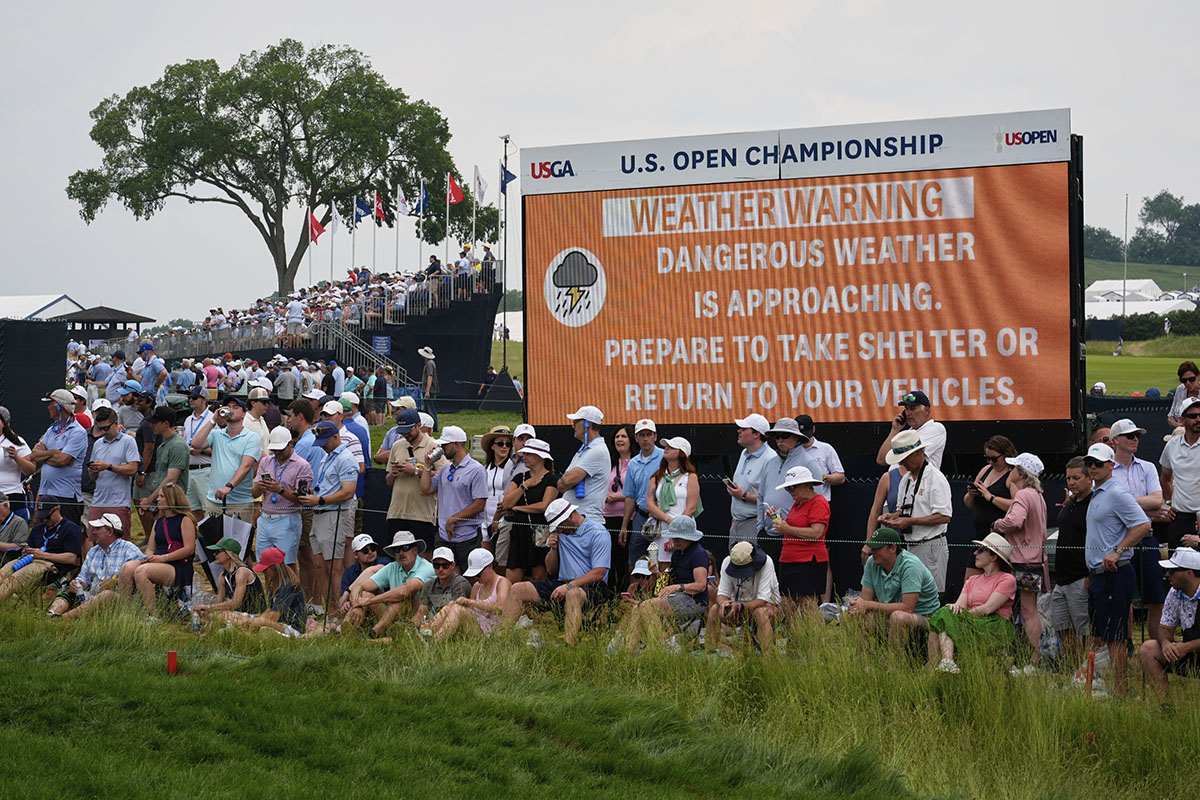
Part of the problem at Oakmont is the combination of the layout — where players literally have to cross a bridge over an interstate to get from the first green to the second tee, and again while going from the eighth green to the ninth tee — and the decisions the course forces you to make.
There’s typically a backup at the par-4 17th, for example, because at close to 300 yards (albeit uphill ones) it’s drivable, meaning the group on the green typically has to putt out before the group behind them can go.
Throw in the stakes — the lure of golf immortality (or at the very least, a healthy paycheck for making the cut) for the pros and the walk of a lifetime for amateurs like dentist-turned-qualifier Matt Vogt — and yeah, things can drag on a bit.
Hovland’s second trip through Oakmont was an adventure. His 1-under 69 in the second round included only eight pars. There was an eagle thanks to a pitch-in on 17, five birdies, three bogeys, and a double.
During a regular PGA Tour event, when scores are lower and the pace is a far more palatable five hours or less, Hovland isn’t sure he would have been able to keep things from spiraling out of control after the second, when a poor drive into the right rough was followed by a mangled pitch into a bunker and eventually a double bogey that threatened to rob him of the momentum he’d build over his first 10 holes.
“If it would have happened at another tournament, for example, I could have potentially lost my mind there a little bit,” he said. “But I felt like I kept things together very well.”
The fact Hovland had time to let his frustration melt away before his driver on the third tee may have helped. The 27-year-old Norwegian knows his game well enough to know that he tends to speed things up when a round threatens to go sideways, and not in a good way.
There was no chance of that on Friday at the toughest test in golf and the United States Golf Association’s big show.
“Yeah, you might have had a bad hole on the last hole, and then you’re sitting on the tee box for 10 to 20 minutes,” he said. “At least it gives you a good opportunity to get that out of your system and reset and think about the next shot.”
Maybe the rhythm of the day will feel more like normal Saturday, when the field goes out in pairs instead of threesomes. Or maybe not.
Considering the lure of history, he’s not going to complain.
“Honestly, we play pretty slow on tour anyway,” he said with a smile. “So what’s another 40 minutes to go around Oakmont?”