
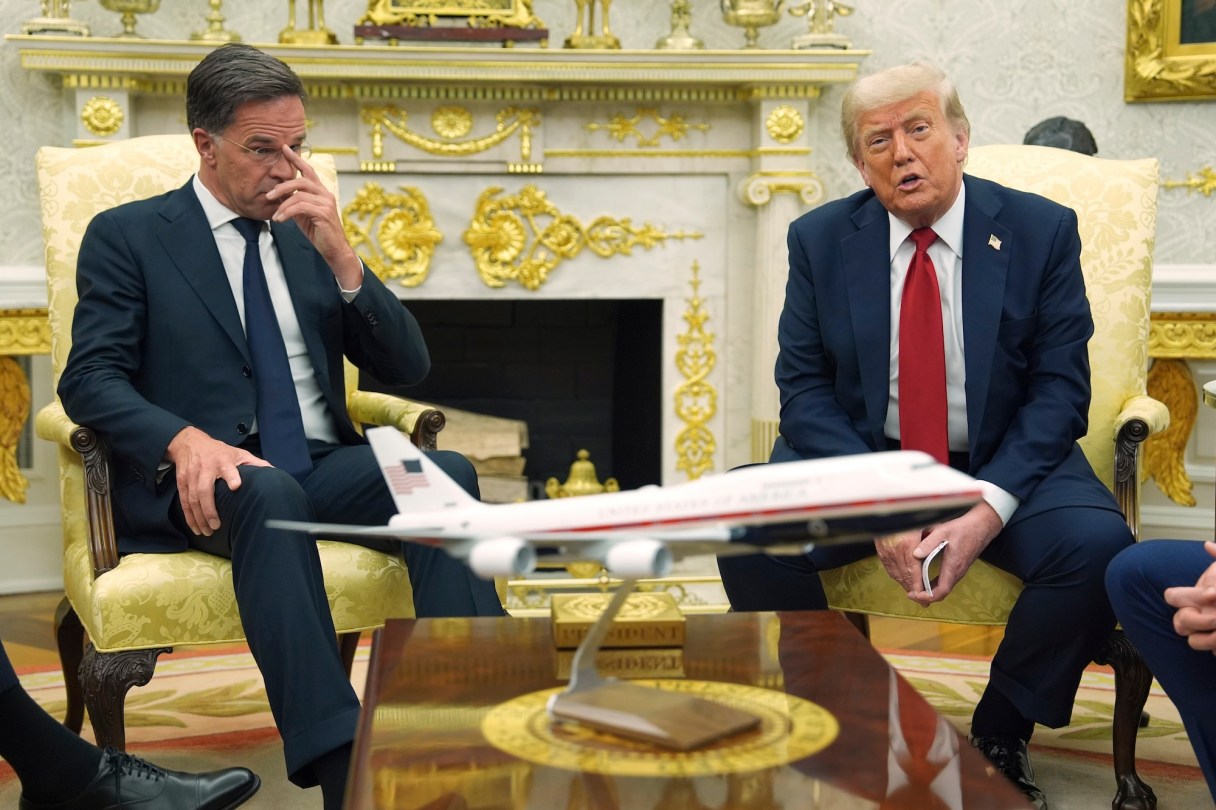
President Donald Trump was tightly wound and unspooling with rapid rambling and redundancy, in his Oval Office event. He was working hard to convince a doubting world that he’s finally getting tough with America’s Number One enemy, Russian leader Vladimir Putin, who he always told you was his friend.
On our news screens, last week, we saw Trump issuing what he considered a tough ultimatum to Putin, built around what he called “very severe tariffs.”
Remember how we got to this place. Three years and five months ago, Putin’s military invaded our ally, Ukraine — the largest invasion of a European nation since Adolf Hitler. Putin’s troops still occupy 20% of Ukraine — and he still bombs families in the rest of it nightly.
But mostly there’s one thing Trump wants you to know — so he said it three times: “It wasn’t my war, it was Biden’s war.” Also: “This is, again, this is a Biden war. This is a Democrat war, not a Republican or Trump war.” And: “I said it before — this is not Trump’s war.”
Sitting alongside Trump in the Oval Office was NATO Secretary-General Mark Rutte. NATO’s leader had just helped him forge a European-funded deal that will speed combat-ready Patriot missiles and batteries to Ukraine to shoot down Russian missiles and drones. Germany will rush two of its Patriot systems to Ukraine. Norway will send one. Both countries will purchase replacements from America.
For years, Trump bragged that he and Putin were friends. This year, he realized Putin made a fool of him, making Trump think he had a deal — then bombing again. Trump said it happened four times.
“I go home,” Trump said, “I tell the First Lady, ‘You know, I spoke to Vladimir today, we had a wonderful conversation.’ She said: ‘Oh, really? Another city was just hit.'”
But Trump also told it the other way — claiming he never fell for Putin’s cons: “He fooled Clinton, Bush, Obama, Biden. He didn’t fool me.” Hmmm.
So Trump used that Oval Office event to publicly give Putin his ultimatum. He’s giving Putin 50 more days to agree to a ceasefire and peace deal with Ukraine. If Putin hasn’t agreed by then — well, America may impose unspecified severe secondary economic sanctions on imports from other countries that purchase oil or gas from Russia. America may impose 100% tariffs on unspecified goods those countries sell in the U.S. The countries may include Russia’s major fuel customers — China and India. Or maybe not.
I was concerned about what Putin seemed free to do in those 50 days. Was Putin free to bomb and slaughter Ukrainian families? I set out to talk with experienced former officials from intelligence, defense, and the White House. My first choice was to call the one ex-official who was all of the above — Leon Panetta, the Democrat who was formerly CIA director, secretary of defense, White House chief of staff and a former congressional chair.
So I had jotted down my concerns about Putin running amok for 50 days — and as I reached for Leon’s phone number, he started telling me just what he thought on all that. Huh? I looked up and there he was — on CNN — voicing the same concerns.
“Frankly, I would have preferred, rather than giving Putin 50 days, the president should have said: ‘By the end of next week, if you do not agree to some kind of ceasefire, we are going to implement sanctions immediately,'” he said. “That ability to be tough and strong with Putin is what is needed now more than ever.”
Exactly. And of course, there was one more thing. Panetta said:
“For those of us in intelligence that have watched Putin for a long time, we know that Putin will be Putin — that he cannot be trusted… The important thing now is for the president to be very tough and to be very clear that he will do everything he can now to help the Ukrainians be able to defend themselves. And he will not back away from it.”
Exactly. But can Trump take that stand — and then stand firm?