
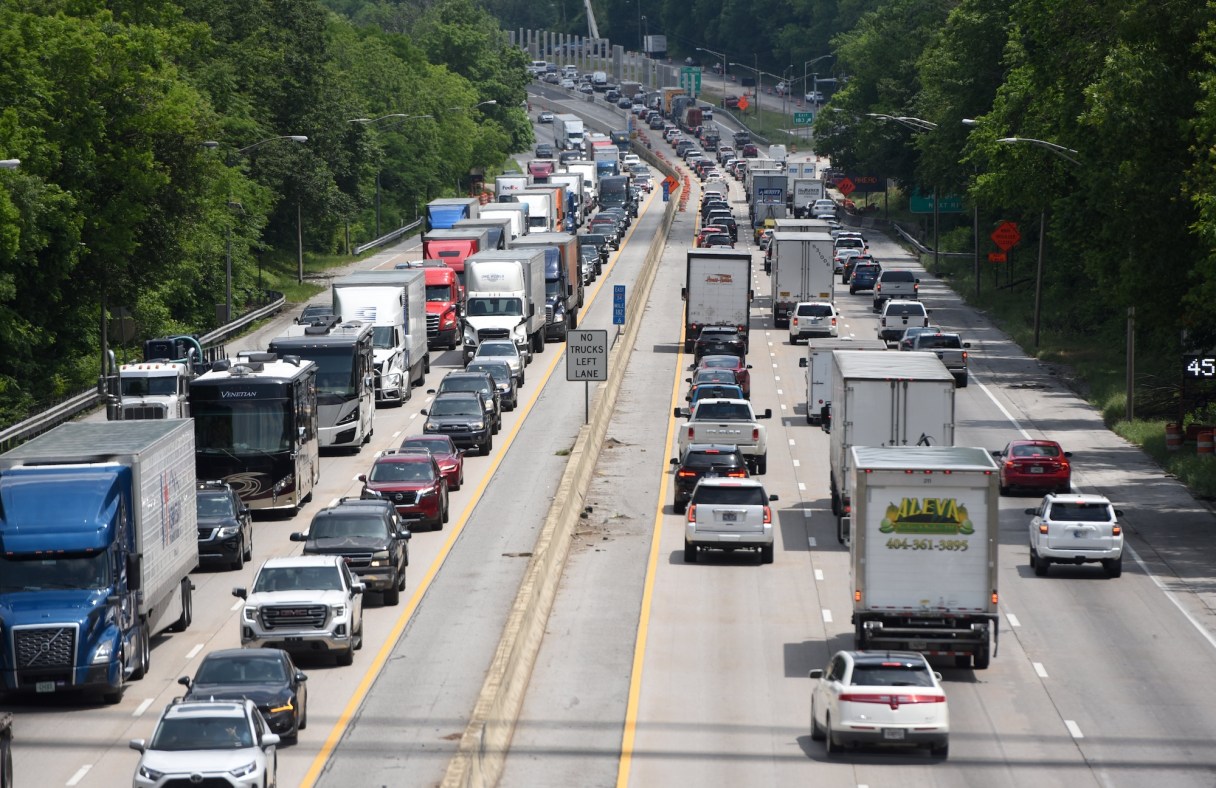
If you’ve driven through the I-75 / I-24 interchange lately, you know the feeling…wedged between tractor-trailers, stuck in stop-and-go traffic, and watching your ETA on the GPS creep later and later. For many of us, this drive has become stressful at best and downright dangerous at worst. Recent flash floods and tragic crashes are a sobering reminder that these are not just traffic jams. These are multi-ton machines moving people and products, and the stakes are high.
You aren’t alone in feeling it. Chattanooga is one of the busiest freight corridors in the entire country. Every day, more than 20,000 trucks travel through our interstate system. That number is climbing, and it’s affecting daily life for families, commuters, businesses, and visitors alike.
At Thrive, we recognize that the I-24 corridor through Moccasin Bend isn’t just a local road — it’s a critical freight route for the entire southeastern United States. I-24 connects distribution hubs and manufacturing centers across our Tennessee, Georgia, and Alabama region. When congestion bottlenecks here, local delivery schedules slip, operating costs climb, and safety risks increase for our families, as well as company drivers.
The Tennessee Department of Transportation is already working on widening I-24 through Moccasin Bend. That project is moving forward, and Thrive has not taken a formal position for or against it. Our role is to convene and elevate regional perspectives to ensure freight needs are weighed alongside community, environmental, and economic impacts.
But here’s the reality — research shows widening alone is not a silver bullet. Increased capacity can temporarily ease congestion in freight-heavy corridors, but eventually more lanes invite more traffic. That’s why widening is one piece of a much broader strategy. If we want real, lasting relief on our interstates, we must think beyond asphalt and consider technology, multimodal options, and smarter land use.