
AI-generated clip is not acceptable
I was locked in watching the Baylor-McCallie game Friday night and know very well the rivalry. I went to the games with my dad growing up and have continued to dial in for 50 years. TFP Sports Editor Stephen Hargis’s article was excellent.
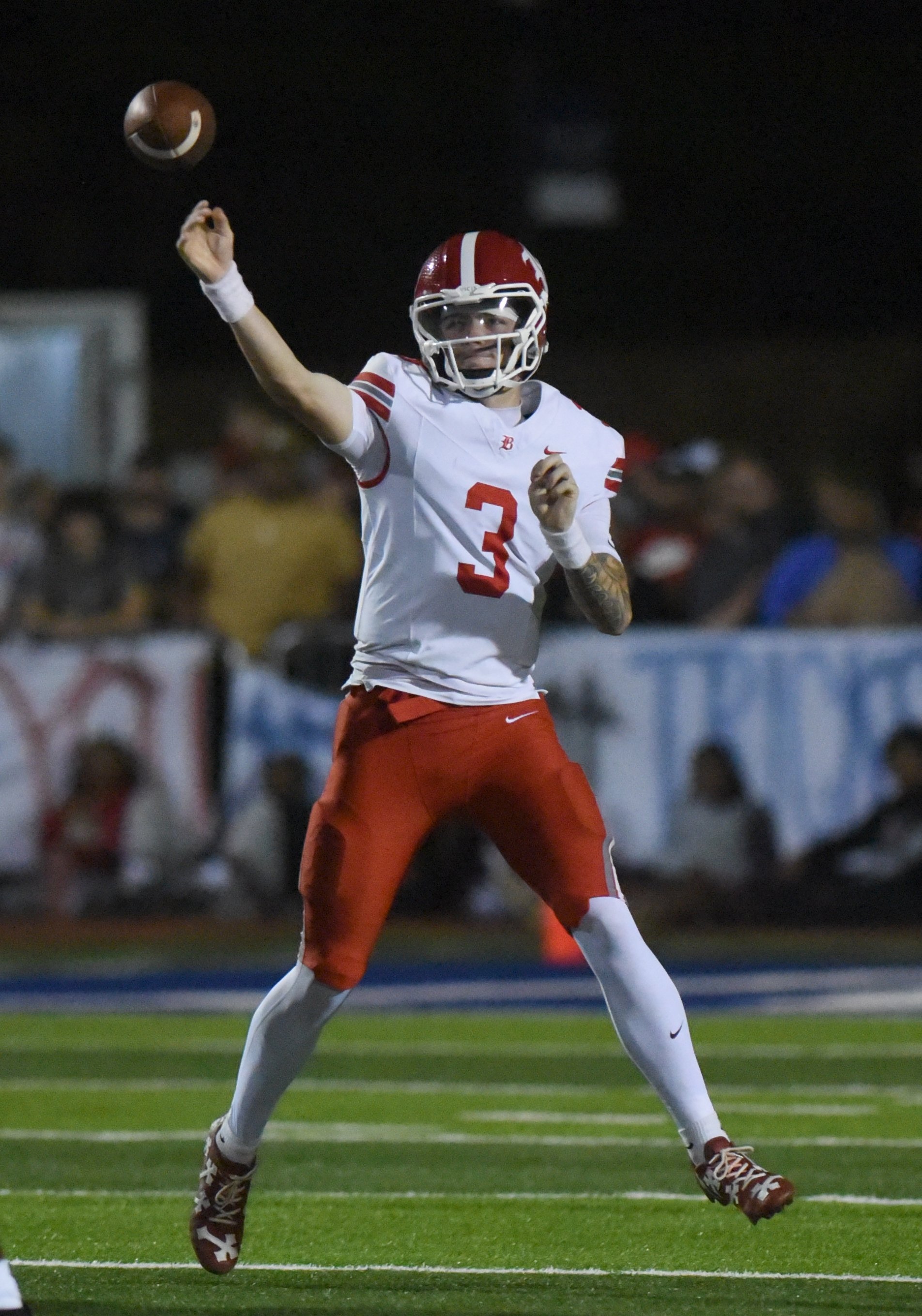
As a mother of two sons who are Baylor alums and now the grandmother of twins, I was appalled to read about the AI-generated video clip that was shared on social media, a photo of Briggs Cherry’s deceased grandfather and an emotionally distraught young man dealing with that loss. Add to that a voice meaning to depict his grandfather leaving a message with racial slurs and vulgar language.
When did this become acceptable behavior, and who knew about it and covered it up? This is mean-girl behavior coming from “boys will be boys,” and I am not OK with it. I would like answers.
Thank you for including it in your article.
Lisa A. McBryde
Hixson
Ryder Cup behavior inexcusable
The Ryder Cup golf tournament between Europe and USA was recently played at Bethpage Black in New York. USA did not play well, and after three days of play, Europe won.
As disappointing as the loss was, the action of some fans was far worse.
Emotions at sports events run high. Some fans were over the line. And the world was watching.
The language used against team members of Europe was unbelievable.
The obscene chant aimed at Rory Mcllroy was constant for three days.
It was not the best day for USA and the actions against Europe. Shameful and embarrassing.
Ruth Cote
Hixson
Why is city unable to live within budget?
The Chattanooga City Council approved a 24.5% property tax increase, with Mayor Kelly insisting it was needed to fund more for police and fire. That claim doesn’t hold up.
Over the past five years, the general fund has grown by 32% and the overall city budget by 34%, while the police department’s budget has grown by only 23%. If public safety were truly the priority, the city could have directed more of its existing revenue to police and fire. Instead, those dollars went elsewhere — and now taxpayers are being told that public safety justifies a tax hike.
This is even harder to accept given Chattanooga’s growth. Property values here have risen faster than the national average, well above inflation. New housing has expanded the tax base and increased revenues. Thousands of new hotel rooms — with more on the way — generate hotel taxes, while record tourism drives sales tax revenue from restaurants, events and attractions. By every measure, city revenues have already grown faster than inflation and faster than peer cities. In fact, Chattanooga collected $233 million more in 2024 compared to 2019. Where has all that new money gone?
Property taxes take a fixed percentage of our home’s value. Raising that rate means we all pay more directly, and it risks depressing appreciation or even causing home value declines compared with cities that manage their finances responsibly. Just ask the many families relocating from Illinois, New York, New Jersey and California who fled high taxes and runaway spending.
The mayor and council owe taxpayers an honest explanation about why they still cannot live within their already rapidly expanding budgets.
Matthew Schwingel
Country not better if Trump is popular
The Chattanooga Free Press editorial of Oct. 7, 2025 editorial refers to the editor’s hope “for the country’s sake” that Trump will be “immensely popular in 2029.” What a ghastly thing to hope for.
If Trump is indeed popular by 2029, it would be because a large majority of the population has come to not only accept but actually embrace his arrogant disregard for constitutional restraints and norms.
Far more patriotic things to hope for by 2029 would include the courts and Congress fully reasserting their authority and reining in a lawless White House. True Americans will also hope that by 2029 Donald Trump will have been removed from office by constitutional means, and that he and his toadies are both out of power and facing justice. Most of all, we should hope that an engaged citizenry has flocked to the polls in 2026 and 2028 and elected decent, upstanding men and women to replace the sniveling majority that currently enables Trumpism.
David Cofield
LaFayette, Georgia
Tennessee growing new desperate class
The Guardian’s recent fine article “Banned! The 20 Books They Didn’t Want You to Read” suddenly clicked an explanation into place for me.
Since the start of this country’s campaign to drive out or incarcerate every undocumented person, anyone who even looks like they may be undocumented, and especially those who are in the process of being documented, I have mulled over what we plan to do for folks desperate enough to do all those jobs no one born here wants to do. Who will pick berries in 110-degree weather? Who will clean motel rooms? Who will labor on roofs under the sun’s blaze and care for our Alzheimer’s elderly and work at meatpacking and chicken processing?
Then it struck me. We want to home-grow our desperate people. And how do we do that? First, gut public education funding, drive teachers out of the profession with blame and impossible-to-meet standards, and sell the bogus narrative that anyone can learn just as well online as in person. Then feed the kids only the most anodyne reading material, nothing controversial, nothing that makes them think. Thinking critically paves the path out of poverty and desperation.
So, well done, Tennessee and Utah and all you other book-banners. You have a great plan. We’ll grow our desperate class. But anyone who thinks these books will disappear simply because you ban them should read Bradbury’s “Fahrenheit 451.” People will always talk about banned books. They’ll especially talk about those.
M.D. Roblyer
Taxpayers shouldn’t foot Northgate bill
Chattanooga should not use Tax Increment Financing (TIF) to cover CBL’s private stormwater project at Northgate Mall. TIFs are meant to spur real community growth, not bail out mall owners for basic property upkeep.
If approved, this deal shifts private costs onto taxpayers while our schools, roads and public services go underfunded. Small businesses don’t get to hand their maintenance bills to the public; neither should large mall owners.
Public money should serve the public good, not subsidize private profits. Let’s keep TIF where it belongs — supporting projects that benefit the whole community, not just one mall owner.
David Long
Hegseth decision ’embarrassing’
That Pete Hegseth’s War Department is allowing 20 7th Cavalry men who participated in the 1890 Battle of Wounded Knee to retain their Medals of Honor is an uneducated, embarrassing and immoral travesty of American history. This “battle” has long been known to have been a massacre of at least 300 Lakota men, but mostly their women and children, by the 7th Cavalry assigned to monitor South Dakota’s Pine Ridge Reservation.
The majority of the 30 soldiers killed in the action were victims of “friendly fire” from several Hotchkiss guns employed by their comrades who had encircled the Lakota camp. Some 20 Medals of Honor were awarded to the soldiers to make it look like a larger and more heroic action than it really was.
In contrast, World War II’s D-Day saw 13 MOHs awarded. On Iwo Jima, where nearly 7,000 Marines and some 18,000 Japanese were killed during the fighting, 27 Medals of Honor were awarded.
Apparently, restoring the “warrior ethos” means that seeing Wounded Knee as a massacre was “woke,” and as Hegseth told the generals, “I’m happy all that bull—— in the past was addressed, and I don’t have to deal with it.”
Grady S. Burgner
Manageable economy means limits, choices
In the midst of a government shutdown and competing narratives over government spending and debt, it may be helpful to recall the basic economics we hopefully learned in high school. On Day 1, we learned that the word “economics” is derived from Greek words meaning “household management.” Making ends meet so that everyone in the household at least has the essentials. On Day 2, we learned about scarcity, the simple concept that there is a finite supply of the world’s goods. And that to obtain anything legally incurs a cost — money, sweat, whatever. And on Day 3 and related to scarcity is the concept of trade-offs or opportunity cost — because the supply of goods is finite, if you choose A, you may not have the resources to also choose B. One or the other.
The government’s fiscal year has just ended, and the deficit is once again in the neighborhood of $2 trillion, racking up a current debt of $37 trillion. In the real world of economics, this is unmanageable. Now trade-offs. One party trumpets the need for enhanced health care premium subsidies, scheduled to expire Dec. 31. What compassionate person can argue against health care for all? But to add many more billions to the current deficit comes necessarily with a cost (there’s no free lunch), so if we choose this option (A), we must forgo a lot of something else (B).
Politicians speak as if money grows on trees. It doesn’t. In the real world, it’s all about scarcity, limits and choices. Always has been and always will be.
Gary Lindley
Lookout Mountain, Georgia