
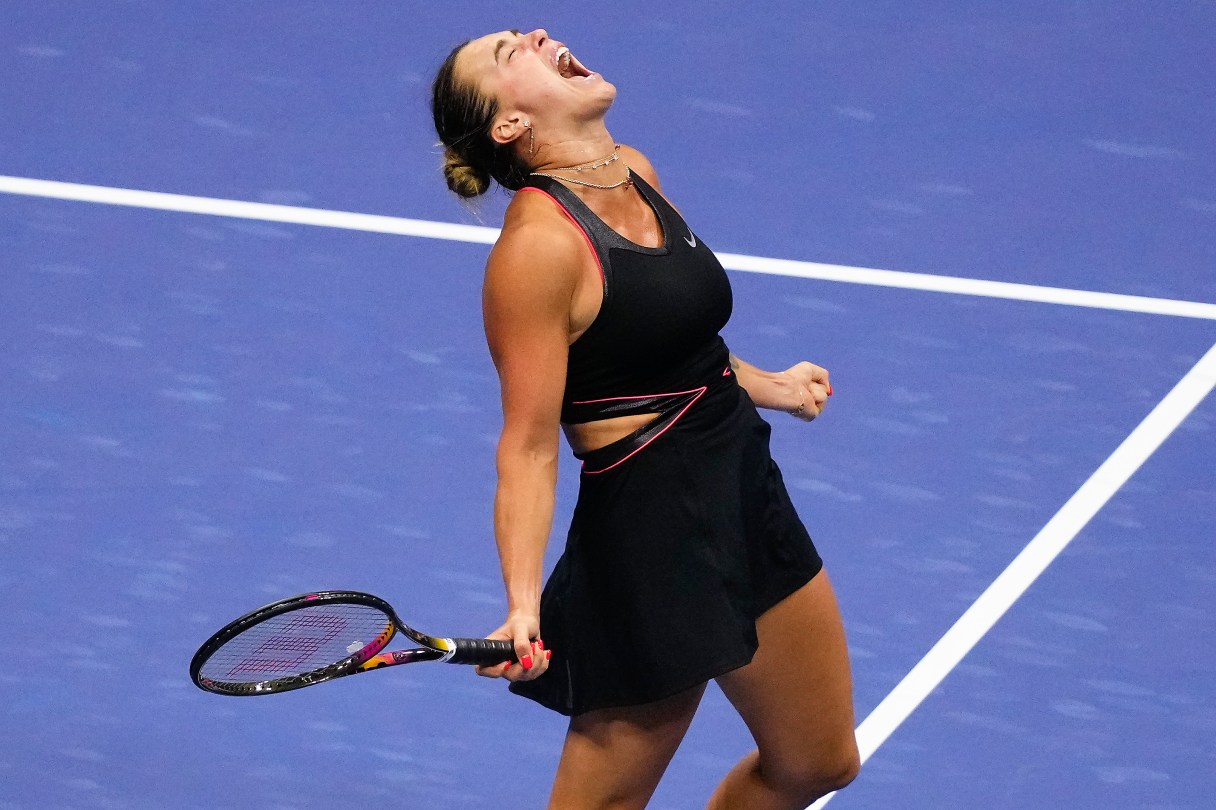
NEW YORK — On Aryna Sabalenka’s first chance to end her U.S. Open semifinal against Jessica Pegula and earn the chance to play for a second consecutive trophy at Flushing Meadows, the reigning women’s singles champion dumped what should have been an easy overhead into the net, then stared at the ground.
On her second chance, she missed a clumsy volley — and later acknowledged she shouldn’t have ventured forward, because she went just 15-for-27 when up at the net.
Uh-oh.
So good at important moments in the high-stakes, high-tension final set, Sabalenka held it together there and held on, converting her third match point Thursday night for a 4-6, 6-3, 6-4 victory over Pegula in a rematch of last year’s final.
“I was super emotional. I was just like, ‘Oh, my gosh, no way it’s happening. Please, just close this match,'” Sabalenka explained afterward. “The whole match, I just keep telling myself: The next one, just one step at a time, don’t worry about the past. Just try better in the next point.”
When it was over, the 27-year-old from Belarus rocked back on her heels, spread her arms and screamed.
On Saturday, when she faces No. 8 Amanda Anisimova of the United States in the final, the top-seeded Sabalenka will be trying to become the first woman to win consecutive championships at Flushing Meadows since Serena Williams earned three in a row at the hard-court Grand Slam tournament in New York from 2012 to 2014.
Anisimova eliminated No. 23 Naomi Osaka of Japan, 6-7 (4), 7-6 (3), 6-3, in a match that ended at nearly 1 a.m. Friday to reach her second straight major final. On the grass of the All England Club at Wimbledon in July, Anisimova was the runner-up to Iga Swiatek, who beat her 6-0, 6-0 in the title match.
Anisimova recovered from that well enough, and quickly enough, to get past Swiatek in two sets in the U.S. Open quarterfinals.
Now the 24-year-old — who was born in New Jersey to Russian immigrant parents and grew up in Florida — gets another shot at winning her first Grand Slam trophy.
She is the first opponent to beat Osaka this late in a Grand Slam tournament. Before this loss, Osaka had been a combined 13-0 over her career in major quarterfinals, semifinals and finals.
Just like Anisimova versus Osaka, Thursday’s first semifinal was quite close — certainly closer than the straight-sets triumph for Sabalenka over Pegula 12 months ago that clinched her third Grand Slam title, all on hard courts.
Since then, Sabalenka was the runner-up to a pair of Americans at two majors — Madison Keys at the hard-court Australian Open in January and to Coco Gauff at the clay-court French Open in June — then was eliminated in the Wimbledon semifinals by Anisimova, who holds a 6-3 edge in their all-time meetings.
Arthur Ashe Stadium’s retractable roof was shut before the semifinals began, which prevented disruption from the wind outside gusting at up to 30 mph and the rain that arrived during play.
In the good, indoor conditions, No. 4 Pegula played about as cleanly as possible in the first set and the third, making just three unforced errors in each. In the second set, though, that count was nine.
By the end, Sabalenka had accumulated more than twice as many winners as Pegula, 43-21.
“We were pushing each other,” Pegula said, “every single game.”
All evening, Pegula went after her returns, taking big cuts and not playing it safe, by any means. This, then, was the key: Sabalenka was able to save all four break points she faced in the final set.
“It was really high level. I don’t really know what else to say,” said Pegula, who was wearing a white New York Yankees jacket and enjoying a root beer lollipop at her news conference. “I don’t know how I didn’t break back in the third.”
Asked how she managed to handle those moments, Sabalenka replied with a laugh: “I don’t know. I was just praying inside and hoping for the best.”
It’s hard now to believe the serve was once a real problem for Sabalenka, but she began retooling her motion in 2022 with a biomechanics coach, Gavin MacMillan, who was hired by Gauff just before this U.S. Open.
In her first two service games alone Thursday, Sabalenka delivered one ace at 114 mph and a couple of winners at 109 mph and 117 mph.
Entering their showdown, neither player had lost a set in the tournament, although Sabalenka needed to go through just four matches, instead of five, to reach the semifinals, because her quarterfinal opponent, Marketa Vondrousova, withdrew with an injured knee.
That meant Sabalenka hadn’t competed since Sunday.
Might she be rusty? It sure didn’t look that way at the outset, and Sabalenka used a nifty drop-shot-volley-winner combination to help go up a break and grab a 4-2 lead.
Pegula didn’t fold, however. In the next game, with the thousands in the stands roaring for every point gained by the 31-year-old American, Sabalenka netted off-balance groundstrokes on two points in a row and double faulted to get broken right back.
Sabalenka shook her head and slammed her arms by her side. That ended her run of consecutive holds at 32, and she draped a white towel over her head at the changeover. Pegula then broke again to cap a four-game run that wrapped up the set, and this time, Sabalenka quickly retrieved her bag and headed off to the locker room.
When she came back, she also elevated her play — and steadied her mind when necessary.
She held on to beat Pegula, as she usually does, and now has the chance to play for another major title.
“It means a lot,” Sabalenka said. “I will go out there on Saturday, and I’ll fight for every point like the last point of my life.”
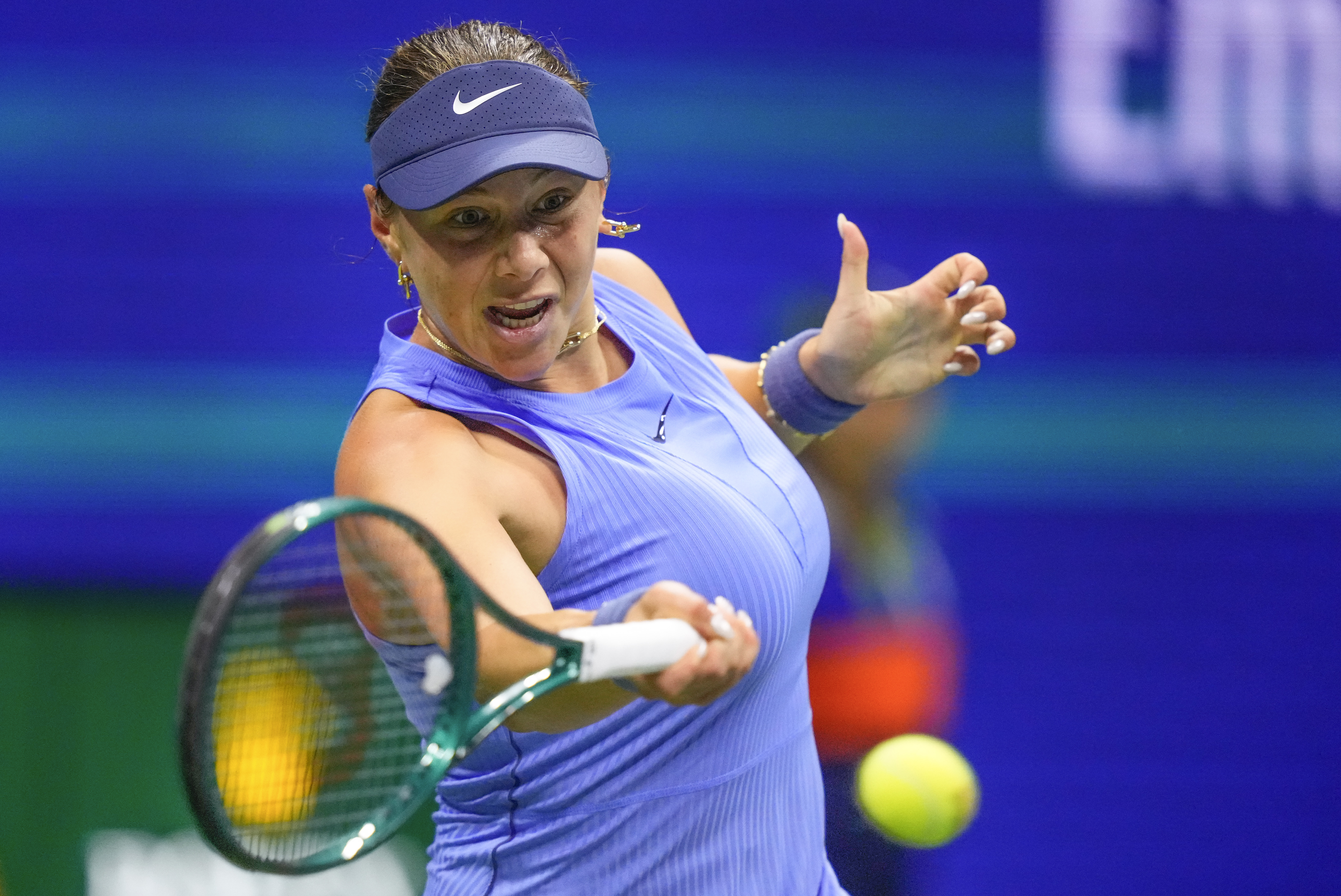
Anisimova has been quite the fighter herself during this spectacular run in New York, including coming through after 2 hours and 56 minutes against Osaka.
“I wasn’t sure I would make it past the finish line, and I tried to dig deep,” said Anisimova, who needed three match points to get the job done. “It was a huge fight out there today.”
When it was over, Anisimova yelled, “Let’s go!” and enjoyed the moment by kneeling on the court and leaning forward.
This is the fifth consecutive women’s final at a major involving an American, though Osaka made the extension of that streak a tough job to finish.
“I mean, honestly I don’t feel sad. It’s really weird. Well, it’s not weird, because I just feel like I did the best that I could,” said Osaka, 27, who took a series of mental health breaks starting in 2021, then was away from the WTA Tour while having a daughter. “Honestly, it’s kind of inspiring for me, because it makes me just want to train and try to get better, and hopefully just give it my very best shot again and see what happens. But I think I can’t be mad or upset at myself.”
Anisimova first got to the final four at a major tournament at the 2019 French Open at age 17. In 2023, she took a break from the tour, saying she had been “struggling with my mental health and burnout” for nearly a year.
At this time last season, Anisimova was ranked 50th and still working her way back. She’s most certainly back, and better than ever.
Asked what allowed her to win against Osaka, Anisimova replied: “Oh, my God. I don’t know. I mean, Naomi is playing amazing tennis. She’s back where she belongs.”
Well, Anisimova did it by forgetting about the opening set, and forgetting about a 6-5 deficit in the second.
She also did it by not holding anything back down the stretch, going for — and delivering — big groundstrokes that usually landed deep in the court and right where she wanted them. That tends to be Osaka’s style, too, but she was not quite able to keep up in the late going and took some pills a trainer gave her after examining her left foot in the third set.
“I wouldn’t say it’s a bigger challenge than I expected, because I kind of knew that she’s that type of player. It was just kind of funny at times, because there is no pattern to what she’s doing. It’s kind of like she just hits at the empty court or whatever, and it usually goes in,” Osaka said about taking on Anisimova. “Obviously she went to the finals of Wimbledon, and now she’s in the finals here, so it just shows that she’s a really good player.”
Both players frequently went over to the corners of the court to look up at their coaches and trade words.
Osaka showed frustration after getting broken in the second set by smacking a ball in anger off the blue court and then tossing her racket toward the sideline. She pounded serves at up to 119 mph and produced 15 aces.
On the other side, Anisimova’s backhand, the purest in women’s tennis, and a forehand that’s almost as good helped her compile 50 winners, 18 more than Osaka.
“Sometimes, I was like, ‘How are we making these shots?'” Anisimova said. “But we were.”
It’s true. Both of them were. Anisimova, though, made more.