
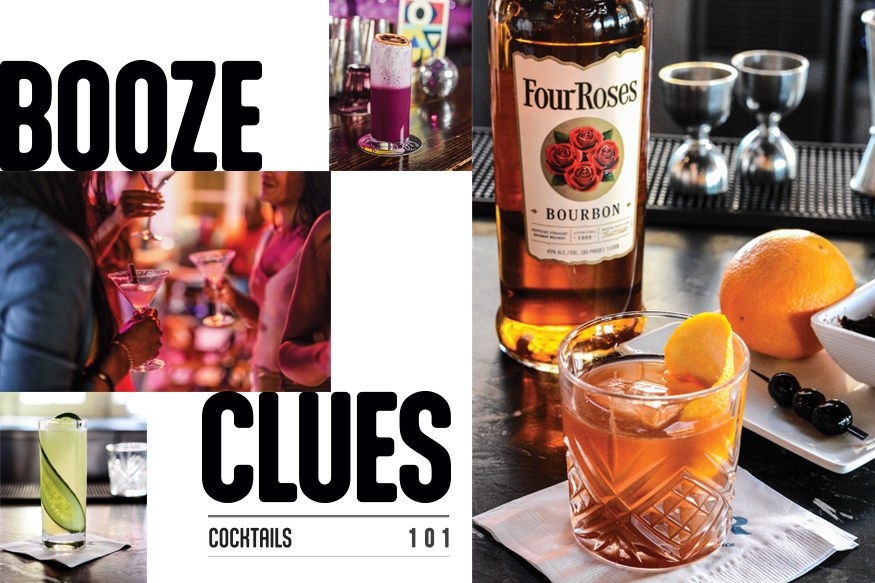
With so many choices and combinations of ingredients and techniques, ordering a cocktail, let alone making one, can seem like a mountain to climb. What will you enjoy? What flavor profile do you want? Do you want something traditional or experimental? Deciphering a cocktail menu might feel like trying to decode the Rosetta Stone, but don’t fret. Once you have a grasp of the basics, the rest comes together — kind of like that drink order of yours. Here, you’ll get a walk-through of how a cocktail gets made, how a drink’s components affect the final result and some advice from local bartenders. Cheers!
BASE
When building a house, you don’t start with the roof. You start with the foundation. With a cocktail, you have your base spirit, which will define the primary flavor profile of your drink, says Steven Huddleston, managing director of beverage and education at SquareOne Holding Company. The base spirit is “the soul of your cocktail,” he says.
Here are some primary base spirits to know, according to Spirits and Distilling’s “Oxford Companion to Spirits and Cocktails.”
— Brandy: A type of spirit “distilled from the fermented juice, mash, pulp or wine of fruit (or from its residue).”
— Gin: A spirit “made by flavoring neutral spirits with juniper berries and other botanicals.”
— Rum: A sort of spirit “made from sugar cane, whether it is from the juice of the cane, the sugar crystallized from it or the byproducts of sugar-making,” including cane syrup, skimmings or molasses.
— Tequila: A type of liquor that comes from the distillation of carbohydrates “extracted from cooked or uncooked blue agave.”
— Vodka: A variety of spirit “distilled from a fermented mash of rye, wheat, potatoes or molasses from sugar beets.”
— Whiskey: A type of spirit referring to “a cereal-grain-based, non-neutral spirit which is usually aged in wood,” with barley and corn serving as the most common grains used.
If someone doesn’t know quite what they want, a vodka-based cocktail can be a good start, says Taylor Vandergriff, bar manager at Chattanooga restaurant and bar STIR. You can go in various directions with a vodka-based cocktail, and it’s not as “punchy” of a spirit as other types, he says.
ICE
If you’ve had any drink — alcoholic or not — with ice in the summertime, you know what a bummer a watered-down beverage can be. That’s why the type of ice used in a cocktail can be such an important component, so as not to ruin the flavor of a finely crafted drink.
STIR and fellow Chattanooga bar Unknown Caller offer various shapes and sizes of ice for drinks. Ice is such an integral tool in mixology that STIR serves up a bevy of artisanal options. Expect shaved, pebbled, crushed, sphere-shaped, long rocks and 1- and 2-inch rocks.
“It’s not going to dilute your drink while you’re drinking it,” Vandergriff says of STIR’s artisanal ice. “Your first sip is going to be the same as your last one.”
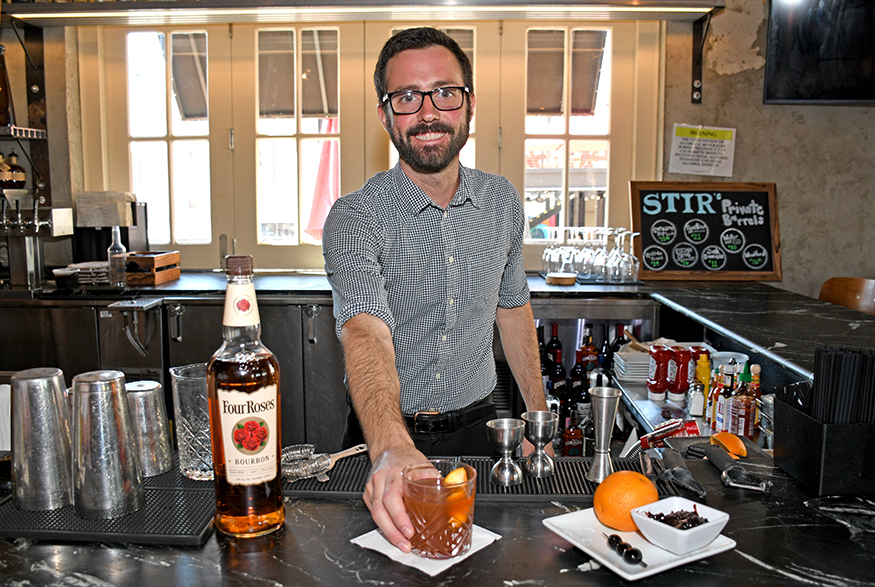
But, where you would want ice to melt is in the dilution of your drink. “Water unlocks flavor and aroma,” Huddleston says. Dilution can be done by shaking or stirring a drink with ice in it. Shaking, with your cocktail ingredients and ice in a tin, integrates ingredients, whereas stirring is better for a liquor-forward cocktail, Vandergriff says. Stirring gives a drink a smoother texture because the ice is not pulverized, he adds.
MODIFIERS and MIXERS
You could have your spirit neat (served at room temperature with no ice), up (chilled and served in a stemmed glass with no ice) or on the rocks (served over ice). Or, you could mix it up with various ingredients. A modifier is “almost anything added to the mixing glass besides the base spirit and ice,” the “Oxford Companion” says.
There are plenty of ingredients to try for modifying a drink, but let’s take a look at just a few to get a sense of their effect.
— Bitters: A liquid essence “produced by macerating various herbs, spices and other botanicals in a base spirit,” resulting in a liquid with concentrated flavor.
— Liqueurs: Spirits “that have been flavored and heavily sweetened.” Examples include Bailey’s Irish Cream, Kahlúa and amaretto.
— Shrubs: These are “acidified syrups used to make beverages,” with one variety being comprised of fruit juice, sugar and vinegar.
— Tincture: A “concentrated extract of an herb, spice or other botanical in alcohol,” used like bitters, except offering just “a single note of flavor.”
— Vermouth: An “aromatized, fortified aperitif wine,” where aromatized “means the wine has been infused with botanicals for flavor and color,” and fortified “means the wine contains added distilled alcohol” that can, among other things, preserve sweetness, extract flavors and improve shelf-stability.
Vermouth, liqueurs and similar ingredients “soften or complement the base spirit, adding complexity or sweetness,” Huddleston says. Ingredients like bitters, shrubs and tinctures “are the flavor amplifiers or contrast elements,” he explains.
GARNISHES
Your garnish is the cherry-on-top of your cocktail. Using STIR’s elderflower sour as an example, a cucumber can be used to contribute to the refreshing flavor expressed with the elderflower, complementing the floral ingredients, Vandergriff says. In an old-fashioned, you use an orange peel as a garnish to add that note of citrus to the drink.
Garnishes can serve dual purposes. In addition to flavor, the garnish can contribute to overall presentation, and presentation is key when serving drinks at a bar, Unknown Caller assistant manager Grant Bengtson explains. After all, you eat with your eyes, he says.
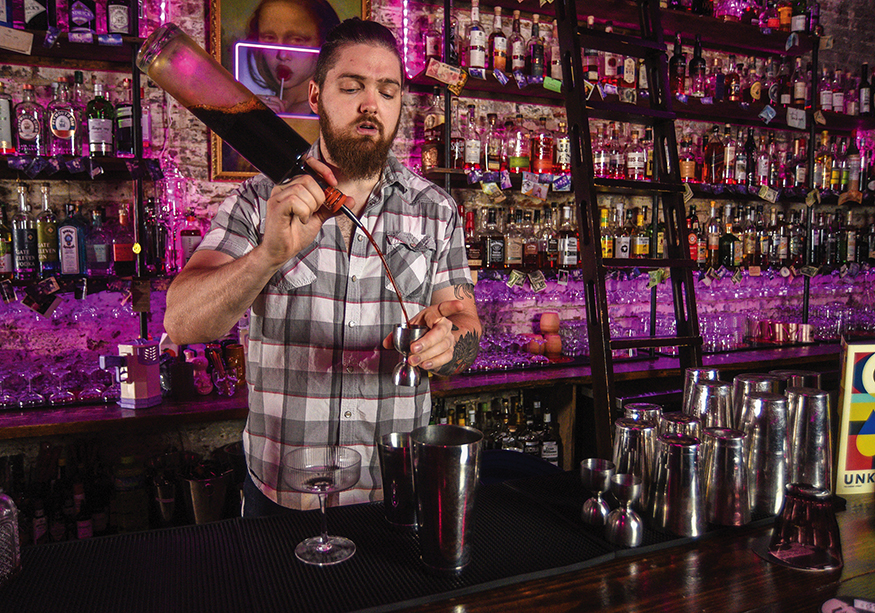
“In general, between cocktails and food, if it doesn’t look appetizing, doesn’t look appealing, then you’re going to have a predisposition to it of like, ‘Oh, I might not enjoy this,'” Bengtson says.
So if a drink looks good, maybe you’ll like it, too.
TEMPLATES
We’ve established key components of cocktails, defining them and looking at how they affect the overall drink. Now, let’s focus on the final product: the drink itself. Because there are a million-and-one cocktails out there, give or take, Bengtson was taught to break cocktails down into six core templates. Once those templates are learned, “you can pretty much do anything,” he says.
Let’s go over these six templates, using the “Oxford Companion” to more easily define them.
— Classic daiquiri: A drink that is “simplicity itself: rum, lime juice and sugar.” Typically, it’s shaken with ice and strained into a chilled glass. The key to a great daiquiri is finding the right balance of sweet and sour. Of course, these days, people often flavor daiquiris and serve them frozen.
— Flip: A drink historically “made by mixing ale, spirit and sweetener in a pitcher,” but more recently “made with ale, spirit, sugar and a whole egg.”
— Highball: A “resolutely simple drink: spirits, sparkling water and ice,” served in a tall glass. Highballs are also often made with a spirit mixed with another carbonated beverage or mixers, beyond just sparkling water.
— Martini: Though there are many fruity and flavored variations these days, a classic martini is simply a drink made “with gin or (much later) vodka cut with vermouth in ever-shifting proportions.”
— Old-fashioned: A drink that embodies its name, with “the first known definition of a cocktail (which dates back to 1806)” describing ingredients such as “spirits of any kind, sugar, water and bitters.”
— Sidecar: A drink made “with Cognac, curaçao triple sec and lemon juice,” “enduring as a symbol of sophisticated drinking for a century.”
Someone who isn’t into cocktails might enjoy starting with the flip template, Bengtson says. A flip can be a good introduction, because it is a sweeter, more dessert-style drink, he adds.
AT A BAR NEAR YOU
As mentioned, there are many, many, many cocktails in the world, and experimentation and variation only multiply those options. But don’t start sweating from choice anxiety, because we’re going to give you some cocktails you can find right here in Chattanooga. (Keep in mind, menus change, so some recommendations may no longer be available.)
— Brightside, combining honeysuckle vodka, strawberry, rhubarb, lemon and soda, at Unknown Caller, 715 Cherry St.
— Elderflower Sour, combining vodka, elderflower, lime, ginger syrup and cucumber, at STIR, 1444 Market St.
— White Russian, combining vodka, Kahlua and creamer (dairy or vegan), at Gate 11 Distillery, 1400 Market St., Suite 108
— Barrel-Aged Old-Fashioned, combining whiskey, demerara syrup and bitters, at Whiskey Thief, 102 Walnut St. in The Edwin Hotel
— The Pink Pony, combining gin, “a banquet of liquors,” Angostura bitters, lime and honey with a tajin rim, at Little Coyote, 3950 Tennessee Ave.
— Rabbit Rush, combining tequila, mezcal, lemon, ginger and honey, at Rosecomb, 921 Barton Ave.
— Arabian Nights, combining Arabic coffee, arak, chocolate liquor, peanut butter tequila and chocolate bitters, at Calliope, 422 E. M.L. King Blvd.
— Aperol Sprinter, combining vodka, Aperol, prosecco and soda, at Home Bar, 409 Market St.
— Creedence in the Glovebox, combining gin, vermouth, sherry, lemon and hot honey, at Mean Jeen’s, 1800 E. Main St.
— Sugarcane Mojito, combining sugar cane juice, rum, muddled mint, lime juice and soda water, at State of Confusion, 301 E. Main St.
— Pink Squirrel, with crème de cacao, crème de noyaux and cream, at 50/50 Wine & Martini Bar, 43 Station St.
BARTENDER’S CHOICE
If you just can’t decide on what you’d like to drink, then take the decision out of your own hands and give it to the bartender. Unknown Caller gives you the option to answer three questions to help the bartender determine what drink to make for you.
1. What spirit do you prefer?
2. What do you like/dislike?
3. Sweet, tropical, boozy, etc.?
When in doubt, ask your bartender. Bengtson advises customers not to be afraid of asking questions.
“Don’t feel bad. Talk to your bartenders,” he says. “They’re going to love it, because that’s what they live for.”
Bartenders are knowledgeable and will be able to help guide you to find a drink you like. Have an open mind, Bengtson says, because you could find something that you might not have thought you’d like.
Echoing this sentiment, Vandergriff advises people not to feel like they have to know everything. Even if it takes a minute, he says, bartenders can help you navigate what you’re looking for. Compared to other beverages, cocktails can be more of a personal experience.
“It’s just fun to make it kind of your own type of thing,” Vandergriff says. “I think that’s an element you don’t necessarily get from beers and wines.”
WHAT’S TRENDING?
What’s popular in the cocktail world ebbs and flows, just as with any other form of artistry. Here’s what Vandergriff and Bengtson say are making waves.
Vandergriff:
— Martinis are making a comeback.
— Non-alcoholic cocktails are becoming more popular.
— In mixology, building off the classics while putting your own twist on them is happening at lots of places.
Bengtson:
— People are getting back into spritzes, especially Aperol spritzes.
— With more exposure of drinks on social media, people are more willing to try new things.
— Again, non-alcoholic drinks are increasing in popularity.
Take a Shot
How to photograph cocktails like a pro
By Lyric Lewin
A cocktail is an art piece in its own right: crushed ice or cubed, a rocks glass or martini — so many shapes and colors and garnishes. Trying to photograph a cocktail, though — that’s when a few handy skills can elevate your mediocre snapshot to a magazine-worthy photograph.
How to take a really great photograph:
1. Find your light.
Make sure that your object (the cocktail) is illuminated by the light. That means having the window behind you so the colors really shine.
2. Control your background.
You don’t want a dirty plate or someone’s yawn in the background. Verify that you have a clean background or shallow depth of field to eliminate distraction.
3. Strong composition.
Be sure that you are filling your frame so that the image is large and bold, or if you want to incorporate negative space, work with the rule of thirds or leading lines to create a striking image.